


Some error occured while loading the Quick View. Please close the Quick View and try reloading the page.
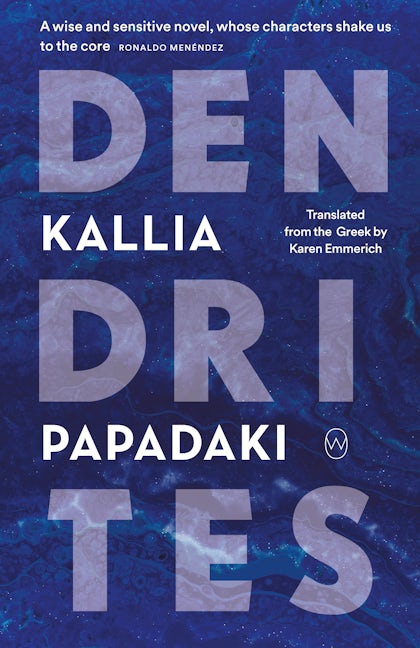
Winner of the 2017 European Union Prize for Literature for readers of Min Jin Lee and The Namesake by Jhumpa Lahiri
When young Minnie is orphaned, the Campanis family decides to take her in. Ex-hippie Susan and her husband Basil, a second-generation Greek American, along with their daughter Leto react to Minnie’s arrival in ways that make old family scars flare up again. Set in crisis-ridden 1980s Camden, New Jersey, among a community of immigrants trying and failing to realize the American dream, Dendrites is a poetical elegy to dignity and courage. In this sensitively told story about the quest for a meaningful life amid the ruins of lost second chances, Kallia Papadaki, one of Greek literature’s most brilliant voices, delivers an unforgettable novel about the power of hope and compassion in the face of adversity.


World Literature Today’s Notable Translations of 2024
"Dendrites is not your conventional immigration story, and that’s partly attributed to Papadaki’s adroit storytelling. Combining the seemingly incongruent styles of stream of consciousness—reminiscent of Virginia Woolf’s To the Lighthouse—with the density of plot in nonlinear novels—echoing Gabriel García Márquez’s One Hundred Years of Solitude—the author produces a rich narrative with fluidity and crispness that readers relish." —World Literature Today
"I loved this fierce, beautiful book. Kallia Papadaki is a truth teller who, with uncommon grace and undeniable power, brings her central characters and the challenges they face in 1980s Camden brilliantly to life. Add Karen Emmerich's marvelous translation to the mix and you have an undeniable winner. I can't recommend it strongly enough." —LAIRD HUNT, author of the 2021 National Book Award finalist Zorrie
"Dendrites is a novel that follows three generations of a Greek immigrant family living in the United States. Papadaki’s attention to the minor is a driving force in the novel. Dendrites is filled with ordinary people, working-class immigrants as they strive for an American dream that always seems just out of reach. Personal joys and crises, chance encounters, and historical events imprint themselves on these lives, altering their directions in small and profound ways. Karen Emmerich’s translation brings Papadaki’s compassionate and intelligent storytelling to English-speaking readers for the first time, and the writing feels as alive in English as it does in the original Greek. It is a breathless book, unspooling in long ribbons of thought. Sentences stretch out across the page, holding on for as long as they can, and yet not a word is wasted. Dendrites shows us that everything matters: every life, every encounter, every ordinary day, every piece of falling snow— despite the knowledge that like everything else, it will all eventually melt away." —Asymptote Journal
“What possibilities do individuals really have when they find themselves in devastating conditions? This question, of Kafkaesque extraction, unites the lives of the characters who inhabit this extraordinary novel. Marginality is not a choice, but a circumstance and a fatality, and Kallia Papadaki explores these margins in the lives of Greek emigrants with profound insight and empathy. The result is a wise and sensitive novel, but not only that, because Kallia is a virtuoso in the art of storytelling, which is increasingly a rarity these days. The result is a cohesive novel, with highly elaborate literary language and a perfect narrative structure. And whose characters shake us to the core.”—RONALDO MENÉNDEZ
"In a fascinating and absorbing read, Dendrites captures the intricate and convoluted lives of everyday people and, like a museum, preserves their stories, aspirations, fears, and ambitions. Dendrites is an enthralling, multigenerational novel about a Greek immigrant, Nondas Kambanis, who struggles to make a life for himself in the US and his son, Vassilis, who although born in the “promised land” is equally destitute, wondering whether to make the opposite journey back to the “motherland” in search of a better life. The title Dendrites is an allusion to both the snowflake metaphor and to the family tree structure; moreover, it addresses the multiplicity and branching of narrative threads that comprise the novel’s story." —World Literature Today
“The winner of the 2017 European Union Prize for Literature vindicates all the female voices in European literature, who are often silenced by a lack of translation into other languages of the EU .” —Vogue
“A novel about disillusion and everyday failures.” —ELLE
“A wonderful debut. Don’t let it pass you by.”—Qué Leer
“In living organisms, the word dendrites refers to the branches of nerve cells. Here, the reference is to branching in general. The novel is like a tree, whose twenty chapters are the branches, each tirelessly described, with the precision of a sociologist, by a an author who is as much a screenwriter as a novelist and who thinks in terms of cinematographic images.”—Le Soir
“With great ease, the novel combines narration with the characters’ inner monologues, thanks to Papadaki’s peculiar, poetic, and versatile prose, which hardly uses any punctuation beyond commas. Dendrites is an ambitious, courageous, and sincere work of literature, as well as a social document of European migration to the USA.” —Todo Literatura
“One of the best Greek novels of the last few years. Truly exceptional.”—Lifo Magazine
“A deeply poetic book of great beauty, which will leave an indelible mark.”—Books Journal
“The book’s two female characters belong next to the classic characters of Greek literature.”—Amagi
“Sad as the blues, existential, profoundly political, contemporary and timely … Simply extraordinary. Had it been written in English, it would have caused a stir.”—Le Monde diplomatique
“Dendrites might be the best Greek novel of the summer.”—Propaganda
“In this magnificent and evocative novel, Kallia Papadaki reconstructs with great poetic prowess the story of a Greek family who emigrate to North America.” —ABC Cultural
“The female characters, in all the different eras of the story, are fiercely determined.”—Aullido
“Dendrites is an existentialist generational chronicle, of surprising psychological clarity, despite its fragmentary structure.”—Indienauta
One of our three recommended translated novels for the 2020 festive season.”—Llanuras
“For the daring with which Papadaki launches us into this story of genesis and exodus from person to person, from era to era, from decision to decision, and for her insistence that all things—losses, and especially successes—are impermanent, we can only recommend her novel, Dendrites.—Culturamas
“In a prose that avoids punctuation and aspires to flow like a litany, Kallia Papadaki wants to show that this history is, like all histories, on the verge of disappearing, and is, like all histories, beautiful and complex in an irreducibly unique way.”—El correo
“Kallia Papadaki understands her craft, maintaining a masterful narrative geometry.”—MSUR
“If there is something that unites us, in addition to nationalities, eras, and circumstances, it is our capacity to keep moving forward despite all the dreams we witness being shattered one by one.”—El Confidencial
“Papadaki has written a fascinating book.”—Book Press
“Papadaki handles her material skillfully, building a solid narrative with cinematic mastery.”—Fractal
“Dendrites captures no less than sixty years of family history, spanning three generations: father, son, stepdaughter. The implacable hand of destiny consumes it all, eliminating the individuality of every life like that of the ice crystals, those dendrites of a unique and irreproducible beauty that melt without a trace. A splendid novel.”—Boulevard Literario
“The striking circular structure of the novel whisks us off into the dramatic history of the Greek emigrants (and it could be about any nationality, really), of their attempts to get ahead in the United States, and their struggle to get a whiff of the ‘American dream.’ The story, stretching from the early twentieth century to the eighties, is personified in the figure of Andonis Cambanis and his son Vasilis. An elegy to resilience.”—La Rossa Bookshop
“Kallia Papadaki did not write a novel about a crisis. She wrote a novel about the human condition after the crisis. She wrote a novel about the stuff human resilience is made of.”—Efsyn
“Kallia Papadaki’s language is stormy. Her breathless prose follows the dizzying speed of change in the story, the American city, and history. The novel is a joy to read, and this is how it ensnares you, so that you can slowly appreciate the breadth of the language, the masterful storytelling, and this complete record of the continuity of history, both personal and collective.”—Kathimerini
“A hymn to resilience.”—Heraldo de Aragón
KALLIA PAPADAKI was born in Didymoteicho, Greece, and grew up in Thessaloniki. She works as a professional screenwriter. Her critically acclaimed short-story collection Ο ήχος του ακάλυπτου “The Back-Lot Sound” won the Diavazo Journal New Writers Award. September, her first feature-length script, won the 2010 International Balkan Fund Script Development Award, received the Nipkow Scholarship in Berlin, and premiered at the 48th Karlovy Vary International Film Festival. Dendrites, her first novel, was awarded the EU Prize for Literature, shortlisted for the Anagnostis Best Novel Award, and won the Clepsidra Best Young Author Prize.
KAREN EMMERICH is a translator of modern Greek literature and an Associate Professor of Comparative Literature at Princeton University. Her translation awards include the National Translation Award for Ersi Sotiropoulos’s What’s Left of the Night, the Best Translated Book Award for Eleni Vakalo’s Beyond Lyricism, and the PEN Poetry in Translation Award for Yannis Ritsos’s Diaries of Exile (co-translated with Edmund Keeley). She lives in Brooklyn.