


Some error occured while loading the Quick View. Please close the Quick View and try reloading the page.
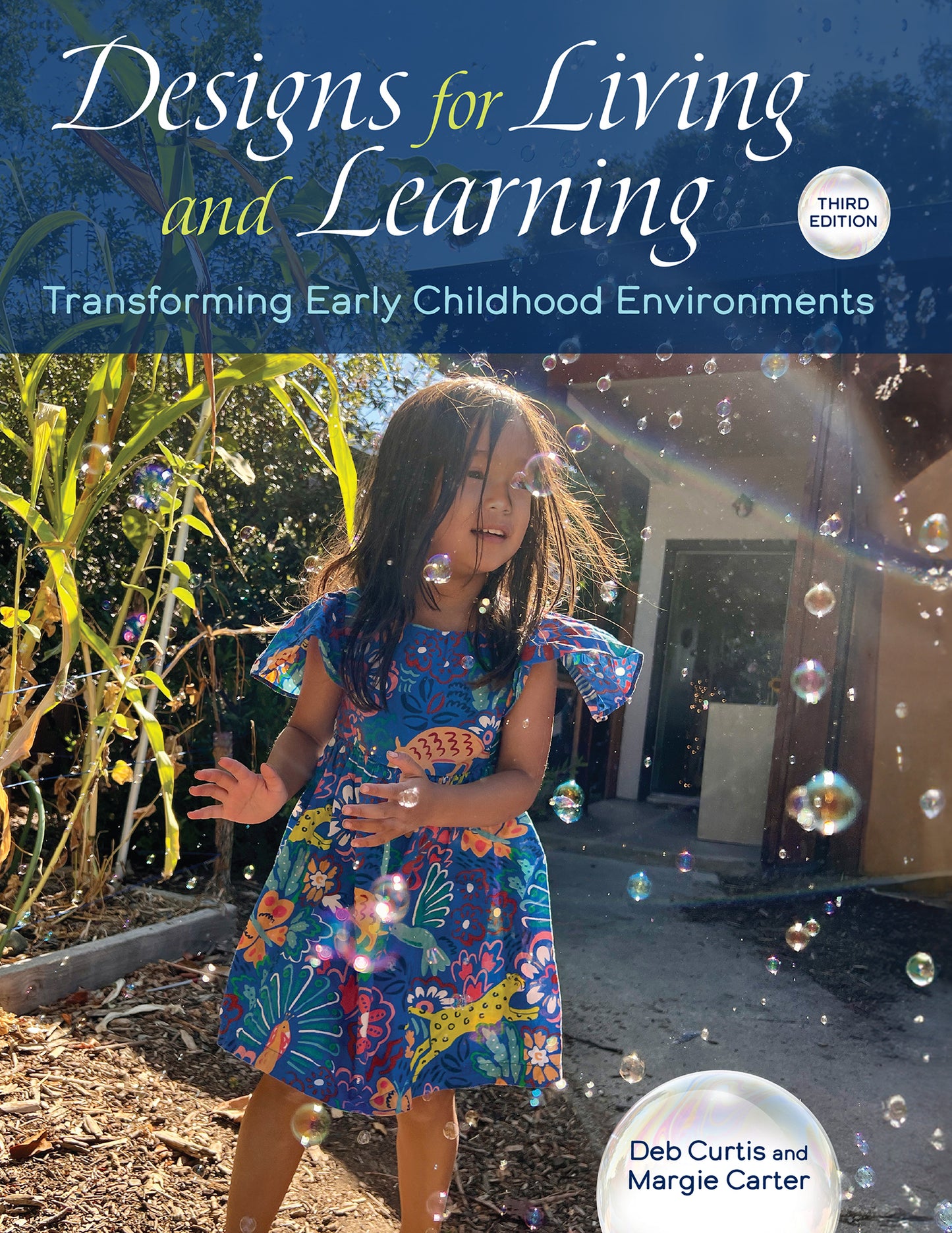
For more than two decades Designs for Living and Learning has been a favorite resource among educators, caregivers, consultants, and college instructors, filled with practical ideas to design captivating environments that nurture children, families, and staff while supporting children’s learning. If you wonder how to hold on to your dreams for creating beautiful, engaging early childhood environments even while facing an array of challenges, this book offers a way to think about your choices and a multitude of examples from educators in a variety of settings.
This updated edition adds inspiring new photos and stories from the authors with contributions from a wide range of imaginative, determined educators in programs moving forward with their dreams as they negotiate uncertainty, stress, a regulatory move toward diminishing possibilities.
These pages are filled with stirring words and visual examples of creativity and the wonder of childhood. At the same time the authors take up the hard questions of how to think about our work in the context of climate imperatives, fear, divisiveness, loss and displacement in our communities. As you digest this book, you’ll find yourself nourished and your imagination itching to move into action.


How exciting to read a third edition of this beloved book! While continuing to encourage educators to think beyond the traditional in terms of environments, Carter and Curtis provoke us to nourish our imaginations and call upon us to think deeply and take creative actions. Acknowledging that we live in difficult times, the authors ask “what might young children need from us as educators?” and ask educators to “be courageous, pay attention, and mobilize collective will and imagination.” This is not only a book about how to create inspiring environments for children, but how to stretch ourselves and our thinking about environments that will ultimately shape our next generation.
—Susan Stacey, author of Emergent Curriculum in Early Childhood Settings, The Unscripted Classroom, Pedagogical Documentation in Early Childhood, and Inquiry Based Early Learning Environments
Wherever your setting, Designs for Living and Learning is a compelling invitation to linger, to pay attention—really pay attention—to the wonder and realities of childhood and the spaces we, and children, make for it. This third edition holds Margie and Deb’s values clearly while responding to our ever-changing world. Thoughtfully organized with research and resources, luscious photos, actionable steps, and a multitude of voices from the field, Designs for Living and Learning gives us all a strong foundation to advocate for spaces and ways of being with children that deeply matter.
—Kelly Matthews, MA, Director of Family Child Care Strategy & Advancement, Wisconsin Early Childhood Association
Back in 2003 when I was still a preschool teacher, Margie Carter and Deb Curtis published their first edition of Designs for Living and Learning, and their ideas, photos, and work on environments had a tremendous impact on changes I made in my own mixed-age preschool classroom. Now as a consultant, author and presenter, this third edition of Designs for Living and Learning still inspires me. I am looking forward to sharing this book with colleagues and using it as professional learning opportunity for those who will engage in creating the environments ALL children deserve.
—Jacky Howell, MA, consultant, co-author of Reflection, Perspective-Taking, and Social Justice: Stories of Empathy and Kindness in the Early Childhood Classroom and Rituals and Traditions: Fostering a Sense of Community in Preschool
The first edition of Designs for Living and Learning changed how I thought about early learning environments, the second edition strengthened my desire to provide beautiful engaging environments for young children, and this newest edition re-ignited my passion all over again. The narrative is powerful and moving and the images help make the ideas come alive. This book is for all educators, those who are just beginning their exploration of early learning environments all the way to seasoned educators who have pushed the envelope for decades. Margie and Deb present the ideas in ways that are accessible and aspirational. This will be a book cherished by the early learning community for years to come.
—Dr. Alissa Mwenelupembe, author of Stories of Resistance: Learning from Black Women in Early Care and Education, Chief Early Learning Quality and Research Officer at the National Association for the Education of Young Children (NAEYC)
This book truly is a love letter, as Deb Curtis and Margie Carter note, and an invitation to boldly reflect on the rich relationship between children and the spaces where they spend their days. Guiding us away from compulsive cuteness and internet algorithm-driven aesthetics, the fresh imagery and timely insights inspire us to think deeply as we evolve spaces, indoors and out, that truly honor children’s intimate, curious and sensory-rich connections with the world around them!
—Kirsten Haugen, MA, Dimensions Foundation Research Director and Early Childhood Specialist for Nature Explore
Thank you, Deb and Margie! This book is beautiful! The inspiring stories from children and teachers around the world, thought-provoking reflection questions, and carefully curated photos will support early childhood educators to dream big. With your help, we will translate our positive image of young children into gorgeous, comfortable, print-rich and playful environments where children can make memories to cherish for a lifetime. This new edition responds to the current moment, helping us to claim our power, resist rising authoritarianism, cultivate democracy, and make the world a better place for generations to come.
—Dr. Megan Pamela Ruth Madison, author, First Conversations series
This book is so much more than a book about setting up environments for young children. It is a deeply hopeful, inspired, and empowering guide for those of us who are dreaming of and working for the very best present and the very best future for all of us.
—Heather Bernt-Santy, M.A. Ed., host of That Early Childhood Nerd and author of Using Schema Play Theory to Advocate for Free Play in Early Childhood
For an early childhood educator who has long struggled with setting up and maintaining classroom environments, Deb and Margie provide foundational grounding in the “why.” This book is a reminder to take a deep breath and slow down, to consider the perspectives of your students and the endless possibilities of materials, and think about whether the space is actually where YOU want to spend your day. Designs for Living and Learning is an invitation not to recreate examples but to utilize a framework and reflective questions to transform a classroom so anyone who enters feels safe, respected and that they belong.
—Makai Kellogg, educator and co-author of Reflection, Perspective-Taking, and Social Justice: Stories of Empathy and Kindness in the Early Childhood Classroom
Deb Curtis has spent many years observing and studying children in early childhood programs throughout North America. Her daily experiences as a child care teacher have led her to a deep respect for children’s competencies and a strong commitment to work on their behalf. Deb is dedicated to learning meaningful anti-bias, anti-racist teaching practices, building on young children’s natural dispositions for empathy, compassion, and fairness to help create a kinder, more equitable world. She holds an MA in human development from Pacific Oaks College and has worked as an infant/toddler caregiver, preschool and school age child care teacher, CDA trainer, Head Start education coordinator, college instructor, and assistant director of a child care program. She is the coauthor of numerous professional learning books with Margie Carter, including The Visionary Director, Training Teachers, The Art of Awareness, Reflecting Children’s Lives, Learning Together with Young Children, and Reflecting in Communities of Practice, and the author of Really Seeing Children.
Margie Carter's decades of work in the early childhood field includes teaching in the primary grades, directing child care centers, serving as adjunct faculty in college settings, speaking and consulting throughout North America, Australia and New Zealand. The pedagogical practices she promotes have deep roots in the study of John Dewey, Paulo Freire, and bell hooks, who promote educational philosophies and practices that serve the goals of a vibrant democracy. With social justice as a lens, Margie speaks to the importance of play as an equity issue, cultural and linguistic democracy, creating environments and organizational cultures that nurture belonging, critical thinking, and active imaginations. She has worked as a preschool, kindergarten and primary school teacher, curriculum developer, High/Scope trainer, child care director, and college instructor. She received her B.S. in Education from Northwestern University and her M.A. in Human Development and Leadership from Pacific Oaks College. Margie is the coauthor of numerous professional learning books with Deb Curtis, including The Visionary Director, Training Teachers, The Art of Awareness, Reflecting Children’s Lives, Learning Together with Young Children, and Reflecting in Communities of Practice.
Introduction
Chapter 1 Lay a Foundation for Living and Learning
Chapter 2 Think Beyond a Traditional Classroom
Chapter 3 Create Connections, a Sense of Place and Belonging
Chapter 4 Keep Space Flexible and Materials Open Ended
Chapter 5 Design Natural Environments That Engage Our Senses
Chapter 6 Provoke Wonder, Curiosity, and Intellectual Challenge
Chapter 7 Engage Children in Symbolic Representations, Literacy, and the Visual Arts
Chapter 8 Enhance Children’s Use of the Environment
Chapter 9 Launch the Process of Transforming an Environment
Chapter 10 Face Barriers and Negotiate Quality Standards
Chapter 11 Seek Children’s Ideas About Environments
Afterword
References
Appendix