


Some error occured while loading the Quick View. Please close the Quick View and try reloading the page.
“These pieces reflect Pritchard’s abiding joy in literature, especially poetry … Included here are insightful appreciations of Anthony Trollope, Anthony Powell, and a sublime reading of Philip Larkin. His essay on Elizabeth Bishop will have poetry lovers reaching for volumes of her work. Pritchard is particularly strong in his evaluations of other critics, including Edmund Wilson, Hugh Kenner, and especially, Clive James … Pritchard is demanding, fastidious, and occasionally cantankerous, yet in a refreshing way that reminds readers what it means to care deeply about literature."
—Booklist
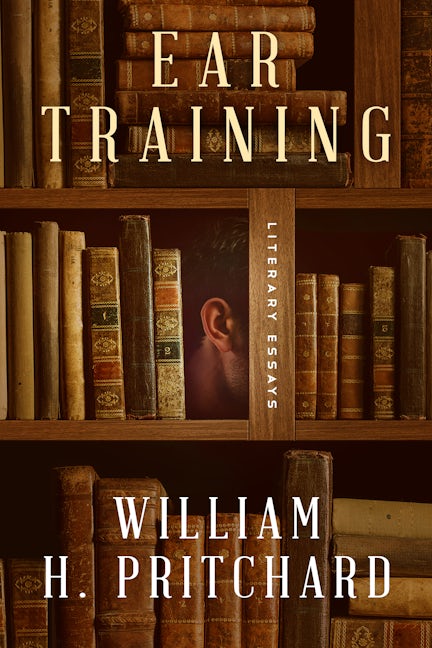
Ear Training gathers thirty essays and reviews by one of America’s most playful critics.
Known for his long career as a professor and writer of critical biographies, for this collection William H. Pritchard has selected some of his favorite shorter pieces on a wide range of topics. United by Pritchard’s philosophy of literature, which he calls “ear training”, pieces on subjects from John Updike to Emily Dickinson to Frank Sinatra to the soap opera The Young and the Restless urge us to consider how literature sounds and how a sense of play in our approach to the world can uncover buried truths and meanings. Also included are the series of letters Pritchard wrote to his students in the early months of the COVID pandemic in 2020, meant to offer commentary on four English writers—Dryden, Swift, Pope, and Samuel Johnson. Throughout the collection Pritchard urges the reader to engage with texts he has found particularly delightful and illuminating, taking us on a tour of the world as he has heard it through poetry, prose, music, and the voices of people he has known.


“These pieces reflect Pritchard’s abiding joy in literature, especially poetry … Included here are insightful appreciations of Anthony Trollope, Anthony Powell, and a sublime reading of Philip Larkin. His essay on Elizabeth Bishop will have poetry lovers reaching for volumes of her work. Pritchard is particularly strong in his evaluations of other critics, including Edmund Wilson, Hugh Kenner, and especially, Clive James … Pritchard is demanding, fastidious, and occasionally cantankerous, yet in a refreshing way that reminds readers what it means to care deeply about literature."
—Booklist
"Through his technique of listening to literature, William H. Pritchard has educated generations of loyal students in all aspects of what he simply calls 'good reading and writing.' How fortunate then for readers-at-large to have the same access to the sounds gleaned from canonical works from Shakespeare to the Modernists, including music itself. In his inimitable style—brilliant, personable, witty, versatile and, sometimes, cantankerous—he makes literature the first basis of understanding life."
—Paula Deitz, Editor, The Hudson Review
"William Pritchard has two gifts essential to a great critic. First, he has read everything. Second, he is always eager to be surprised, and to revise his opinions accordingly. He has a third gift, however, his solid anchorage in another art form. He has refined his ear for music in tune with his love for poetry and prose. Pritchard is a great critic with perfect pitch."
—Christopher Benfey, author of A Summer of Hummingbirds
"Pritchard’s wide range and freedom from cant have endured . . . Those qualities, to be treasured in a book reviewer, are on display in Ear Training."
—The New Criterion
PRAISE FOR WILLIAM H. PRITCHARD'S EARLIER BOOKS:
"What shines through here is Pritchard's passionate commitment to literature and writing in an impoverished academic world. This is a clear-minded and judicious tale of one critic's quest to situate his critical identity in a world that has largely left his kind behind."
—Library Journal on English Papers: A Teaching Life
"A savvy literary critic . . . Pritchard writes with both uncommon clarity and easygoing erudition."
—Publishers Weekly on Updike: America's Man of Letters
"Pritchard's sympathetic, kinetic engagement with the canon has always distinguished him from other voices of the academy. Maybe that's because Pritchard believes less in great books than in great writing. His immersion in literature is emotional and philosophical, as well as technical and professional."
—Kirkus Reviews on Talking Back to Emily Dickinson, and Other Essays
INTRODUCTION: Ear
Training
SECTION I: NOVELISTS
Glorious Trollope
Anthony Powell’s Serious Comedy
Elizabeth Taylor's Otherness
Evan Connell's Mrs. Bridge
SECTION II: POETS AND POETRY
The Hermeneutical Mafia or, After Strange Gods at Yale
Talking Back to Emily Dickinson
Larkin's Presence
Elizabeth Bishop: Poems, Prose and Letters
James Merrill Collected
SECTION III: CRITICS, CRITICISM
Johnson's Lives
What to Do with Carlyle?
John Churton Collins: Forgotten Man of Letters
Hugh Kenner's Achievement
The Genius of Clive James
SECTION IV: EPISTOLARY
Housman in his Letters
Impossible [Evelyn Waugh]
Talking Piss: Kingsley Amis in his Letters
SECTION V: R.I.P.
F.R. Leavis (1895-1978)
Criticism on the Record: B.H. Haggin (1900-1987)
Updike Posthumous
1. His Legacy
2. Endpoint and Other Poems: Darkness Undimmed
3. My Father’s Tears and Other Stories
4. Reminiscences
Terry Southern: R.I.P.
SECTION VI: MUSIC, MUSICIANS
Keyboard Reflections
Frank Sinatra [Sinatra’s Century by David Lehman]
[Listening to] Toscanini
[Terry Teachout’s] Ellington
Soap Opera Days, or Days of My Life
SECTION VII: TEACHING
Teaching Shakespeare
Amherst English: Theodore Baird
CREDO: Confessions of an Impenitent
Reviewer