


Some error occured while loading the Quick View. Please close the Quick View and try reloading the page.
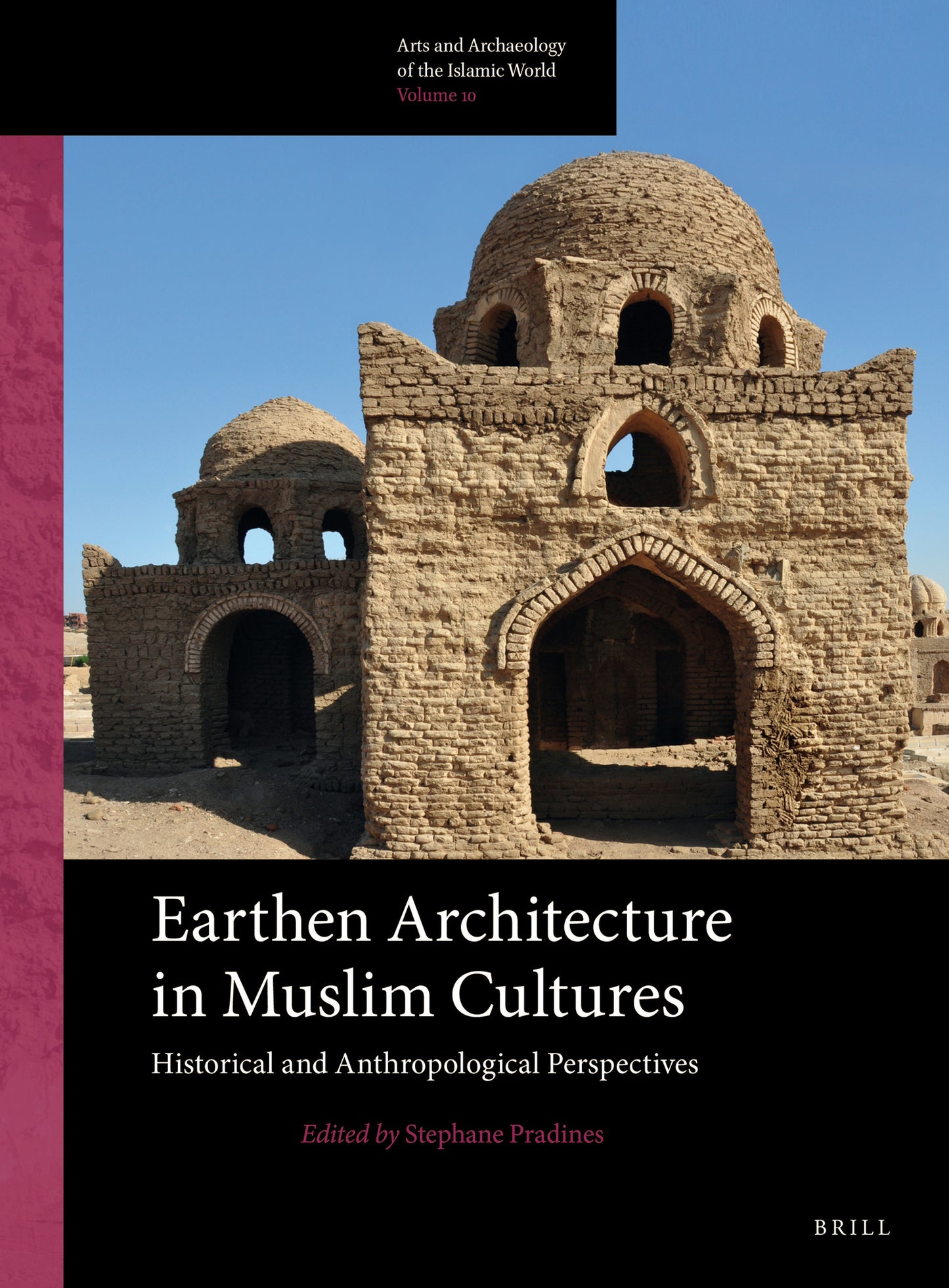
This edited volume follows the panel “Earth in Islamic Architecture” organised for the World Congress for Middle Eastern Studies (WOCMES) in Ankara, on the 19th of August 2014. Earthen architecture is well-known among archaeologists and anthropologists whose work extends from Central Asia to Spain, including Africa. However, little collective attention has been paid to earthen architecture within Muslim cultures. This book endeavours to share knowledge and methods of different disciplines such as history, anthropology, archaeology and architecture. Its objective is to establish a link between historical and archaeological studies given that Muslim cultures cannot be dissociated from social history.
Contributors: Marinella Arena; Mounia Chekhab-Abudaya; Christian Darles; François-Xavier Fauvelle; Elizabeth Golden; Moritz Kinzel; Rolando Melo da Rosa; Atri Hatef Naiemi; Bertrand Poissonnier; Stéphane Pradines; Paola Raffa and Paul D. Wordsworth.
Contributors: Marinella Arena; Mounia Chekhab-Abudaya; Christian Darles; François-Xavier Fauvelle; Elizabeth Golden; Moritz Kinzel; Rolando Melo da Rosa; Atri Hatef Naiemi; Bertrand Poissonnier; Stéphane Pradines; Paola Raffa and Paul D. Wordsworth.

Price: $193.00
Pages: 284
Publisher: Brill
Imprint: Brill
Publication Date:
24 September 2018
ISBN: 9789004355316
Format: Hardcover

"Earthen architecture (that is architecture that uses as its prime and main material earth: adobe, mud brick, rammed earth, mud render, etc) was for very long underappreciated and it was not until the late 70’s that it took its position as an important part of the architectural heritage of the Islamic world. But what the academic world was still lacking was: a) an appreciation of its versatile character and nature and b) a study of all the parameters associated with this particular type of architecture. As refers to the former, earthen architecture was until now mainly consigned to
an architectural typology of building houses in agricultural, peripheral regions. For this reason, earth, as architectural material, was tarnished as the material of the poor, the farmers and the needy. On the other hand, studies related to Islamic earthen architecture used to omit any references to its historical, anthropological and sociological connotations, almost presenting it as a phenomenon separate and foreign to the mores and traditions of the Muslim lands.The present volume addresses all the different aspects (technical, artistic, cultural) of Islamic earthen architecture covering, at the same time, its immense geographical and historical span and breadth. By doing so, it manages to reestablish earthen architecture as an essential part of the Islamic architectural culture, a kind of architecture that was for for everybody and for anyone... All these contributions manage to shed light to the different types and methods of earthen architecture and its connection to the history, the religion, the culture and the traditions of the Islamic world. All in all, a meticulous and erudite edition which is also a joy to read."
Sotiris S. Livas: in Journal of Oriental and African Studies, Vol. 29, 2020.
Sotiris S. Livas: in Journal of Oriental and African Studies, Vol. 29, 2020.
Stephane Pradines is an archaeologist and Professor of Islamic Art and Architecture at the Aga Khan University, Institute for the Study of Muslim Civilisations (AKU-ISMC) in London. S. Pradines received his PhD in 2001 from the University of the Sorbonne in Paris, then from 2001 to 2011, he was the Head of Islamic archaeology Department for the prestigious French Institute of Archaeology in Cairo, Egypt. Stéphane Pradines was the Director of several archaeological excavations such as the Fatimid and Ayyubid Walls of Cairo and many other excavations in the Indian Ocean (Maldives) and East Africa (Kenya, Tanzania, Comoros). Stephane Pradines is a specialist of Islamic archaeology in Sub-Saharan Africa, Indian Ocean medieval trade, Swahili architecture and Muslim material cultures of war: military architecture and weapons.