


Some error occured while loading the Quick View. Please close the Quick View and try reloading the page.
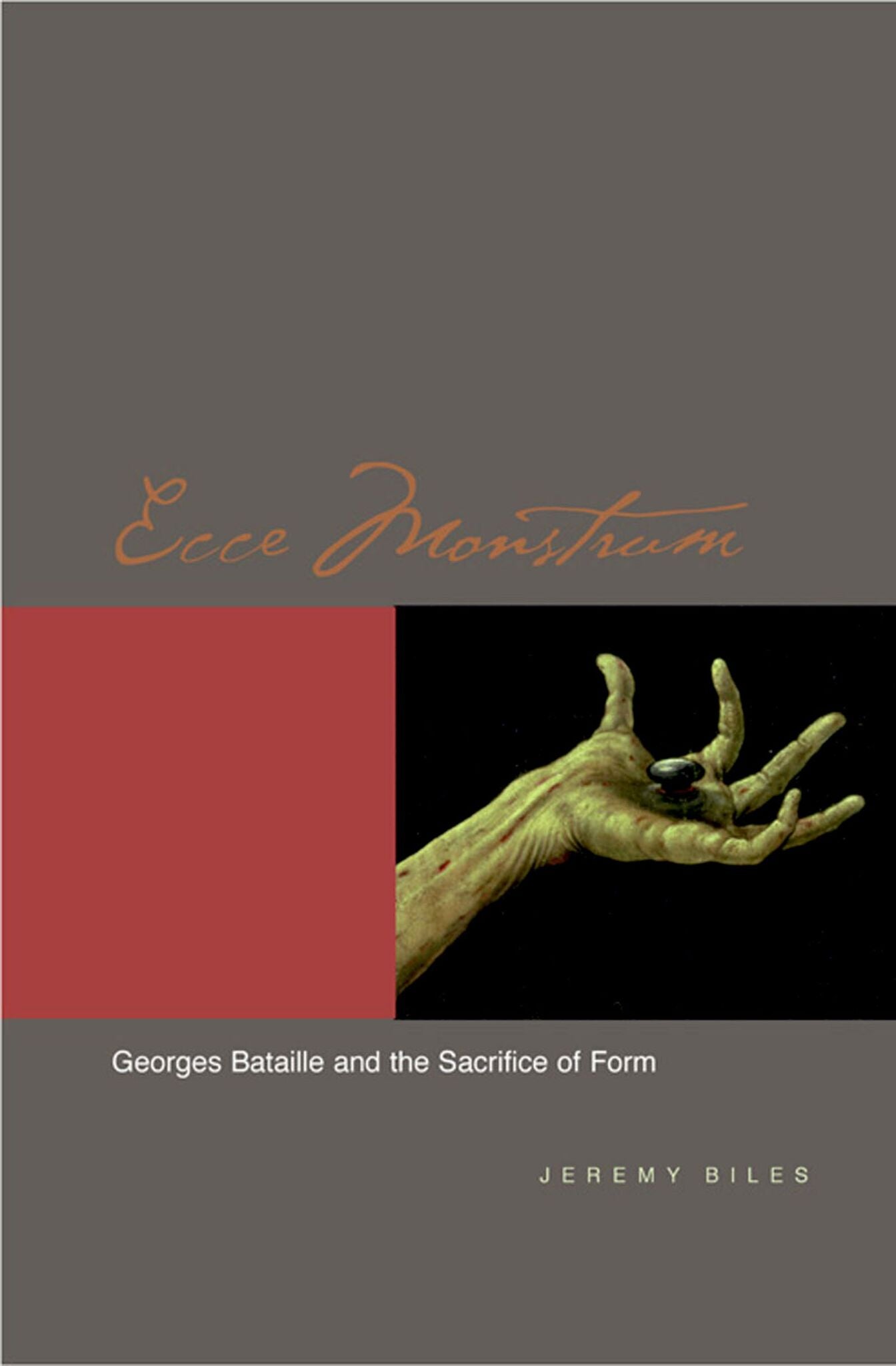
In the 1930s, Georges Bataille proclaimed a "ferociously religious" sensibility characterized by simultaneous ecstasy and horror. Ecce Monstrum investigates the content and implications of this religious sensibility by examining Bataille's insistent linking of monstrosity and the sacred.
Extending and sometimes challenging major interpretations of Bataille by thinkers like Denis Hollier and Rosalind Krauss the book reveals how his writings betray the monstrous marks of the affective and intellectual contradictions he seeks to produce in his readers. Charting a new approach to recent debates concerning Bataille's formulation of the informe ("formless"), the author demonstrates that the motif of monstrosity is keyed to Bataille's notion of sacrifice--an operation that ruptures the integrality of the individual form.
Bataille enacts a "monstrous" mode of reading and writing in his approaches to other thinkers and artists--a mode that is at once agonistic and intimate. Ecce Monstrum examines this monstrous mode of reading and writing through investigations of Bataille's "sacrificial" interpretations of Kojève's Hegel and Friedrich Nietzsche; his contentious relationship with Simone Weil and its implications for his mystical and writing practices; his fraught affiliation with surrealist André Breton and his attempt to displace surrealism with "hyperchristianity"; and his peculiar relations to artist Hans Bellmer, whose work evokes Bataille's "religious sensibility."
With its wide-ranging analyses, this book offers insights of interest to scholars of religion, philosophers, art historians, and students of French intellectual history and early modernism.


All in all, among recent studies on Bataille, Biles's book is the one that perhaps approaches best Bataille's thought while proposing new interpretations of his work.
Biles demonstrates an excellent grasp of the critical commentary on, and the cultural context of Georges Bataille. The stakes of Bataille's work in the areas of intellectual history, literary history, and modern, and postmodern, art are clearly explored. Wonderfully informative and stimulating.---—Allan Stoekl, Pennsylvania State University
One is struck by Biles's erudition: not only has he read, with patience and great sensitivity, the entirety of Bataille's writings along with his principal commentators, but he writes insightfully also about the works of the many figures (Hegel, Nietzsche, Simone Weil, André Breton) in relation to whom he situates Bataille.---—Peter Tracey Connor, Barnard College