


Some error occured while loading the Quick View. Please close the Quick View and try reloading the page.
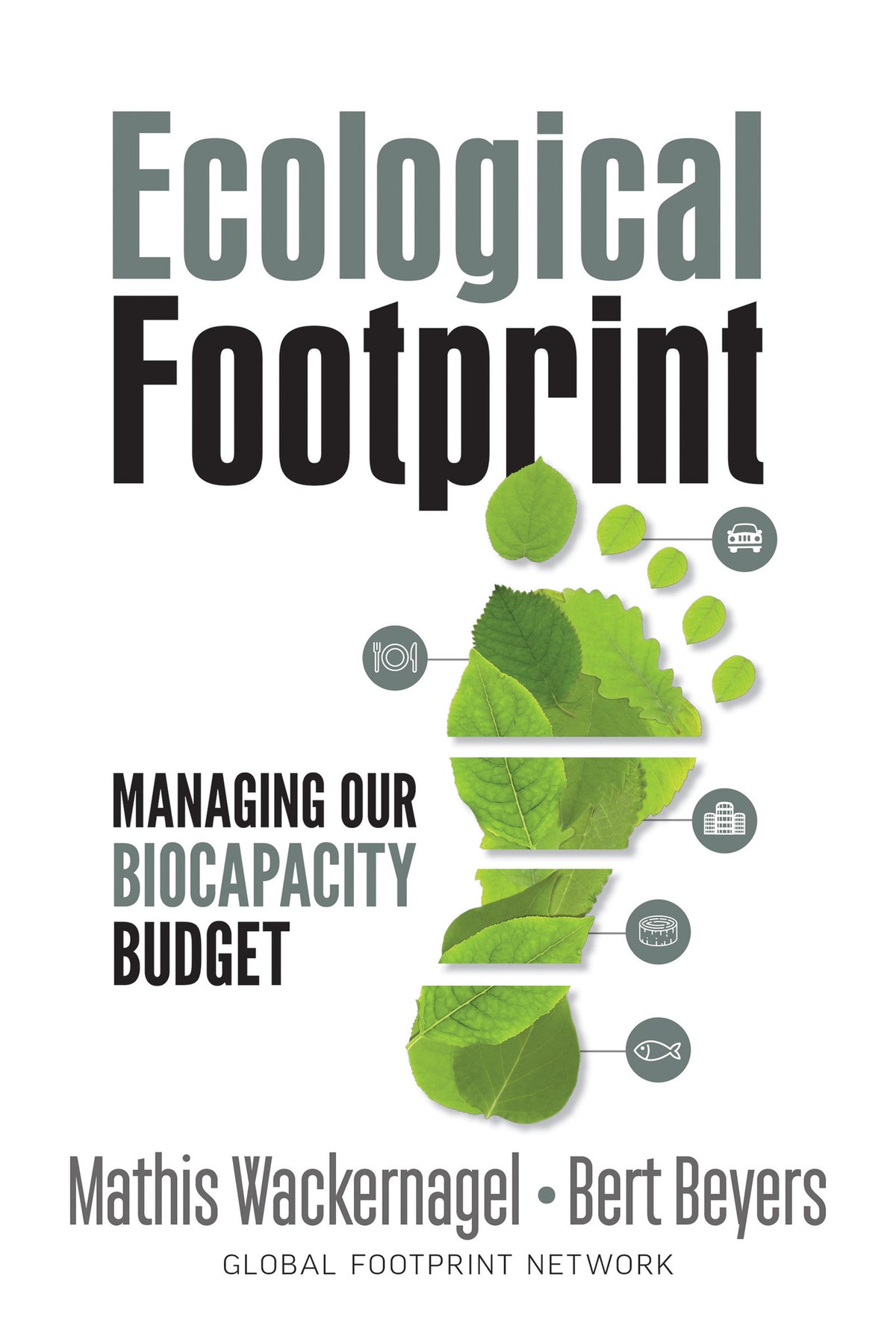
The only metric that tracks how much nature we have – and how much nature we use
Ecological Footprint accounting, first introduced in the 1990s and continuously developed, continues to be the only metric that compares overall human demand on nature with what our planet can renew — its biocapacity — and distils this into one number: how many Earths we use.
Our economy is running a Bernie Madoff-style Ponzi scheme with the planet. We use future resources to run the present, using more than Earth can replenish. Like any such scheme, this works for a limited time, followed by a crash.
Avoiding ecological bankruptcy requires rigorous resource accounting — a challenging task, but doable with the right tools.
Ecological Footprint provides a complete introduction, covering:
- Footprint and biocapacity accounting
- Data and key findings for nations
- Worldwide examples including businesses, cities, and countries
- Strategies for creating regenerative economies
Whether you’re a student, business leader, future-oriented city planner, economist, or have an abiding interest in humanity’s future, Footprint and biocapacity are key parameters to be reckoned with and Ecological Footprint is your essential guide.
AWARDS
- SILVER | 2020 Eric Zencey Prize
- SILVER | 2019 Nautilus Book Awards: Ecology & Environment
- FINALIST | 2019 Foreword INDIES: Ecology & Environment


"How much of the Earth's biocapacity are humans using? Before the Ecological Footprint, no one knew for sure. Now, we have the equivalent of an instrument panel. This is a momentous development, and one that all citizens of the planet should know about — because the warning lights are flashing red."
— Richard Heinberg, Senior Fellow, Post Carbon Institute, author of The End of Growth and Peak Everything
"This excellent book helps us understand and truly appreciate Nature's capacity to continue to provide life support for our planet and for all of its inhabitants."
— Julia Marton-Lefèvre, Former Director General, International Union of Conservation of Nature
"The great challenge for humanity in the 21st century is not to stop the growth of the economy, but to stop the growth in the human ecological footprint — and eventually bring it back to one planet. This important book by the inventors of the concept explains why and how."
— Prof. Jorgen Randers, former President of the BI Norwegian Business School, coauthor of The Limits to Growth, author of 2052 — A Global Forecast for the Next Forty Years
"If we did to our bank account what we have been doing to the Earth's natural capital we would have been bankrupt long ago. The planet has been extremely lenient with us but that resilience is about to give way to a natural and human crisis. This book is a loud wake up call to everyone."
— Christiana Figueres, former Executive Secretary, UNFCCC
"In the nick of time, as humanity crashes up against the resource limitations of our collective twenty first century lifestyles, Ecological Footprint provides a clear eyed and accessible analysis of the challenge. With clarity and compassion, Ecological Footprint reveals both our alarming self-inflicted situation and the way forward. Wackernagel and Beyers' well written book has the power to turn the tide."
— Thomas E. Lovejoy, Professor of Environmental Science and Policy, Institute for a Sustainable Earth George Mason University
"A superb treatment of Ecological Footprint accounting as a part of our global balance sheet. Regardless of whether you are a student, a teacher, or an economist, you will find much of substantial importance in this book."
— Peter H. Raven, President Emeritus, Missouri Botanical Garden, St. Louis
"Looking for a science based practical tool to navigate your future on Earth? Here it is. Ecological Footprint provides an integrated and concrete measure of our human pressure on the Planet. We all urgently need to reconnect our lives to planet Earth and adopt a biocapacity approach to modern life, translating it into concrete steps of how each and every one of us can contribute to building resilient and sustainable societies."
— Prof. Johan Rockström, Director of the Potsdam Institute for Climate Impact Research
"Human societies live — and die — by cultural myths including the catastrophic modern myth of perpetual economic growth. With their update of the Ecological Footprint, Wackernagel and Beyers wield the most effective myth-busting tool available. Failure to read this book should disqualify any would-be elected official from running for office."
— William Rees is a human ecologist, ecological economist and former Director of UBC's School of Community and Regional Planning in Vancouver. He co-developed the ecological footprint with Mathis Wackernagel
"At a time when we must find ways to urgently respond to the existential threats of climate change and ecosystems extinction, this book systematically lays before us the accounting metric necessary to evaluate a world in overshoot. Almost 50 years ago two of the "Limits to Growth" scenarios predicted global system"overshoot and collapse" by the mid- to latter-part of the 21st century. Today ecological footprinting, if adopted by governments and business leaders, alongside comparable planetary solutions, could help navigate our emergence from emergency."
— Sandrine Dixson-Declève, Co-President, The Club of Rome
Mathis Wackernagel, born in Basel, Switzerland, is co-creator of the Ecological Footprint and president of Global Footprint Network, which was named one of the World’s 100 Top NGOs by The Global Journal. Wackernagel has worked on sustainability with governments, corporations, and international NGOs on six continents, and has lectured at more than a hundred universities. He previously served as the director of the Sustainability Program at Redefining Progress in California and ran the Centro de Estudios para la Sustentabilidad at Anáhuac University in Mexico. Wackernagel has authored or contributed to over one hundred peer-reviewed papers, numerous articles and reports, and various books on sustainability including the bestselling Our Ecological Footprint. With dozens of international awards and accolades for his pioneering work, he has been identified as a leader who is driving the world’s most significant problems to zero. He lives in Oakland, CA. www.footprintnetwork.org
Bert Beyers, born in Mönchengladbach, Germany, is a senior editor at the Norddeutscher Rundfunk in Hamburg. For several decades, questions of ecology and future have been his professional passion. He has published widely including a book with Franz Josef Radermacher on survival in the 21st century entitled Welt mit Zukunft: Die ökozoziale Perspektive. He lives in Hamburg, Germany.
Prelude
Footprint — Why? (Introduction)
Part I: Footprint — The Tool
1. Area as Currency — How Much Biocapacity Does a Person Need?
2. Ecological Hinterland — How Much Biocapacity Does a City Need?
3. Croplands, Forests, and Oceans — How Much Biocapacity Do We Have?
4. One Planet — Ecological Limits and Then What?
5. Footprint as Compass — How Much Biocapacity Do We Need for a Good Life?
Part II: Footprint — Challenges Defining the 21st Century
6. End Overshoot! — Communication Is Key
7. Winners and Losers — Strategies for Countries to Consider
8. Footprint Scenarios — Ways out of Global Overshoot
Part III: Footprint — Case Studies
9. Footprint Calculations — Individuals, Cities, Countries, Products, and Companies
10. Footprint in Architecture and City Planning— BedZED, Masdar City, and Peter Seidel
11. China — A New Model of Development?
12. Africa — Protecting One's Resources
13. Footprint — A Conversation
Acknowledgments: Who is Powering All This?
Glossary
Notes
Index
About the Authors
About New Society Publishers