


Some error occured while loading the Quick View. Please close the Quick View and try reloading the page.
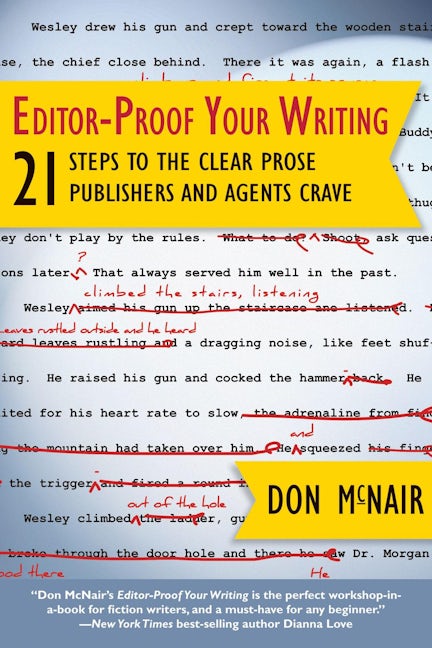
Don’t let simple mistakes ruin your book’s chances!
If you’re not getting published, you may suffer from foggy writing—writing that’s full of unnecessary, misused, and overused words. Foggy writing drives editors crazy, and it’s the number one reason most manuscripts are rejected on first glance.
Let veteran editor Don McNair show you how to clear up your foggy writing and produce sparkling copy that will attract agents, editors, readers, and sales.
Editor-Proof Your Writing will show you how to avoid fatal writing mistakes by eliminating unnecessary words—and in the process you’ll strengthen your book’s action, invigorate your dialogue, and make your writing crackle with life. Containing 21 simple, straightforward principles, Editor-Proof Your Writing teaches how to edit weak verb forms, strip away author intrusions, ban redundancies, eliminate foggy phrases, correct passive-voice sentences, slash misused and overused words, and fix other writing mistakes.
A must-have addition to every writer’s toolkit, Editor-Proof Your Writing won’t just make your writing clearer; it will make you a better writer — more expressive, more entertaining, and more likely to sell.


Introduction: You can be published!
PART ONE: PUTTING WORDS IN
chapter 1 Your classroom? It’s your first chapter!
chapter 2 Why you should be a hooker
chapter 3 What’s your point of view?
chapter 4 Don’t be an information dumper
chapter 5 Your manuscript is a Christmas tree
chapter 6 William Brennan: A “Christmas tree” case history
chapter 7 Make your scenes work harder
chapter 8 Don’t discuss sows’ ears with silken words
chapter 9 You say your heroine doesn’t hate your hero? Too bad!
chapter 10 But they have to like each other, too!
PART TWO: TAKING WORDS OUT
Introduction: 21 Steps to fog-free writing
step 1 Use fewer –ing words
step 2 Use fewer infinitives
step 3 Change passive voice to active voice
step 4 Avoid “expletive” and “had ____ that” constructions
step 5 Use fewer “hads” in internal dialogue
step 6 Shorten verbs
step 7 Eliminate double verbs
step 8 Eliminate double nouns, adjectives, and adverbs
step 9 Watch for foggy phrases
step 10 Remove character filters
step 11 Delete -ly words
step 12 Get rid of all dialogue tags except “said”
step 13 Now, get rid of “said”!
step 14 Cut the dialogue!
step 15 Eliminate redundancies
step 16 Use fewer prepositional phrases
step 17 Get rid of throwaway words
step 18 Edit for conciseness
step 19 Avoid clichés like the plague
step 20 Get rid of superficials
step 21 Stop those wandering eyes
PART THREE: SHARING YOUR WORDS
Introduction: Sharing Your Work
chapter 11 Critique partners
chapter 12 Professional editors
chapter 13 Publishers and agents
chapter 14 Writing the query letter
chapter 15 Writing the synopsis
Appendix
Exercise Solutions
Sarah’s Perils Solutions
Mystery on Firefly Knob Synopsis
Novels used as examples
Index
About the author