


Some error occured while loading the Quick View. Please close the Quick View and try reloading the page.
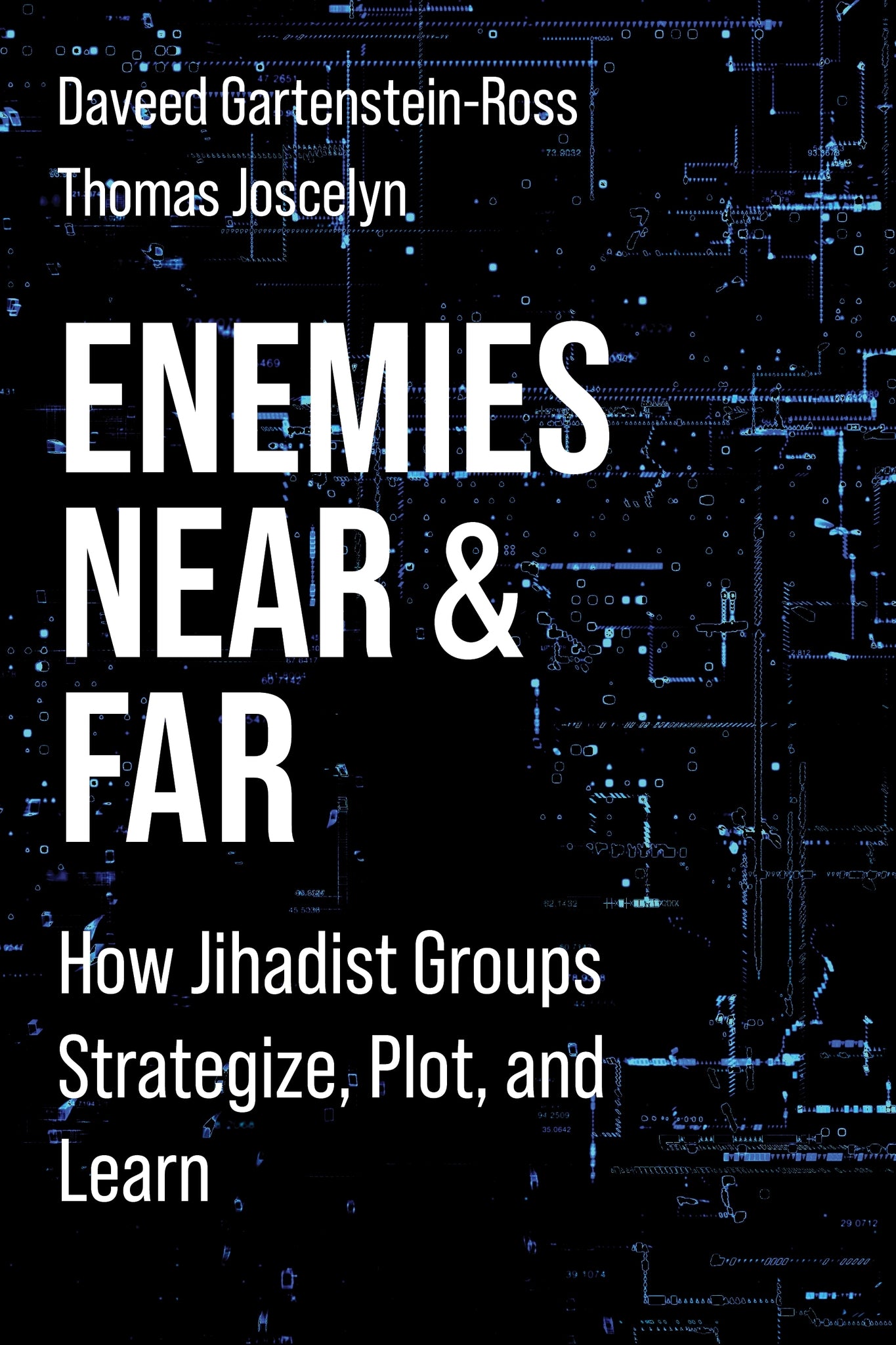
Although the United States has prioritized its fight against militant groups for two decades, the transnational jihadist movement has proved surprisingly resilient and adaptable. Many analysts and practitioners have underestimated these militant organizations, viewing them as unsophisticated or unchanging despite the ongoing evolution of their tactics and strategies.
In Enemies Near and Far, two internationally recognized experts use newly available documents from al-Qaeda and ISIS to explain how jihadist groups think, grow, and adapt. Daveed Gartenstein-Ross and Thomas Joscelyn recast militant groups as learning organizations, detailing their embrace of strategic, tactical, and technological innovation. Drawing on theories of organizational learning, they provide a sweeping account of these groups’ experimentation over time. Gartenstein-Ross and Joscelyn shed light on militant groups’ most effective strategic and tactical moves, including attacks targeting aircraft and the use of the internet to inspire and direct lone attackers, and they examine jihadists’ ability to shift their strategy based on political context. While militant groups’ initial efforts to upgrade their capabilities often fail, these attempts should generally be understood not as failures but as experiments in service of a learning process—a process that continues until these groups achieve a breakthrough.
Providing unprecedented historical and strategic perspective on how jihadist groups learn and evolve, Enemies Near and Far also explores how to anticipate future threats, analyzing how militants are likely to deploy a range of emerging technologies.


Enemies Near and Far offers a compelling explanation for the persistence of Al Qaeda and ISIS despite more than twenty years of aggressive U.S. counterterrorism. Daveed Gartenstein-Ross and Thomas Joscelyn, two leading terrorism experts, explain how jihadist groups innovate and how counterterrorism officials can better anticipate, and disrupt, these deadly organizations.
— Daniel Byman, author of Road Warriors: Foreign Fighters in the Armies of Jihad
Enemies Near and Far is an impressively comprehensive overview of terrorism around the world in the modern era. Gartenstein-Ross and Joscelyn’s excellent theoretical framework provides compelling insights to which every policy maker should pay close attention.
— Yasmin Green, director of research and development, Jigsaw (Google)
Very few can master the complexity of the ever-expanding list of local movements, but Gartenstein-Ross and Joscelyn give us an authoritative bird’s eye view of jihadism around the globe, with tremendous access and analysis of important primary sources uncovered in their exhaustive research.
— Craig Whiteside, coauthor of The ISIS Reader: Milestone Texts of the Islamic State Movement
Enemies Near and Far is a well-researched and comprehensive examination of the organizational culture and strategic preferences of al-Qaeda and the ISIS and their many allies...a conceptual masterpiece.
[Enemies Near and Far] offers a ground-breaking approach that makes us wonder if we have been interpreting jihadist actions incorrectly since the very beginning.
An absolute gem. . . . This work will have enduring utility for years to come.
Enemies Near and Far is a conceptual masterpiece. It summarizes two decades of with intellectual rigor.
Daveed Gartenstein-Ross is the founder and chief executive officer of Valens Global and a senior adviser at the Foundation for Defense of Democracies. He has led numerous policy projects, including serving as the lead drafter of the U.S. Department of Homeland Security’s 2019 Strategic Framework for Countering Terrorism and Targeted Violence. His books include My Year Inside Radical Islam: A Memoir (2007).
Thomas Joscelyn is a senior fellow at the Foundation for Defense of Democracies, where he is also senior editor of the Long War Journal. He has served as a consultant for the FBI’s Counterterrorism Division.
1. The Fire Next Time
2. Learning to Win
3. The Far-Enemy Strategy
4. The Unfriendly Skies: Plots Against Aviation
5. The Early Adopter: Anwar al-Awlaki in the Digital Space
6. Strategic Learning: Al-Qaeda and Jihadism in the Arab Spring
7. The Islamic State’s Rise and Rule
8. The Fitna: ISIS Versus al-Qaeda
9. How al-Qaeda Survived the War in Afghanistan
10. ISIS’s External Operations: A Study in Innovation
11. The Past and Future of Jihadist Organizational Learning
Acknowledgments
Abbreviations
Notes
Index