


Some error occured while loading the Quick View. Please close the Quick View and try reloading the page.
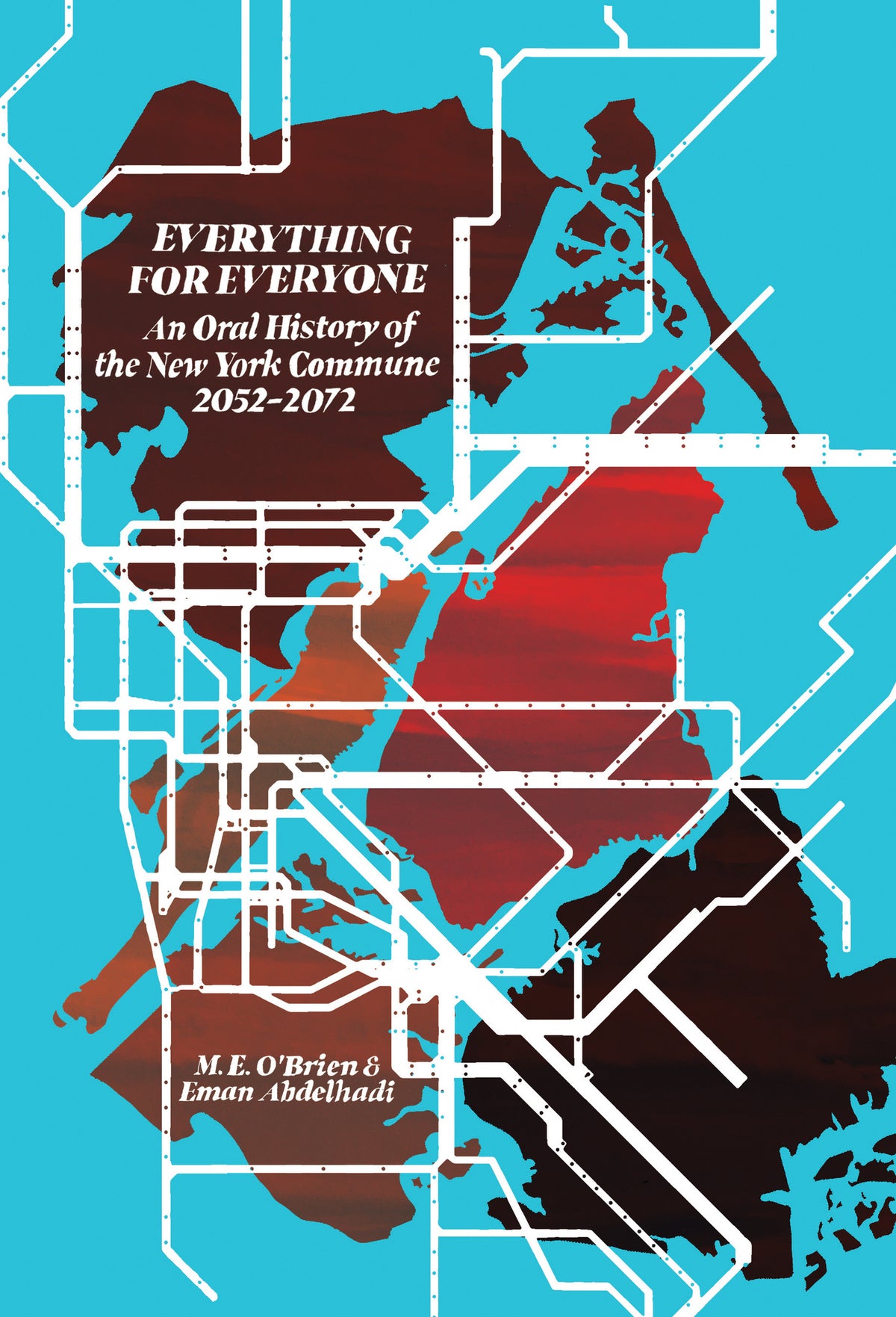
By the middle of the twenty-first century, war, famine, economic collapse, and climate catastrophe had toppled the world's governments. In the 2050s, the insurrections reached the nerve center of global capitalism—New York City. This book, a collection of interviews with the people who made the revolution, was published to mark the twentieth anniversary of the New York Commune, a radically new social order forged in the ashes of capitalist collapse.
Here is the insurrection in the words of the people who made it, a cast as diverse as the city itself. Nurses, sex workers, antifascist militants, and survivors of all stripes recall the collapse of life as they knew it and the emergence of a collective alternative. Their stories, delivered in deeply human fashion, together outline how ordinary people's efforts to survive in the face of crisis contain the seeds of a new world.


“A really fascinating glimpse into a future New York City after a revolution has transformed the US and much of the world into an antifascist, communist utopia…necessary and empowering, providing a hypothetical foundation for an ideal future.“—Buzzfeed, "34 New Summer Books You Won’t Be Able To Put Down"
"Every socialist needs to read this book. Every abolitionist, every Marxist, every anarchist, every revolutionary needs to read this book. Every person who has ever wondered how the world will function after the final retirement of the market, the commodity form, money, wages, rent, coercive gender roles, prisons, police, class, nation states, borders, profit, and in general the dominating power of any humans over any others…It’s a book that will engage seasoned organizers, well-read academics, and street-level agitators. It also could serve quite well as a dazzling introduction for newly politicizing folks who would benefit from a clear end-goal and would want to know what could be accomplished by the movements for human liberation.”—Spectre Journal
“[Everything for Everyone] challenges us to not just write fiction about revolution but to make books that practice the kinds of collaboration necessary to make revolution…This book is an uncompromising, anticolonial, profoundly queer and trans, buoying, addictive, and wholly original creation…Everything for Everyone has no patience with docile truisms about how we are supposed to write. Instead, it’s a shot across the bow for contemporary fiction, raising the bar on how to crystallize utopian longings in literary form.“—BOMB Magazine
“But if you come to Everything for Everyone for the politics, stay for the writing. Barring Vladimir Nabokov in Pale Fire, I can’t think of another author who uses an academic form to achieve a literary result so successfully. Each of the interviewees and interviewers has an entirely unique and authentic voice. The book is utterly plausible as the archival project it claims to be, while also telling gripping stories and slipping in details to delight sci-fi fans (a space elevator in Quito! Sentient algae-based AI! Augmented reality implants for dance parties!).“—TruthOut
“Charts dizzying, delightful new futures for science fiction, urban planning, and engaged social practice. I spent 15 years as a community organizer and never dreamed of seeing something that so bravely, brilliantly combines liberational nonfiction and radical documentary with the exuberance of the best speculative storytelling.“ —Sam J. Miller, Nebula-Award-winning author of Blackfish City and The Art of Starving
“Eman Abdelhadi and M. E. O’Brien’s tall tales of the future draw on real experiences of the past and present. The book’s multiple narratives, equal parts hope and pain, merge into a prayer for collective survival and for the eventual flourishing of our powers of love and invention. Voices from as-yet-unlived lives instill faith that our becoming is not yet done. Abdelhadi and O’Brien have created a vivid image of the possibility that we will one day make a home of the world.” —Hannah Black
“The special magic of Everything for Everyone is that it combines the genres of the oral history interview with speculative utopian fiction. Oral histories can show how in their everyday lives ordinary people can make the world. Utopian fiction can show the worlds we might want to be making. Every cook, or sex worker, can govern. And this is the life they might build from the ruins of this civilization, such as it is. Such a pleasure to feel one could be making the world over with them.” —McKenzie Wark, author of The Beach Beneath the Street
“Eman Abdelhadi and M. E. O’Brien are changing the game of what the novel is and what the novel can be. Much as James Baldwin, Ta-Nehisi Coates and Imani Perry did with the epistolary form in non-fiction, Everything for Everyone uses speculative oral history to expand and explode the limits of what fiction can do. Their imagined oral histories from many parties help us understand the present from many possible points of view in the future looking back, like Rashômon meets House of Leaves. In Everything for Everyone, binaries (of male-versus-female, fiction-versus-non-fiction, past-versus-future) are irrelevant compared to something much more interesting and important that Abdelhadi and O’Brien seek to illustrate: truth, and the way we might find liberation in it.” —Steven W. Thrasher, author of The Viral Underclass
“I had no idea I was a post-revolution speculative fiction fangirl till I started reading Everything for Everyone, which kicks off with a food riot at the Hunts Point Market led by a sex worker. I’m really bummed out by the fact that I’ll be 82—hopefully!—when their fictional revolution kicks off and dead by the time the dust settles. Exciting to read something hopeful, intersectional and an antidote to our dystopian doldrums.” —Sherry Wolf, author of Sexuality and Socialism: History, Politics and Theory of LGBT Liberation
“In this genre-bending work of utopian fiction, O'Brien and Abdelhadi imagine a world that might emerge from the ashes of our own. Part speculative social science, part abolitionist manifesto, it explores the social forms and political possibilities of life after capitalism—the novel ways of organizing life, doing gender, and coping with the psychic costs of transformation that may follow the inevitable crises of capital and climate that lie in our future. Like the best utopian fiction, Everything for Everyone is also a startling work of political theory: it gives us the opportunity, as all utopias do, to learn about our own desires and hopes for a way out of our current conjuncture.” —Katrina Forrester, author of In the Shadow of Justice
“Leftists are often accused of being against everything, but not having a vision of what we're fighting for. Everything for Everyone is a corrective, a sweeping vision of the type of world and society we imagine can and will provide for us all, abundantly. Not all beautiful novels are invested in social restructuring, and not all social restructuring is envisaged in novels, but here we have exactly their meeting point: a beautiful novel bristling with the necessary changes we must make to survive on this planet. The future has sex in it, and community; it has food and labor and joy. It has trauma and memories of the harm, the nightmare, of capitalist precarity. The future is sure to exist; will it have us in it? Everything for Everyone imagines that it will, and, given this remarkable vision, this perpetual possibility, it's now our work to live up to it.” —Joseph Osmundson, author of Virology
“Everything for Everyone is a window into a possible future and a powerful antidote to our present moment’s ubiquitous moods of anti-utopianism, despair, nostalgia, and capitalist-realism…this must-read speculative fiction…chronicle[s] the first stages of the abolition of the family; the history of the ecological restoration projects and interplanetary technologies that might render our planet liveable and leisurely; the invention of real democracy; and the armed conflagrations that were necessary along the way. So, if you have ever wondered to yourself, What will the triumph of indigenous land struggles, the overthrow of colonial occupations, and the fall of capitalism look like? Which parts of New York would be at the forefront of a communist revolution, and which would double down into religious, hyper-patriarchal fascism? Whose knowledges of facilitation, healing, conflict resolution and partying will help the population heal from its collective trauma?—then this superb novel is the book for you.”—Sophie Lewis, author of Abolish the Family: A Manifesto of Care and Liberation
TABLE OF CONTENTS
1: Introduction: On Oral History and Insurrection, reflecting from the 20th Anniversary of the New York Commune (co-written by O’Brien and Abdelhadi)
An “academic” introduction reflecting on the value of oral history to make sense of the transformative experience of participation in revolutionary social change. It will outline the events of the 2040s that led to the revolutionary outbreak in the New York City region, including the defeat of the United States in a protracted war in Iran, the secessionist outbreaks across multiple rural regions of the US, the broader context of global rebellion and the formation of the Communes of the Andes, of Guangdong, of the Maghreb, of the Levant and of the Mississippi River Delta.
2: Miss Kelley on the Insurrection of Hunts Point (O’Brien)
A sex work activist describing the events of 2052, when mass hunger riots in the South Bronx led to the direct seizure of the Hunts Point Produce Market, and the establishment of the regional food distribution networks that fed the coming decade of urban civil war.
3: Kawkab Hassan on Liberating the Levant (Abdelhadi)
A transnational activist and freedom fighter, Kawkab Hassan recounts her life of struggle across the globe. She grew up amidst the Palestinian community of Bay Ridge, Brooklyn, and migrated to her grandparents’ native Palestine in the mid-20s to join the Gaza Rebellion. Designated a terrorist and stripped of her American citizenship, she was unable to return to the United States for decades and instead dedicated her life to resistance movements in the Arab world.
4: Tanya John on the Free Assembly of Barretto Park (O’Brien)
Tanya had led the logistics and planning for the Free Assembly of Barretto Park, a convening in 2055 that is widely regarded as a turning point in the revolutionary struggle in NYC.
5: Belquees Chowdhury on Lower Manhattan (Abdelhadi)Lower Manhattan remained relatively immune to the broader insurrection engulfing NYC until an occupation of the Borough of Manhattan Community College in early 2056, where Belquees was a student. She describes growing up in an immigrant Bengali family in Queens, becoming a taxi driver and student. At BMCC, she became active in CUNY Against the War, the leading group in the 2056 occupation.
6: Quinn Liu on Internment, Guangxi and Flushing (Abdelhadi)Quinn Liu was born in 2025 in an immigrant internment camp in Northern California, set up in the aftermath of the COVID-19 crisis. Her parents were Chinese immigrants who lost their jobs and legal status after the 2020 immigration ban. Living without documentation for a couple of years, they were eventually captured and placed in a camp.
7: S. Addams on the Church Fathers of Staten Island (O’Brien)S. describes growing up in the fascist, Christian cult that eventually came to run Staten Island from 2053 to 2058. They describe the isolation and brutality women faced under the Church Fathers, indicating that they were considered a young girl and teenage woman in the Church.
8: Aniyah Reeds on Sex Work in Uptown (Abdelhadi)
Aniyah Reeds describes her evolving relationships with sex work and sex education throughout the revolutionary decades leading up to the New York Commune’s 20th Anniversary. Over the course of two decades in the trade, she becomes the de facto leader of an informal sex worker collective.
9: Connor Stephens on the Fall of Colorado Springs (O’Brien)
Connor recounts being born on the Wind River Reservation, and was attending highschool in Riverton when the civil war began. After a decade of participating in guerilla war across the Rocky Mountain States, he became a commander in the North American Liberation Front.
10: Latif Timbers on Gestation Work (Abdelhadi)
Latif Timbers speaks about his work as a counselor in his commune’s gestation center in Flatbush, Brooklyn. As the interview goes on, he reveals the traumatic events of his childhood.
11: Kayla Puan on the North Ironbound Commune (O’Brien)
A 2069 interview with a young trans artist planning a major ‘sojourn’, a coming of age trip, and her understanding of her family’s role in establishing the residential communes of Newark.
12: Alkasi Sanchez on the Mid-Atlantic Free Assembly (O’Brien)
The Mid-Atlantic Free Assembly in 2072 both celebrated the 20th Anniversary of the New York Commune, and was the closest to a formal codification of the major social institutions that constituted the new communist society. Alkasi, a social planner and militant theorist invited to give an opening speech to the Assembly, reflects on the peculiarities of how gender, subjectivity and geography have changed over the course of their life.