


Some error occured while loading the Quick View. Please close the Quick View and try reloading the page.
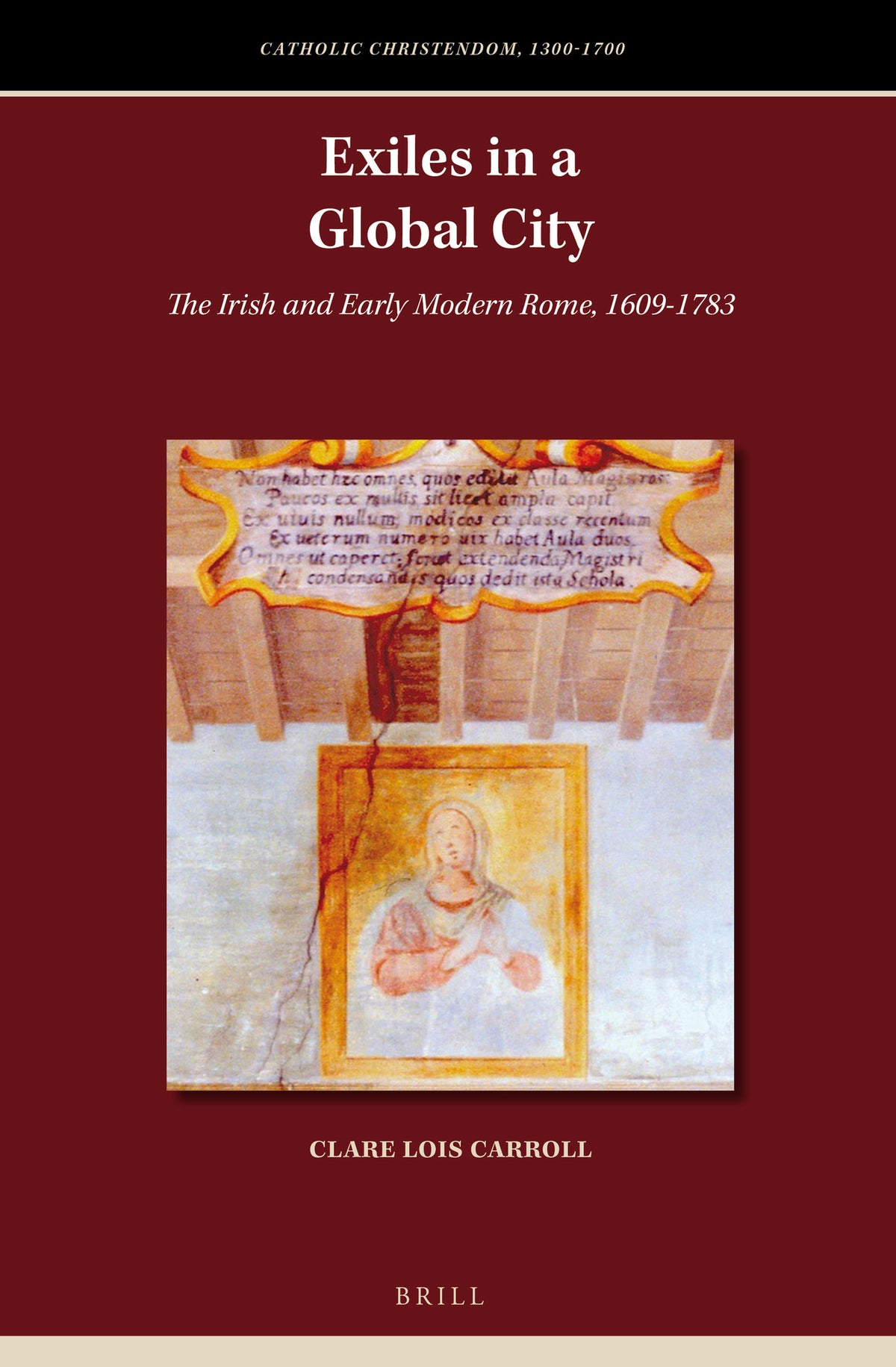
In Exiles in a Global City, Clare Carroll explores Irish migrants’ experiences in early modern Rome (1609-1783) and interprets representations of their cultural identities in relation to their interaction with world-wide Spanish and Roman institutions. This study focuses on some sources in Roman archives not previously considered by Irish historians. The book examines a wide array of cultural productions—Ó Cianáin’s account of O’Neill’s progress from Ireland to Rome, Luke Wadding’s history of the Franciscan order, the portraits at S. Isidoro, the first printed Irish grammar, the letters of Oliver Plunkett, the records of a hospice for converts, Charles Wogan’s memoir, and reports on the national college—for how they transformed emerging senses of an Irish nation.

Price: $207.00
Pages: 342
Publisher: Brill
Imprint: Brill
Publication Date:
November 16, 2017
ISBN: 9789004335165
Format: Hardcover

“Carroll’s book is a must-read text which has shed light on the multifaceted – and thorny – experience of the Irish exiled in Rome from the early seventeenth century up until the late eighteenth century. Through a magisterial use of a wide array of primary sources the author has finally brought into the light one of the least known, but interesting, foreign communities of Rome.”
Matteo Binasco, Università per gli stranieri, Siena. In: The Journal of Ecclesiastical History, Vol. 70, No. 2 (April 2019), pp. 394–395.
“Carroll deserves credit for being the first Irish scholar to examine a number of sources previously overlooked in Rome’s archives. Both the frescoes of the Aula Maxima at St. Isodore’s and the records of the Ospizio lend originality to her work and make a convincing case regarding the influence of the Irish exile experience on early modern representations of nation and shifting identities.”
David O’Hara, University of Central Arkansas. In: Journal of Early Modern History, Vol. 23, No. 1 (March 2019), pp. 96–98.
“This book goes some way toward explaining an aspect of Irishness that is too often taken for granted, and it is a welcome addition to the recent wave of research on Ireland in an early modern European context.”
Christopher Maginn, Fordham University. In: Renaissance Quarterly, Vol. 72, No. 2 (summer 2019), pp. 725–726.
“Lucidly written, richly illustrated and freighted with footnotes pointing to the secondary literature in a range of languages, this work is based on extensive archival research. Both in content and in method, the book is a significant contribution to the growing literature on the Irish in early modern Europe.”
Brian Mac Cuarta S.J. In: Irish Economic and Social History, Vol. 46, No. 1 (2019), pp. 167–170.
“The book’s relevance transcends its concentration on the Irish, as the methodological approaches Carroll took and developed continue to be exemplary in the study of Rome, and the city’s impact on her communities. Although Carroll comes out of the literary studies tradition, I would recommend the book even to art historians, especially those involved in early modern Rome, as an example of the usefulness of cross-disciplinary perspective on visual evidence. Furthermore, the book is deeply inspiring as it shows that careful and attentive research […] can continue to generate fresh, thought-provoking, and relevant scholarship.”
Anatole Upart, University of Chicago. In: Sixteenth Century Journal, Vol. 44, No. 4 (Winter 2018), pp. 1184–1186.
Matteo Binasco, Università per gli stranieri, Siena. In: The Journal of Ecclesiastical History, Vol. 70, No. 2 (April 2019), pp. 394–395.
“Carroll deserves credit for being the first Irish scholar to examine a number of sources previously overlooked in Rome’s archives. Both the frescoes of the Aula Maxima at St. Isodore’s and the records of the Ospizio lend originality to her work and make a convincing case regarding the influence of the Irish exile experience on early modern representations of nation and shifting identities.”
David O’Hara, University of Central Arkansas. In: Journal of Early Modern History, Vol. 23, No. 1 (March 2019), pp. 96–98.
“This book goes some way toward explaining an aspect of Irishness that is too often taken for granted, and it is a welcome addition to the recent wave of research on Ireland in an early modern European context.”
Christopher Maginn, Fordham University. In: Renaissance Quarterly, Vol. 72, No. 2 (summer 2019), pp. 725–726.
“Lucidly written, richly illustrated and freighted with footnotes pointing to the secondary literature in a range of languages, this work is based on extensive archival research. Both in content and in method, the book is a significant contribution to the growing literature on the Irish in early modern Europe.”
Brian Mac Cuarta S.J. In: Irish Economic and Social History, Vol. 46, No. 1 (2019), pp. 167–170.
“The book’s relevance transcends its concentration on the Irish, as the methodological approaches Carroll took and developed continue to be exemplary in the study of Rome, and the city’s impact on her communities. Although Carroll comes out of the literary studies tradition, I would recommend the book even to art historians, especially those involved in early modern Rome, as an example of the usefulness of cross-disciplinary perspective on visual evidence. Furthermore, the book is deeply inspiring as it shows that careful and attentive research […] can continue to generate fresh, thought-provoking, and relevant scholarship.”
Anatole Upart, University of Chicago. In: Sixteenth Century Journal, Vol. 44, No. 4 (Winter 2018), pp. 1184–1186.
Clare Carroll (Professor of Comparative Literature, Queens College and The Graduate Center, CUNY) is the author of Circe's Cup: Cultural Transformations in Early Modern Ireland (Cork UP, 2001), and editor of Ireland and Postcolonial Theory (Cork, 2003).