


Some error occured while loading the Quick View. Please close the Quick View and try reloading the page.
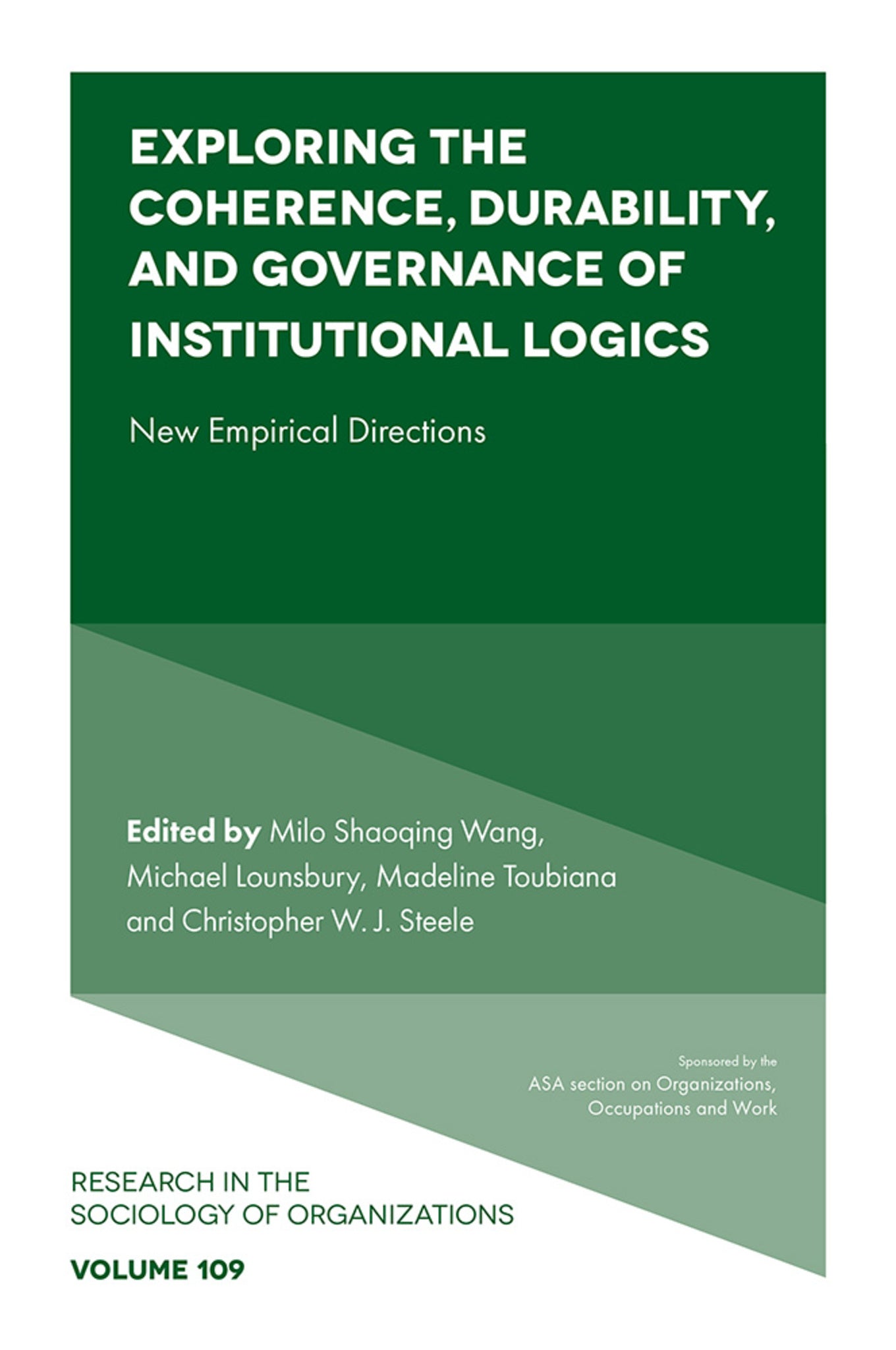
Institutional logics continue to shape research across organizational and societal domains, yet the empirical mechanisms through which logics cohere, evolve and interact remain a central area of inquiry. This volume examines how institutional logics operate in practice, focusing on the dynamics that structure their stability, adaptation and governance across varied empirical settings.
Bringing together a collection of new empirical papers, Exploring the Coherence, Durability, and Governance of Institutional Logics: New Empirical Directions investigates how institutional logics are enacted, contested and reconfigured through real‑world processes. The contributions analyze how gendered meanings and forms of capital intersect within institutional fields; how open‑access publishing systems accommodate competing logics; how market logic variants influence entrepreneurial alertness; and how state logics are decomposed and recomposed through organizational reforms. Additional papers examine elite disruptions of established orders, the governance role of ESG analysts navigating institutional complexity and logic‑sequencing under time‑compressed disaster‑recovery conditions.
Providing grounded analyses of institutional logics across diverse empirical contexts, this volume extends understanding of how logics gain durability, encounter challenges and evolve over time.


Milo Shaoqing Wang is an Assistant Professor in the Department of Management and Entrepreneurship at Arizona State University’s W. P. Carey School of Business, USA, where he is also an affiliated faculty at the Center for AI and Data Analytics for Business and Society.
Michael Lounsbury is a Professor, the A.F (Chip) Collins Chair, and Chair of the Strategy, Entrepreneurship and Management Department at the University of Alberta School of Business, Canada, where he is also the Academic Director of the eHUB entrepreneurship centre. He is also a Professor of Business Strategy & Entrepreneurship (Part-Time) at the Australian National University College of Business and Economics.
Madeline Toubiana is Professor of Strategy and Organization and the Desmarais Chair of entrepreneurship at University of Ottawa, Canada.
Christopher W. J. Steele is an Associate Professor of Strategy, Entrepreneurship, and Management and Eric Geddes Professor of Business at the University of Alberta, Canada.
Institutional Logics as Phenomena: Advancing the Study of Coherence, Durability, and Governance; Milo Shaoqing Wang, Michael Lounsbury, Madeline Toubiana, and Christopher W. J. Steel
Chapter 1. Institutional Accommodation in Open Access Publishing: New Directions in the Study of Institutional Logics and Change; Evelyn Micelotta, Chelsea Dufresne, and Michael Lounsbury
Chapter 2. Jolted to Change: How Do Elites Disrupt the Institutional Orders They Inhabit?; Rongrong Zhang, Chang Lu, and Emma Lei Jing
Chapter 3. Where Are the Seeds of Opportunities? How Variants of the Market Logic Change Alertness to Entrepreneurial Opportunities and Entrepreneurial Behaviour; Kim Klyver, Suna Løwe Nielsen, and Patricia H. Thornton
Chapter 4. Decomposing Goals in State Logic: Local State-Owned Enterprise Corporatization and Urban Entrepreneurship; Jeremy Lei Xu, Jade Y. Lo, Li-Qun Wei, and Siddharth Vedula
Chapter 5. Between Markets and Movements: The Governance Role of ESG Analysts in Institutional Complexity; Gulnaz Khamidullina and David M. Brock
Chapter 6. Redefining the Allocation of Disaster Assistance for Business Recovery: A Model of Institutional Logic Sequencing Under Time Compression; Maria Watson, Patricia H. Thornton, and Yu Xiao
Chapter 7. Gender and Eros: Capital, Fields and Institutional Logics; Henk Roose and Roger Friedland
Postscript to Exploring the Coherence, Durability, and Governance of Institutional Logics: Conceptual Advances and New Empirical Directions; Patricia H. Thornton