


Some error occured while loading the Quick View. Please close the Quick View and try reloading the page.
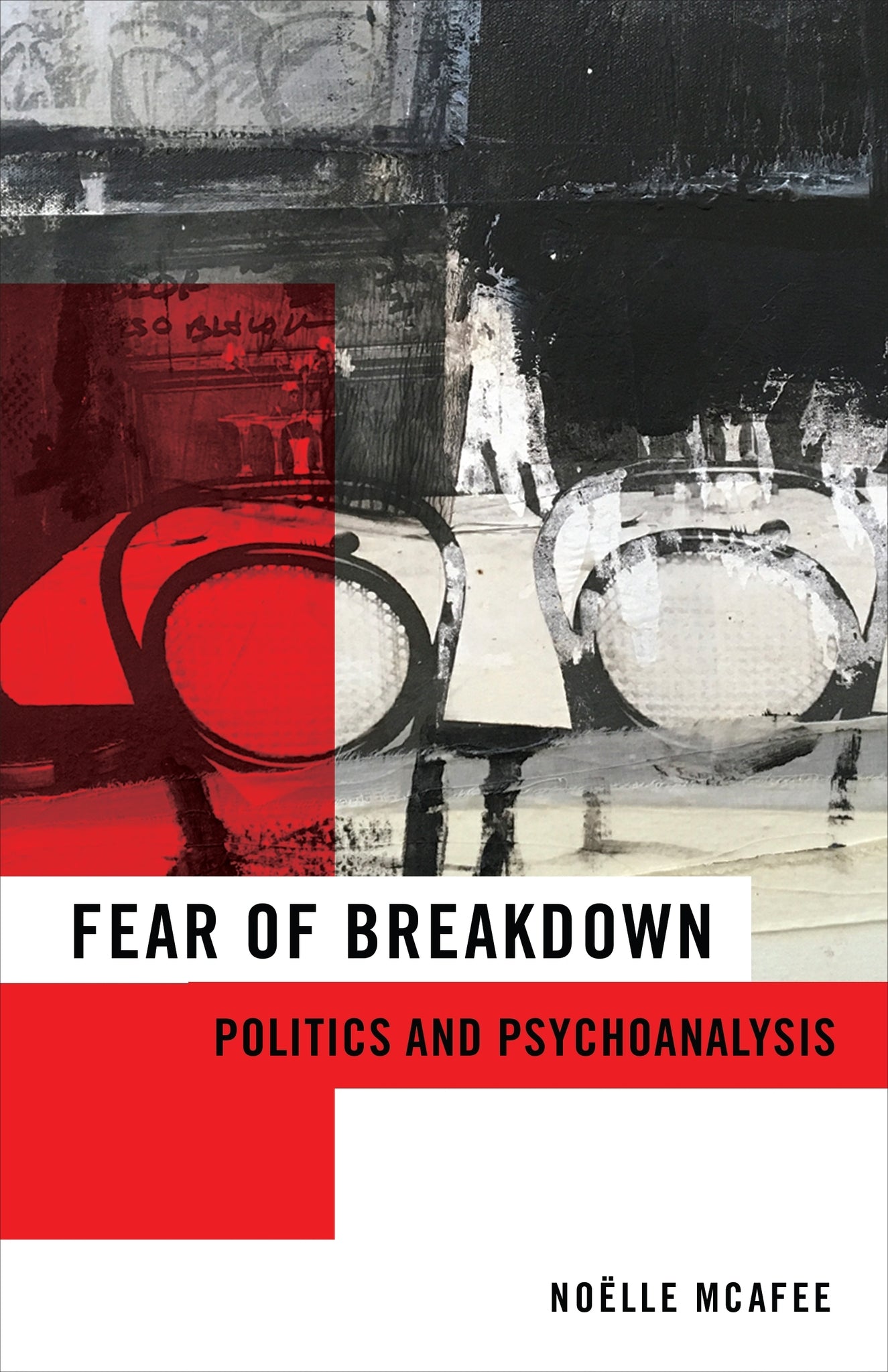
What is behind the upsurge of virulent nationalism and intransigent politics across the globe today? In Fear of Breakdown, Noëlle McAfee uses psychoanalytic theory to explore the subterranean anxieties behind current crises and the ways in which democratic practices can help work through seemingly intractable political conflicts. Working at the intersection of psyche and society, McAfee draws on psychoanalyst D. W. Winnicott’s concept of the fear of breakdown to show how hypernationalism stems from unconscious anxieties over the origins of personal and social identities, giving rise to temptations to reify exclusionary phantasies of national origins.
Fear of Breakdown contends that politics needs something that only psychoanalysis has been able to offer: an understanding of how to work through anxieties, ambiguity, fragility, and loss in order to create a more democratic politics. Coupling robust psychoanalytic theory with concrete democratic practice, Fear of Breakdown shows how a politics of working through can help counter a politics of splitting, paranoia, and demonization. McAfee argues for a new approach to deliberative democratic theory, not the usual philosopher-sanctioned process of reason-giving but an affective process of making difficult choices, encountering others, and mourning what cannot be had.


— Mari Ruti, author of Penis Envy and Other Bad Feelings: The Emotional Costs of Everyday Life
Fear of Breakdown is a tour de force that provides us with a new framework that resolves some of the tensions between psychoanalysis and politics through an interpretation of D. W. Winnicott’s notion of breakdown. McAfee offers us nothing less than a rethinking of key terms of politics—citizenship, deliberation, false consciousness, and nationalism, to name a few. A must-read for anyone concerned with the crisis of democracy.
— Drucilla Cornell, coauthor of The Spirit of Revolution: Beyond the Dead Ends of Man
Hercules had twelve labors but, if Noëlle McAfee is right, democratic citizens have only six tasks to undertake for the Herculean task of reclaiming democracy. Guided by Winnicott’s penetrating insight that the fear of breakdown is a fear of what has already happened, McAfee develops a vision of politics as a deliberative practice of political working through, open to 'radical questioning and learning anew.' A joy to read.
— Bonnie Honig, author of Public Things: Democracy in Disrepair
Where Freud’s rather dark account of human nature tended to hypostatize the antisocial aspects of the psyche, subsequent psychoanalytic theorists on the left have tended to err in the opposite direction, painting an overly socialized picture of the human animal. McAfee avoids both errors and develops a progressive view of politics that does not simplify the complexities of the human nature. Her analysis of Winnicott’s notion of the ‘fear of breakdown’ is especially useful for conceptualizing the current political landscape.
— Joel Whitebook, author of Freud: An Intellectual Biography
Ambitious and provocative . . . a learned and thought-provoking call for a radical reimagination of democratic institutions.
Acknowledgments
By Way of a Preface
Introduction
1. Defining Politics
2. Psychoanalysis and Political Theory
3. Politics and the Fear of Breakdown
4. Practicing Democracy
5. Democratic Imaginaries
6. Becoming Citizens
7. Definitions of the Situation
8. Deliberating Otherwise
9. Political Works of Mourning
10. Public Will and Action
11. Radical Imaginaries
12. Nationalism and the Fear of Breakdown
Conclusion: Working Through the Breakdown
Notes
References
Index