


Some error occured while loading the Quick View. Please close the Quick View and try reloading the page.
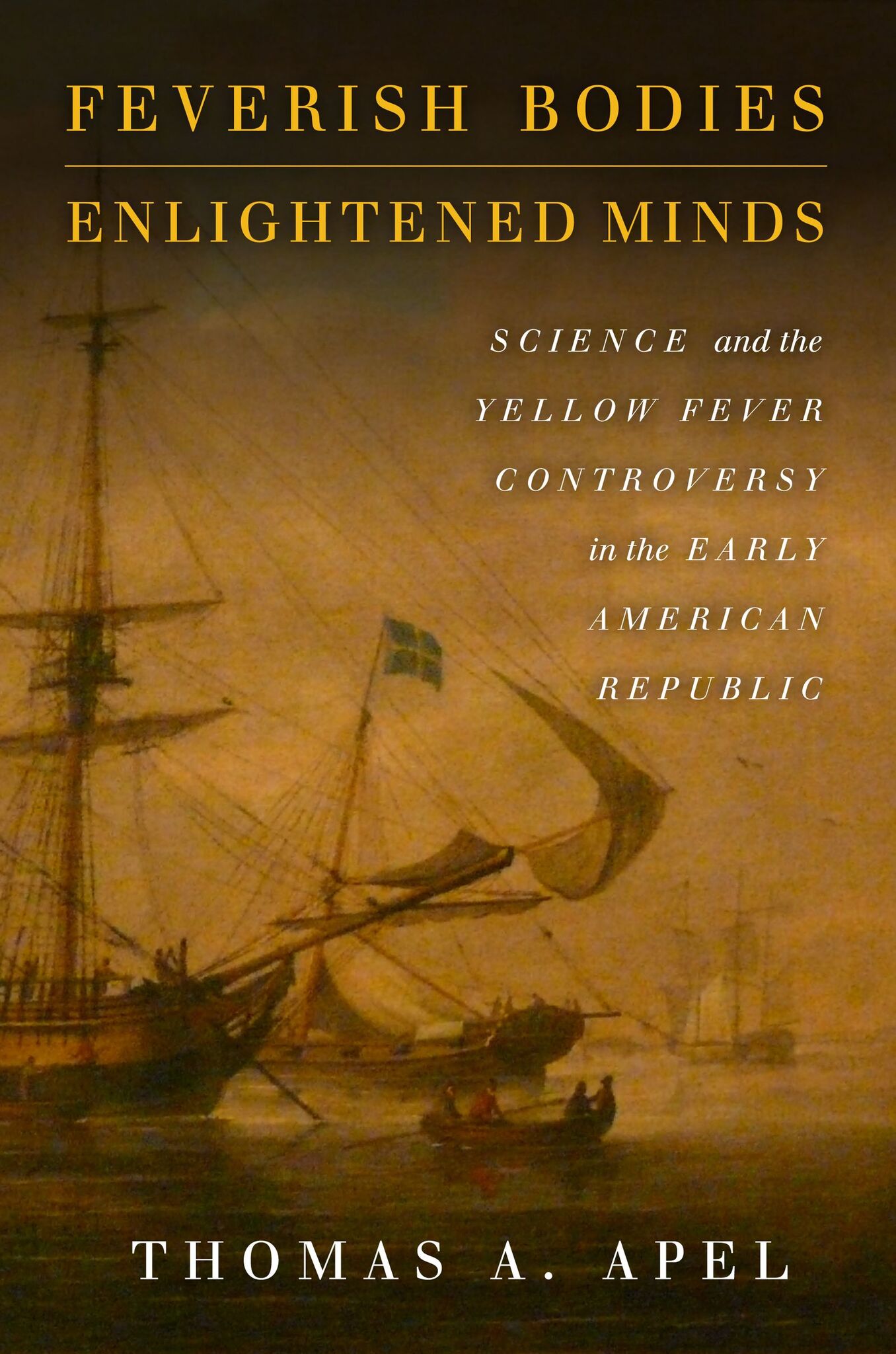
From 1793 to 1805, yellow fever devastated U.S. port cities in a series of terrifying epidemics. The search for the cause and prevention of the disease involved many prominent American intellectuals, including Noah Webster and Benjamin Rush. This investigation produced one of the most substantial and innovative outpourings of scientific thought in early American history. But it also led to a heated and divisive debate—both political and theological—around the place of science in American society.
Feverish Bodies, Enlightened Minds opens an important window onto the conduct of scientific inquiry in the early American republic. The debate between "contagionists," who thought the disease was imported, and "localists," who thought it came from domestic sources, reflected contemporary beliefs about God and creation, the capacities of the human mind, and even the appropriate direction of the new nation. Through this thoughtful investigation of the yellow fever epidemic and engaging examination of natural science in early America, Thomas Apel demonstrates that the scientific imaginations of early republicans were far broader than historians have realized: in order to understand their science, we must understand their ideas about God.


— David Waldstreicher
"Apel delivers a panoramic view of the significance of the yellow fever controversy. The disease struck as an event in biological history, in which a virus and a mosquito were the principal actors. But its interpretation was a human affair, deeply embedded in society and culture. Apel has shown how the outbreaks on the eastern seaboard in the 1790s were understood in ways that reflected the political polarization of the era and its peculiar melding of scientific and religious thought. His prose is vivid and clear, and his discursive footnotes open up many possible directions for future inquiry. Readers will appreciate his contribution to solving the problem that vexed commentators at the time of the outbreaks themselves: that of interpreting a devastating series of epidemics as historical events with profound implications for human self-understanding."
— Jan Golinski
"While competing explanations for the yellow fever epidemics that swept the northeast are the primary subject, Apel persuasively shows how these understandings of disease were infused with theological and political assumptions. Lively and jargon-free, his book should find a wide readership among historians of medicine and of the Early Republic."
— Sara Gronim
"Feverish Bodies, Enlightened Minds is an excellent contribution to the history of science, ideas, medicine, and politics in the early American republic. I recommend it highly to students of all of these fields."
— Rebecca J. Tannenbaum
"In this new monograph, Thomas A. Apel provides a compelling examination of the intellectual controversy surrounding outbreaks of yellow fever in the northeastern United States at the turn of the nineteenth century...Apel's work represents a welcomed addition to our knowledge of the yellow fever controversy. Even more profound, Feverish Bodies, Enlightened Minds provides an open window into the intellectual concerns of the United States' governing classes at the turn of the nineteenth century, exploring the political, religious, and naturalistic anxieties that plagued early Republican intellectuals."
— Christopher Willoughby
"Thomas Apel's Feverish Bodies, Enlightened Minds: Science and the Yellow Fever Controversy in the Early American Republic undertakes an epistemological approach to the question of health knowledge in the early Americas. It is a beautifully written book about the series of yellow fever outbreaks between 1793 and 1805....Apel's book makes an important contribution that will be welcomed by scholars looking to write about the outbreaks."
— Sari Altschuler
"Feverish Bodies is valuable for bringing North American perspectives on yellow fever into conversation with theology, chemistry, and medicine."
— Michael A. Osborne
The Introduction accentuates the depths of the problem of yellow fever, and it situates Feverish Bodies, Enlightened Minds in the relevant historiographies. Most works on yellow fever have focused on the devastating epidemic of 1793 and depicted the dispute about its cause as a familiar contest that pitted stale theories against each other. The Introduction suggests that episode reveals much more about knowledge construction than others have thought, and it argues specifically that the yellow fever controversy reflected prevailing ideological concerns of early republicans, including their concerns about political conflict, the direction of the republic, and the sanctity of religion at a time of turbulence.
Chapter One frames the parameters of the debate and establishes the prevailing intellectual orientation of the investigators. As scientists, investigators cast themselves as the descendants of Bacon, and asserted the importance of inductive reasoning and empirical evidence, which manifested itself in the yellow fever debate as an eagerness for the "facts" of the disease's occurrences. As pious Protestants, they rejected the perceived excesses of empirical skepticism, which threatened to reduce nature to mere mechanism and science to a cold, passionless pursuit. Investigators celebrated "common sense," the God-given capacity of the mind that enabled humans to sift through the scattered phenomena of nature and find truth. Casting the issue of yellow fever as a matter of common sense, the localists in particular came to view the debate not only as a scientific question, but one that affected the integrity of their conceptions of nature, the human mind, and God's purpose.
Chapter Two considers the investigators' uses of history to determine the cause of yellow fever. A vast repository of facts about disease, history appealed to the investigators' desire to place disease inquiry on a firm empirical footing. The historical turn culminated in two massive works on the history of disease published almost simultaneously in 1799: theTreatise on the Plague and Yellow Feverby the contagionist James Tytler, and theBrief History of Epidemic and Pestilential Diseasesby the localist Noah Webster. Whereas Tytler's work was roundly rejected by investigators, Webster'sBrief Historycogently situated the yellow fever epidemics in the sweep of history. But the localist victory was a Pyrrhic one.The appeal to the past exposed problems that undermined investigators' hopes that history could serve as an empirical basis of disease inquiry and it forced early republicans to reckon with their precarious places in the cycles of time.
Chapter Three examines the investigators' uses of the new chemistry of Antoine Laurent Lavoisier. Lavoisier's "chemical revolution" produced a Kuhnian paradigm shift that fundamentally altered scientists' conceptions of the elemental construction of matter. Investigators' used it to identify the chemical constitution of the particles that caused yellow fever, but not as their French creators had intended. During an period of war and revolution, investigators' were troubled by the very Frenchness of Lavoisier's chemistry, and they utterly rejected the experimental programme of the French for its basis in heretical doctrines. Celebrating the common sense capacities of the mind, chemists produced fanciful, reverential, and highly theoretical theories about the chemical origins of yellow fever, which anticipated strains of Romanticism in American science. Again, chemistry redounded to the benefit of the localists who used the science to construct plausible theories about the chemical identity of the miasmas that brought on the disease.
Chapter Four considers the natural theology of yellow fever. Convinced that yellow fever appeared as a punishment for sins and that the disease arose from natural processes, the investigators sought to interpret the purpose of yellow fever from the evidence of design. The localists found an elegant compromise. By negligently and carelessly allowing filth to accumulate, they argued, city-dwellers of afflicted cities violated both scriptural and common-sense prohibitions against uncleanliness, setting in motion a chain of events that naturally produced yellow fever. Localists embarked on a vigorous public health campaign, through which they stressed the duties of all Americans, as citizens of the republic and subjects of God, to abide by sanitary regulations. Considering the natural theology of yellow fever, however, reinforced republican fears of cities and further disillusioned early republicans about the direction of the American nation.
Chapter Five examines the tenor of the debate, especially its conspiratorial tone. Participants on both sides of the debate cast themselves as victims of the persecutions of their opponents, who had conspired to subvert the truth. The fever discourse thus mirrored the well-known "paranoid style" of contemporary political discourse. These parallel discourses were mutually reinforcing and both were rooted at least in part in the similar material organizations of early republican discursive communities. This chapter also argues that common sense epistemology itself provoked intolerance. For if truths about nature or politics offered themselves to common sense, then those who differed were not merely incorrect, but dangerously wayward and probably ill-intentioned. The vitriol of the yellow fever debate left investigators wanting to exert greater top-down control over the course of natural inquiry, just as the bitterness of the1790s political wars left intellectuals wanting to contain political discourse.
The Conclusion suggests that the yellow fever debate revealed the untenability of scientific inquiry based on the common-sense model, which could not sustain productive debate. It also contends that the yellow fever years help explain the trajectory of American science and medicine in the nineteenth century, when natural inquiry began to move out of the public sphere and into professional organizations and institutions of "experts." In medicine, this tendency crystallized in the rise of hospitals and autopsy, and in the search for disease in the tissues of the body. The debate between localists and contagionists reappeared in American South in response to its own yellow fever epidemics and in the United States' industrial cities in response to cholera, but these investigators would be inclined to look for answers in the bodies and corpses of their patients, as much as in ships and putrid effluvia.