


Some error occured while loading the Quick View. Please close the Quick View and try reloading the page.
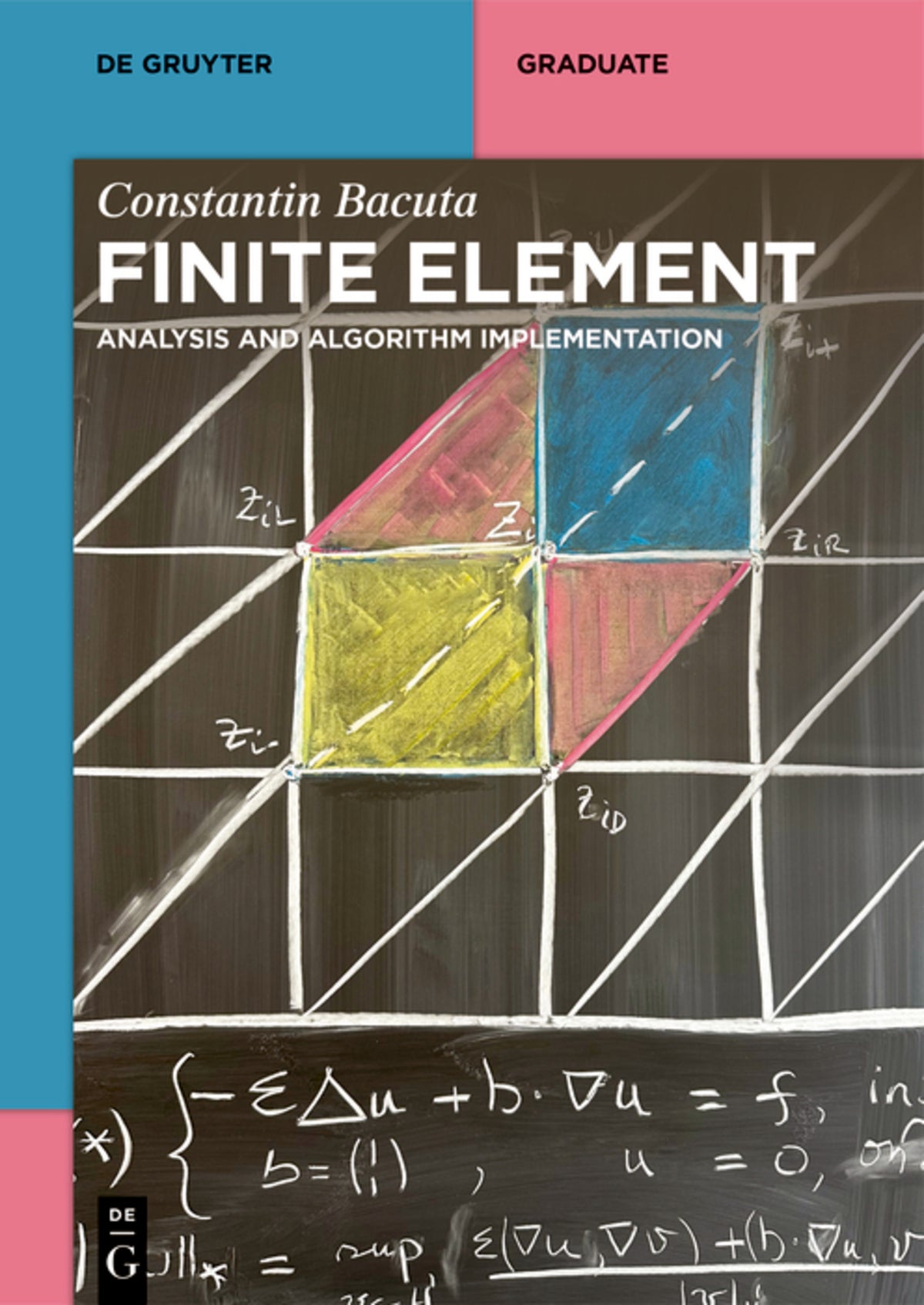
This book is the result of 25 years of study, reflection, and organization of ideas in the field of numerical discretization of PDEs while teaching courses in numerical analysis and searching for the best resource for teaching and learning the finite element (FE) method. The first part introduces the main building blocks of the FE discretization, together with analysis and algorithm development. The next part covers a specialized technique based on least squares approximation and multilevel preconditioning of variational formulations with different test and trial spaces. Various applications to elliptic boundary value problems, in particular, discretization to Stokes type systems and convection dominated problems, are included. Optimal norm on trial spaces, upwinding Petrov-Galerkin, and multilevel Uzawa algorithms are used for analysis and discretization. The last part focuses on special tools for FE analysis of PDEs on non-smooth domains, and PDEs with solutions in fractional spaces, such as the real method of interpolation, subspace interpolation, and Besov spaces. The organization of the ideas makes this book a freestanding textbook on FE including problem sets and algorithm implementation tips to support learning/advancing FE.


Constantin Bacuta is a professor in the Department of Mathematical Sciences at the University of Delaware. He got his Ph.D. in Mathematics with the dissertation ''Interpolation Between Subspaces of Hilbert Spaces and Applications to Shift Theorems for Elliptic Boundary Value Problems and Finite Element Methods’’ under James H. Bramble at Texas A&M University in 2000.
His research areas are in Numerical Analysis and Scientific Computing, especially, finite element discretization of Partial Differential Equations (PDE). His research focus is on finite element approximation of boundary value problems using special iterative methods and multilevel preconditioning techniques. His most recent work is devoted to least square methods for variational formulations with different trial and test spaces, and to building robust discretization of convection dominated problems. His most recent interest is in finding connections between concepts and methods that help teach discretizations of PDEs in a unified and rigorous way. The last three most recent publications on this subject are as follows:
• Connections Between Finite Difference and Finite Element Approximations, 2021
• Connections Between Finite Difference and Finite Element Approximations for a Convection-Diffusion Problem, 2024
• Comparison of variational discretizations for a convection-diffusion problem, 2024
He has been serving as an Associate Editor for the Journal of Applicable Analysis, as a referee for NSF projects, and as a reviewer for various numerical analysis journals.