


Some error occured while loading the Quick View. Please close the Quick View and try reloading the page.
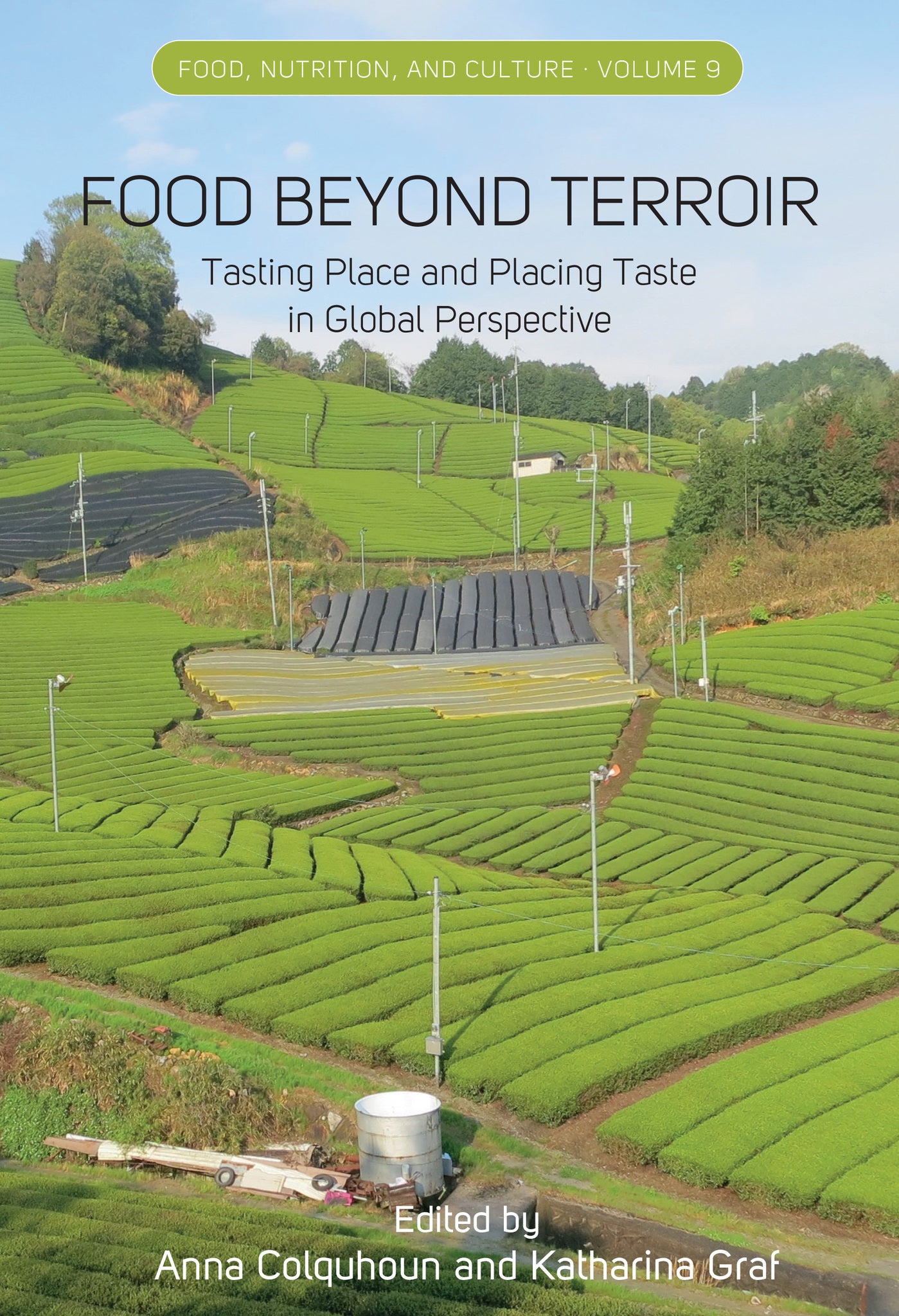
From winemaking in occupied territories to fishing in polluted seas, home cooking in refugee communities, and vegan cheesemaking, this collection explores the complex ways taste and place intersect with political, ecological, social, and economic issues. Through diverse ethnographic case studies, leading food scholars examine the meaning and making of place and taste. In doing so, the book challenges terroir-inspired notions of a fixed taste of place and pushes the boundaries of what we think we know about taste-place relations.


“Food Beyond Terroir offers global perspectives on the cultural, social and political aspects of the connection between food and place. The case studies and theoretical chapters are sure to spur excellent discussions in the classroom.” • Rachel Black, Connecticut College
“An outstanding collection, which provides a genuine rethinking of terroir. Each chapter piqued my interest and got me to think about familiar topics in new ways. Food Beyond Terroir is sure to be a touchstone for future scholarship on the “taste of place,” and required reading across the spectrum of food studies.” • David Sutton, Southern Illinois University
“This is an exciting new collection of critical perspectives on taste of place by leading theorists working with diverse and rich empirical material.” • Krishnendu Ray, New York University
“How do people come to believe that they can taste place, history, culture, and more in their food? Is “terroir” just marketing hype or is it the antithesis to bland globalization? Readable and sometimes provocative, these essays are essential for anyone who wants to understand the contested connections between food and place.” • David I. Beriss, University of New Orleans
Anna Colquhoun is a social anthropologist based at the SOAS Food Studies Centre. Her research interests include culinary tourism and the cultural economy, hospitality and cooking, and localized and post-socialist food systems.
List of Figures
Acknowledgments
Introduction
Anna Colquhoun, Katharina Graf & Harry G. West
Part I: Lands
Chapter 1. Terroir in Contested Territories
Anne Meneley
Chapter 2. Beating the Bounds of Terroir: A Perambulation of the Micro and Macro Cultures of Cidermaking in Devon, England
Simon Pope & Harry G. West
Chapter 3. Fishnets: Land-Sea Relationalities and Contingencies in Coastal Latvian “Taste of Place”
Guntra A. Aistara
Chapter 4. On Being Placeless? The Case of Vegan Cheeses
Sarah Czerny
Chapter 5. What’s Mine Is Mine and What’s Yours Is Mine: The Terroirism of Nash in Russian Culinary Colonialism
Melissa L. Caldwell
Part II: Laws
Chapter 6. The Domaće Relations of Cured Pork: “Homemade” Resistance to Terroir Products in Croatian Istria
Anna Colquhoun
Chapter 7. From Terroir to Viticultural Bricolages: Facing Environmental Challenges in Burgundy
Marion Demossier
Chapter 8. Food Producers and Place Brands in Contemporary Japan
Greg de St. Maurice
Chapter 9. Shifting Wind, Eternal Earth: Lapsang Souchong, a Foreign Fengtu Comes Home
Kunbing Xiao
Part III: Bodies
Chapter 10. Domestic Cooks’ Work toward Moroccan Beldi Foods
Katharina Graf
Chapter 11. Culinary Mestizaje: On the Making of an Authentic Cuban Taste of Place
Hanna Garth
Chapter 12. Food, Place, and Personhood in South India: The Limits of Terroir
James Staples
Chapter 13. To Chop Means to Eat: The Cosmology of Taste in Ghanaian Foodways
Brandi Simpson Miller
Part IV: Imaginaries
Chapter 14. Terroir in Future Tense? Gender, Taste, and Emplacement in an Age of Borders
Charlotte Sanders
Chapter 15. British-born Chinese Restaurateurs and the Reinvention of Chinese Cuisine
Jakob A. Klein
Chapter 16. “Good Wine” (Dobro Vino) and the Social Imaginary of Place: Wine Quality Debates in the Bulgarian Wine Industry
Yuson Jung
Chapter 17. Intimacy at Scale: Sovereignty as Political Temporality
Cristina Grasseni
Afterword: Thinking, and Becoming, Beyond Terroir
Heather Paxson & Brad Weiss
Index