


Some error occured while loading the Quick View. Please close the Quick View and try reloading the page.
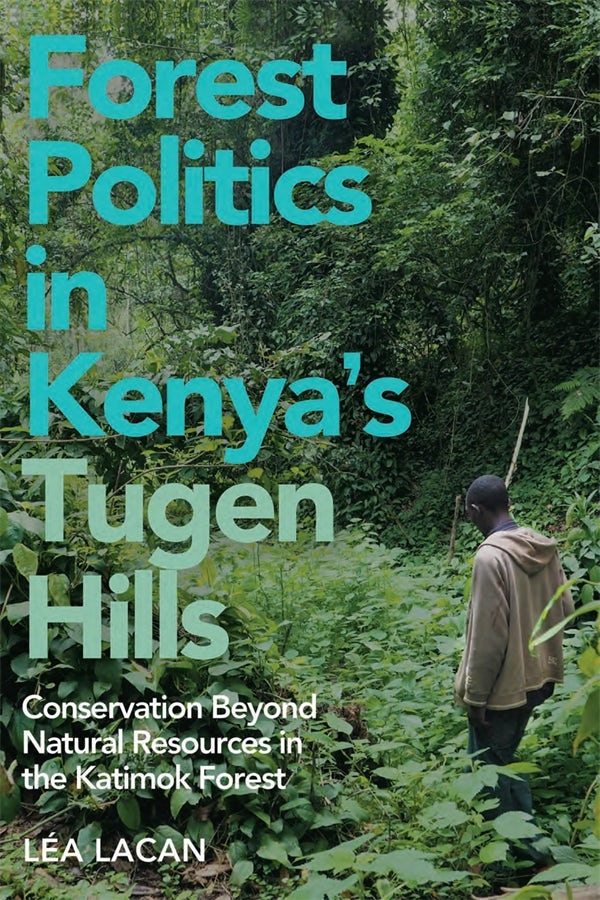
Explores the ways in which human and forest futures are interdependent, and the need to recognize its multiple meanings equally with its wealth of natural resources.
Forests are a changing environment, impacted as much by people and politics as by the species-rich diversity they contain. This book explores human-sylvan relations in the Katimok forest, Baringo highlands, Kenya, and asks us to rethink the forest beyond questions of access and control of natural resources, as a habitat where forest politics and human lives are inextricably intertwined.
Tracing the development of the Katimok forest from colonial times to the present day, the author shows how - as with many forests in Africa - it has become constructed as a category and territory of nature under state control: an area both to be protected and turned into exploitable resources. For those living within and on the boundaries of the forest, this social-ecological transformation has had a significant impact. Despite now being settled outside Katimok itself, dispossessed by administrators heedless of local management practices, many former residents continue to maintain a close connection with the forest, not only to sustain their livelihoods, but also to maintain their intimate links with ancestral lands, where their stories and memories are materially inscribed and powerfully invoked. Intimate connections to the forest are revealed to be as political as the use of its resources, culminating in local claims for redress of historical dispossessions.
Forests are a changing environment, impacted as much by people and politics as by the species-rich diversity they contain. This book explores human-sylvan relations in the Katimok forest, Baringo highlands, Kenya, and asks us to rethink the forest beyond questions of access and control of natural resources, as a habitat where forest politics and human lives are inextricably intertwined.
Tracing the development of the Katimok forest from colonial times to the present day, the author shows how - as with many forests in Africa - it has become constructed as a category and territory of nature under state control: an area both to be protected and turned into exploitable resources. For those living within and on the boundaries of the forest, this social-ecological transformation has had a significant impact. Despite now being settled outside Katimok itself, dispossessed by administrators heedless of local management practices, many former residents continue to maintain a close connection with the forest, not only to sustain their livelihoods, but also to maintain their intimate links with ancestral lands, where their stories and memories are materially inscribed and powerfully invoked. Intimate connections to the forest are revealed to be as political as the use of its resources, culminating in local claims for redress of historical dispossessions.

Price: $130.00
Pages: 300
Publisher: Boydell & Brewer Inc.
Imprint: James Currey
Publication Date:
02 July 2024
Trim Size: 9.21 X 6.14 in
ISBN: 9781847013811
Format: Hardcover
BISACs:
POLITICAL SCIENCE / Public Policy / Environmental Policy, Environmental policy and protocols, HISTORY / Africa / East, POLITICAL SCIENCE / Colonialism & Post-Colonialism, African history, Colonialism and imperialism, Political geography

Forest Politics balances a wealth of ethnographic and historical detail with conceptual clarity and innovation, and an attention to the stakes for forest residents of the dynamic human-sylvan assemblage that exists in Kenya's Katimok Forest. The result is a moving portrait of a set of communities, their histories, and their entanglements with forests, reconstructed through careful and sophisticated interdisciplinary methods, that resonates with and informs global conversations about space, knowledge, history, power, and the methods required to inform our study of these intersecting phenomena.
Introduction
PART I: Making the forest: from a colonial resource to modern forest landscapes
1. Improving the forest and its inhabitants: colonial state power and local resistance, 1895-1963
2. The post-colonial forest and the Kenyan state, 1963-2002
PART II - Living with the state forest: economic livelihoods under and beyond state control
3. Forest livelihoods in Talai and local dependency on forest resources
4. Beyond state control: forest use at the margins of legality
PART III: Living and becoming with the trees and the landscape: an intimate and political forest
5. Ecological knowledge in Talai: human-sylvan engagement, attunement and care
6. Bridging generations: a forest of transmission and belonging
7. Political forest: claim-making and reappropriating the forest in Katimok
Conclusion
Glossary
Appendix: Plants in and around Katimok and their description
PART I: Making the forest: from a colonial resource to modern forest landscapes
1. Improving the forest and its inhabitants: colonial state power and local resistance, 1895-1963
2. The post-colonial forest and the Kenyan state, 1963-2002
PART II - Living with the state forest: economic livelihoods under and beyond state control
3. Forest livelihoods in Talai and local dependency on forest resources
4. Beyond state control: forest use at the margins of legality
PART III: Living and becoming with the trees and the landscape: an intimate and political forest
5. Ecological knowledge in Talai: human-sylvan engagement, attunement and care
6. Bridging generations: a forest of transmission and belonging
7. Political forest: claim-making and reappropriating the forest in Katimok
Conclusion
Glossary
Appendix: Plants in and around Katimok and their description