


Some error occured while loading the Quick View. Please close the Quick View and try reloading the page.
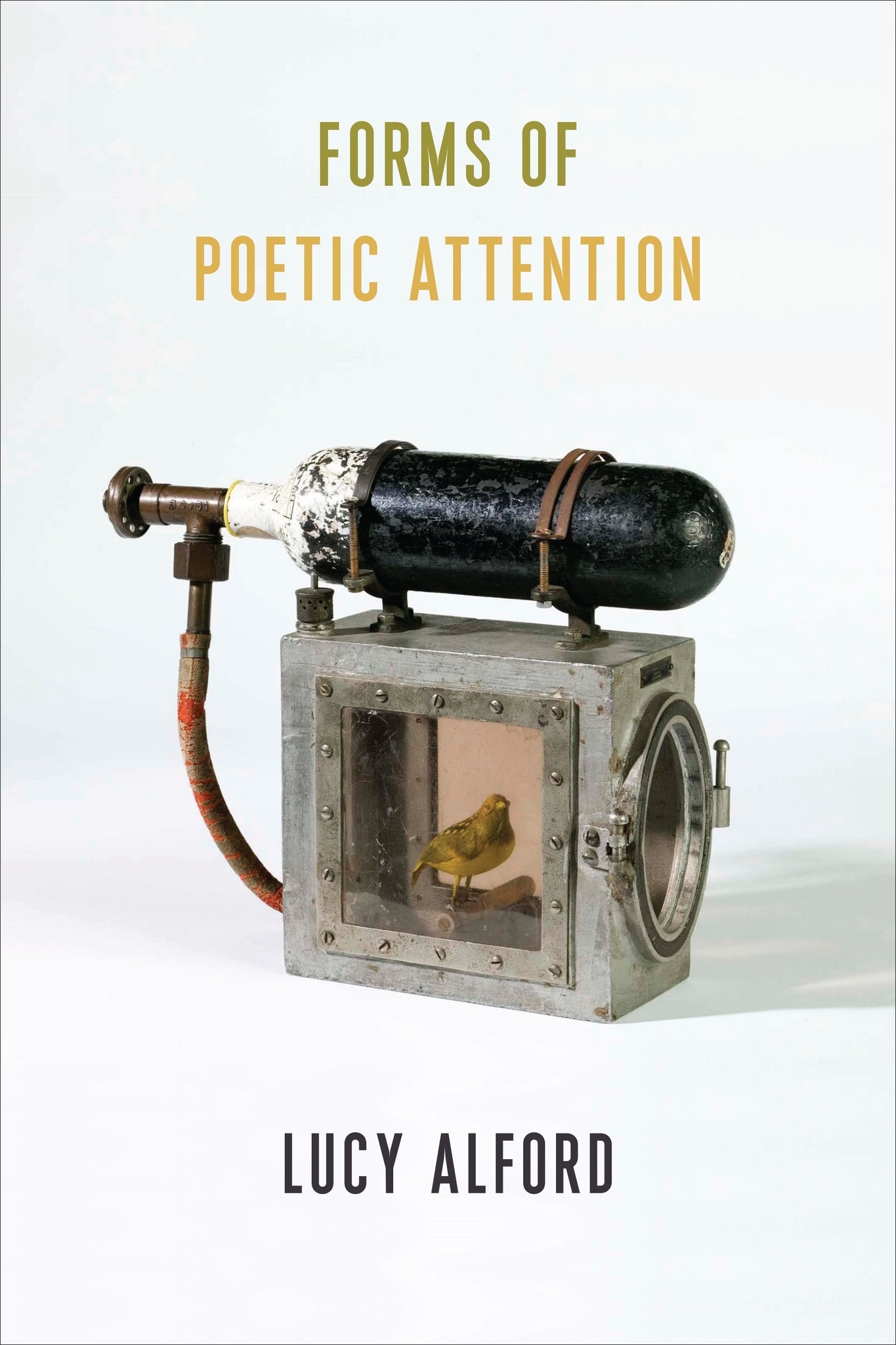
A poem is often read as a set of formal, technical, and conventional devices that generate meaning or affect. However, Lucy Alford suggests that poetic language might be better understood as an instrument for tuning and refining the attention. Identifying a crucial link between poetic form and the forming of attention, Alford offers a new terminology for how poetic attention works and how attention becomes a subject and object of poetry.
Forms of Poetic Attention combines close readings of a wide variety of poems with research in the philosophy, aesthetics, and psychology of attention. Drawing on the work of a wide variety of poets such as T. S. Eliot, Wallace Stevens, Frank O’Hara, Anne Carson, Theresa Hak Kyung Cha, Harryette Mullen, Al-Khansā’, Rainer Maria Rilke, Arthur Rimbaud, and Claudia Rankine, Alford defines and locates the particular forms of attention poems both require and produce. She theorizes the process of attention-making—its objects, its coordinates, its variables—while introducing a broad set of interpretive tools into the field of literary studies. Forms of Poetic Attention makes the original claim that attention is poetry’s primary medium, and that the forms of attention demanded by a poem can train, hone, and refine our capacities for perception and judgment, on and off the page.


— Susan Stewart, Avalon Foundation University Professor of the Humanities, Princeton University
Widely read in modern poetry and in philosophical, psychological, and sociological studies of attention, Lucy Alford has produced a boldly ambitious book with a new take on poetry in general and the sorts of things it can do. She explores how poems shape and are shaped by different kinds of attention with authority, eloquence, and sureness of touch.
— Jonathan Culler, author of Theory of the Lyric
Lucy Alford’s elegant and original book incisively distinguishes among the various forms of poetic attention. Fusing lyrical responsiveness with sharp-eyed analysis, it offers supple and intricate readings of attention in a stunningly transnational and transhistorical array of poems, from ancient Egypt and Greece to contemporary America.
— Jahan Ramazani, author of Poetry and Its Others: News, Prayer, Song, and the Dialogue of Genres
Alford proposes a truly new taxonomy of interest to any student of poetry and poetics: how do poems hold our attention? What are the separable ways in which they do so? How does a poem send us back out into the rest of the world, and when does it encourage us to go, and to stay, nowhere? These questions apply not just to particular poets, but to the whole of a literary enterprise: Alford gives us an acoustically and aesthetically sensitive way to talk about poems from varying language and periods and about the diversity within their unity.
— Stephanie Burt, author of Don't Read Poetry: A Book About How to Read Poems
Her readings are sensitive and nuanced.
Acknowledgments
Introduction: What Is Poetic Attention?
Part I. Attending to Objects
1. Modes of Transitive Attention
2. Contemplation: Attention’s Reach
3. Desire: Attention’s Hunger
4. Recollection: Attending to the Departed Object
5. Imagination: Attention’s Poiesis
Part II. Objectless Awareness
6. Modes of Intransitive Attention
7. Vigilance: States of Suspension
8. Resignation: Relinquishing the Object
9. Idleness: Doldrums and Gardens of Time
10. Boredom: End-Stopped Attention
Coda: Toward a Practice of Poetic Attention
Notes
Bibliography
Permission Credits
Index