


Some error occured while loading the Quick View. Please close the Quick View and try reloading the page.
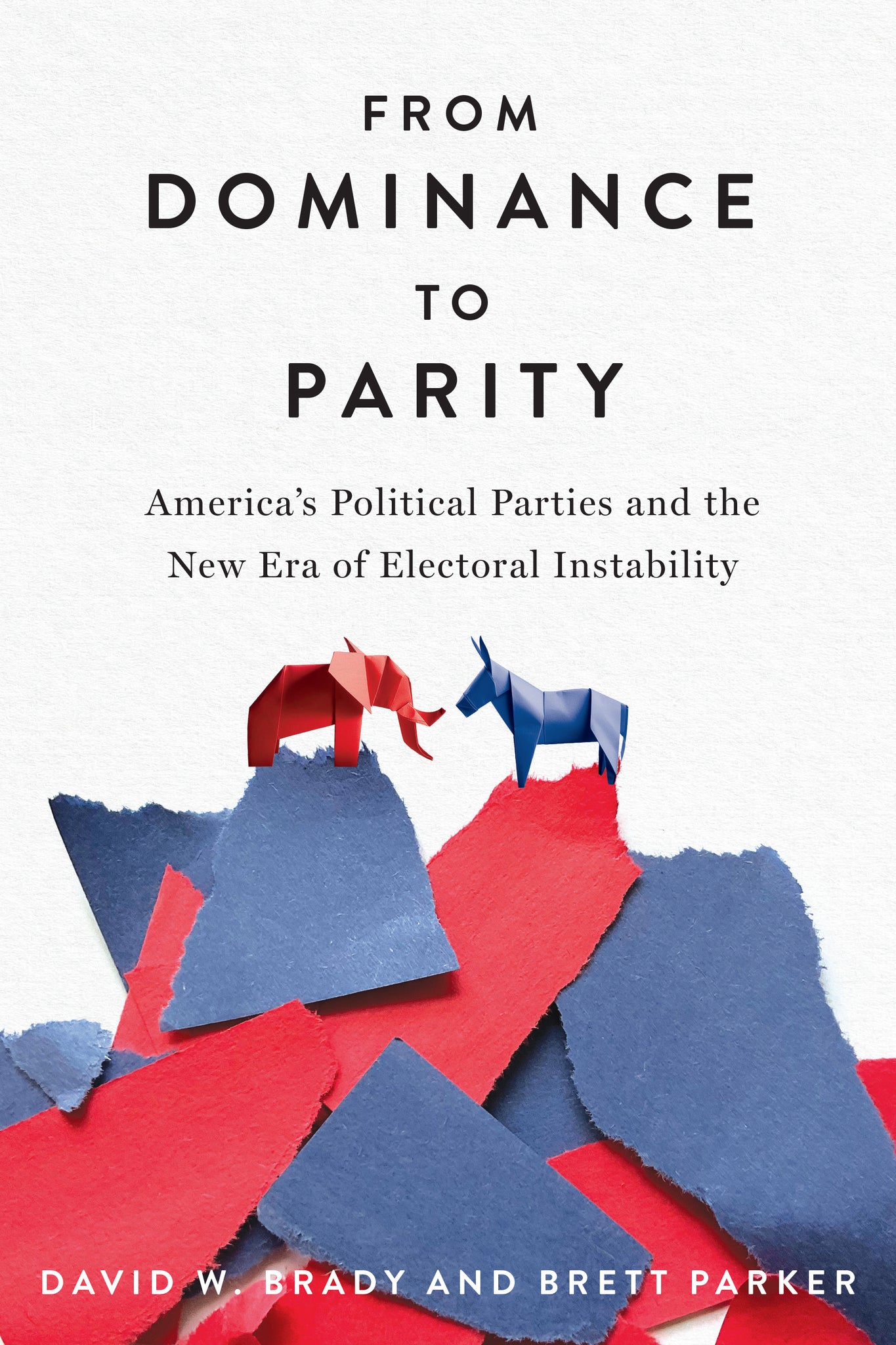
At the time Jimmy Carter was inaugurated as the 39th president of the United States, the Democratic Party had been enjoying a half-century of sustained electoral advantage. It had long controlled Congress and dominated measures of party identification. When Carter defeated Gerald Ford in 1976, 40 percent of Americans called themselves Democrats and another 12 percent told survey takers they leaned towards the party. To win the election of 1976, Carter just needed to hold the voters that started out on his side. Nearly fifty years later, American politics has inverted itself. Close electoral competition is the norm, and politics are at a stalemate. Brady and Parker call the existing deadlock the era of party parity, an age of division unseen since the late-nineteenth century. This book explains this profound shift in electoral politics. Drawing on fresh datasets and long-running surveys, the authors trace the decline of the Democratic majority and consider how this decline differed from past realignments. They show why modern American presidential elections are always close and argue that the rise of Donald Trump largely reinforced preexisting trends. Their work represents a significant contribution to the scholarly literature on party identification and realignment.


"David W. Brady has long been one of our most astute political scientists. He and Brett Parker have produced an essential book that should be required reading for anyone who participates in politics—or who cares about, covers, or comments on American civics." —Carl Cannon, RealClearPolitics
"A welcome addition to our understanding of our current political climate. Chock full of important (and sometimes overlooked) historical data, this book provides a fresh perspective on the 2024 election and helps cogently explain what to anticipate for the future of American electoral politics." —Fred Yang, Hart Research Associates
"If William Butler Yeats were a political scientist, he would say that the center cannot hold because there is no center anymore. So it is left to two political scientists, David W. Brady and Brett Parker of Stanford, to explain to us why, as Yeats surely would have written had he been observing American politics in this fraught time, 'Mere anarchy is loosed upon the political world.'" —David M. Shribman, Pittsburgh Post-Gazette
"This analytically sound and lucidly argued book is essential reading for all students of American politics.... Highly recommended." —S. E. Schier, Choice
INTRODUCTION
1. MASS PARTISANSHIP FROM ROOSEVELT TO TRUMP
2. POSTWAR REGIONAL PARTISANSHIP
3. PARTY ID IN FLUX
4. PARITY REALIZED
5. TRUMP-ERA POLITICS
6. THE FUTURE OF THE PARITY ERA
AFTERWORD: THE 2024 ELECTION AND BEYOND
Appendix
Notes
Bibliography
Index