Skip to product information
1 of 1

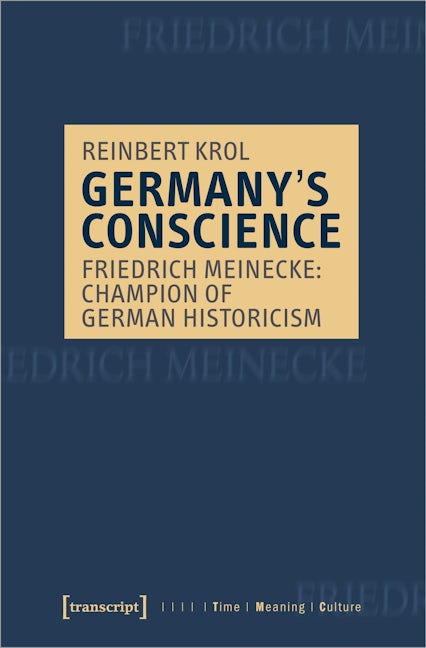
Germany's Conscience

Regular price $40.00
Regular price $40.00 Sale price $40.00
Sold out
Reinbert Krol’s analysis of the German historian Friedrich Meinecke’s intellectual development does not only give us insight into his philosophy of history—which turns out to be more conciliatory t...
Read More
  • 02 August 2021
View Product Details
Questions of truth, ethics, state power, and propaganda, of how to render account of catastrophes and reconcile oneself with one's past are not only crucial to our time, they were also central to the German historian Friedrich Meinecke (1862-1954). Probably no generation of historians before Meinecke had lived through more unsettling transformations, during which these questions were most pressing. Reinbert Krol's analysis of Meinecke's intellectual development does not only give us insight into his philosophy of history – which turns out to be more conciliatory than previously assumed – it can also be a source of inspiration for scholars of history today.
files/i.png Icon
Price: $40.00
Pages: 302
Publisher: transcript publishing
Imprint: transcript publishing
Publication Date: 02 August 2021
Trim Size: 8.86 X 5.83 in
ISBN: 9783837651355
Format: Paperback
BISACs: HISTORY / Social History, SCIENCE / History, HISTORY / General
REVIEWS Icon
»Krol's well-wrought argument on Meinecke's conception of history offers a profound analysis of Meinecke's overall intellectual development. Krol's excellent book convincingly shows the ambiguity of Meinecke's historical, philosophical and political thought. And most importantly, Krol's study contributes to the international debate in both the United States and Germany in an original and innovative way.«
Reinbert Krol, born 1979, teaches history at the University of Groningen. His research interests are German political and cultural history, with a specific focus on philosophy of history.

Frontmatter 1
Contents 5
Preface 7
Introduction 11
Introduction 47
1.1 Nations, the national state and cosmopolitanism 53
1.2 The universal and the national 55
1.3 The reconciliation of cosmopolitanism and the national state? 68
1.4 The tradition of the ideal 75
Conclusion 78
Introduction 81
2.1 Prelude 84
2.2 Staatsräson according to Meinecke 87
2.3 The tragic character of Meinecke's Staatsräson 98
Introduction 113
3.1 Staatsräson as a 'solution' 114
3.2 The statesman's conscience 124
Conclusion 132
Introduction 135
4.1 The individualizing view 139
4.2 Pietism and Neoplatonism 145
4.3 Reason and Unreason 151
4.4 Traditionalism and historicism 153
4.5 The prelude to Meinecke's historicism 157
4.6 Science or world view 162
Conclusion 172
Introduction 175
5.1 Polarities and harmony 180
5.2 Meinecke's Umdeutung of Goethe 192
5.3 Goethe and the daemonic 196
5.4 Harmony and dissonance 200
5.5 Meinecke and the crisis of historicism 204
Conclusion 221
Introduction 225
6.1 A controversial study 231
6.2 A catastrophic synthesis 234
6.3 Nature, chance, fate 239
6.4 Kultur as cure 245
6.5 Apotheosis 252
Conclusion 260
Final conclusions 263
Bibliography 271
Index 296