


Some error occured while loading the Quick View. Please close the Quick View and try reloading the page.
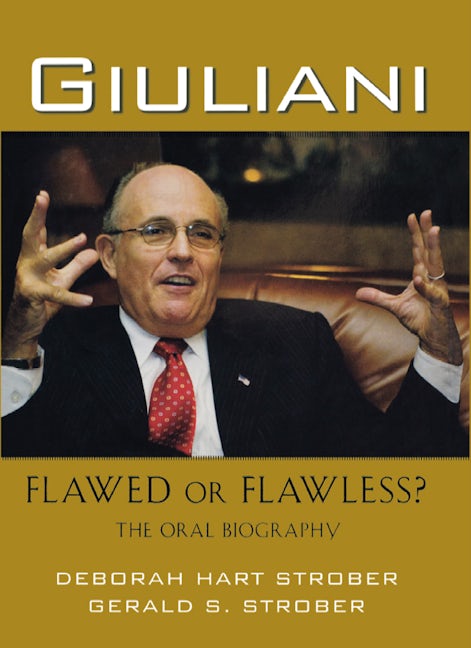
In the fall of 2001, a lame-duck mayor became the most admired man in America, and perhaps the world. Displaying enormous personal courage, boundless energy, and utter confidence in his ability to lead, Rudolph Giuliani took charge of his city's response to the 9/11 attacks while state and federal authorities were still paralyzed by shock. But who is Rudy Giuliani? What insights would his friends, associates, allies, and enemies offer to explain what makes him tick; how he responded—or contributed—to other crises during his term as mayor; and, should he choose to seek higher office, how he might perform as president?
Giuliani presents a living portrait of one of the most prominent and controversial politicians of our era in the words of those who know him best. Featuring more than forty interviews with longtime political associates, teachers, protégées, and friends, as well as his opponents, critics, and other astute political observers, it offers deep and revealing insights into the political and personal evolution of America's most famous ex-mayor.
Complete with an in-depth exploration of Rudy's response to the September 11th terrorist attacks, Giuliani is must reading for devotees of politics and anyone interested in Rudolph Giuliani as a possible presidential contender.


Conventional wisdom says that social conservatives who dominate the GOP primary process just don't know Rudy's record. Once they see that the emperor has no clothes - or, rather, likes to wear women's clothes - his numbers will slip and his prospects will sink.
That line, repeated by Democrats across New York, may prove to be true. But don't be so quick to write off Rudy. Deconstruct that conventional wisdom, and you find that it rests on shaky premises, knee-jerk biases—and, perhaps most importantly, a fundamental misunderstanding of the post-9/11 political climate.
Of course, Giuliani's had a rough week or two; even if he's still the front-runner, he's hardly a sure thing for the nomination. He raised an impressive $10 million in March alone, but keep in mind that his high standing in the polls has a lot to do with the relative weakness of the current field, which could change.
That said, I suspect the "Rudy can't win" mantra is being driven as much by Democratic fear and loathing - of both conservatives and Giuliani himself - as by Republican politics and performance.
As Deborah Hart Strober and Gerald Strober's "Flawed or Flawless" amply documents through dozens of interviews with friends and foes alike, liberals widely despise Giuliani. Not just because they see him as a racially insensitive, rights-suppressing bully, but because he succeeded in this big blue city largely because of his hard-charging style, not despite it.
To these liberals, Giuliani winning the GOP nomination is doubly scary: He threatens their worldview - and, worse, as a socially tolerant 9/11 hero, he's probably the biggest threat to beat the Democratic nominee. So when they say he can't win, part of what they're really saying is they don't want him to win.
More important, though, is how the left sees the right. The way many of my Democratic friends view evangelicals, and conservatives more broadly, is best summed up by the infamous Washington Post mischaracterization—"poor, uneducated and easy to command." So in their eyes, what's wrong with Kansas will prove to be what's wrong with Rudy's campaign.
That glib analysis is flawed, though. It treats movement conservatives as an unthinking monolith and wrongly presumes they would never tolerate or nominate a moderate.
Democrats also ignore the conservative appeal of Giuliani's strong moral streak, which he memorably demonstrated in his 1999 confrontation over the Brooklyn Museum's controversial "Sensation" exhibit. That's probably not enough to compensate for his apostasies on abortion and gay rights, but at a minimum it'll help him connect with some less-doctrinaire primary voters and likely mollify others' concerns about his cultural profile.
But liberals' big error here is to dramatically discount the long-term political impact of 9/11. They just don't see how the terrorist attacks of that day, and the ongoing threat of jihadism, have transformed millions of Americans (especially on the right) into security-first voters. This is the pre-eminent, transcendent issue for this generation of conservatives, and Rudy's credentials are saint-like.
Remember, conservatives willingly overlooked Ronald Reagan's divorce at a time when divorce was a much bigger political taboo than it is today. To righties of that generation, fighting Communism was the preeminent, transcendent cause, and Reagan was peerless when it came to waging and winning the Cold War. (It didn't hurt that he was a tax-cutting zealot, too.)
One of Giuliani's considerable advantages, much like Reagan, is the president he would replace. Many voters saw Reagan's strength and clarity as welcome antidotes to Jimmy Carter's weakness and malaise. To today's Republicans, Giulia