


Some error occured while loading the Quick View. Please close the Quick View and try reloading the page.
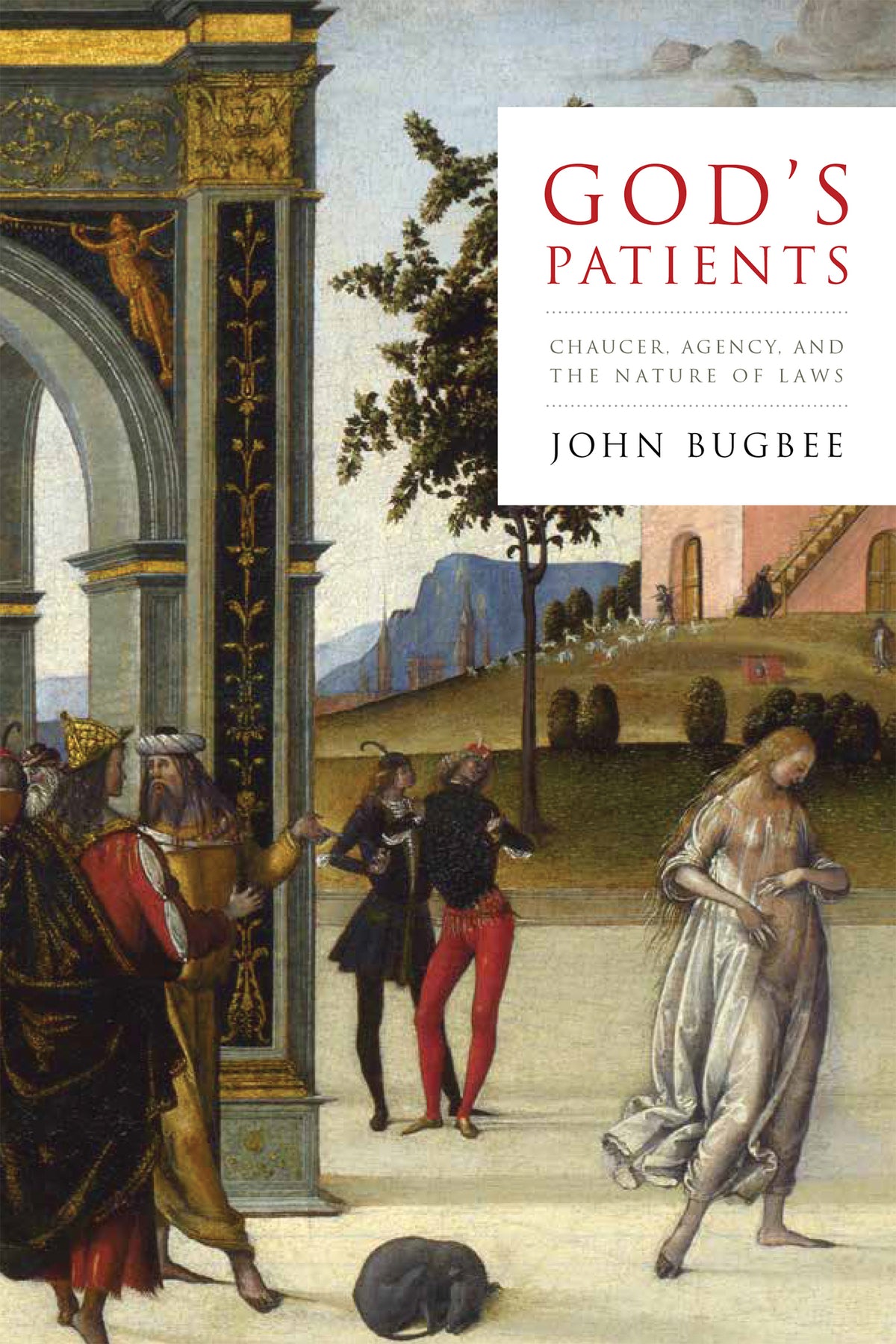
God’s Patients approaches some of Chaucer’s most challenging poems with two philosophical questions in mind: How does action relate to passion, to being-acted-on? And what does it mean to submit one’s will to a law? Responding to critics (Jill Mann, Mark Miller) who have pointed out the subtlety of Chaucer’s approach to such fundamentals of ethics, John Bugbee seeks the source of the subtlety and argues that much of it is ready to hand in a tradition of religious (and what we would today call “mystical”) writing that shaped the poet’s thought. Bugbee considers the Clerk’s, Man of Law’s, Knight’s, Franklin’s, Physician’s, and Second Nun’s Tales in juxtaposition with an excellent informant on a major stream of medieval religious culture, Bernard of Clairvaux, whose works lay out ethical ideas closely matching those detectable beneath the surface of the poems. While some of the positions that emerge—most spectacularly the notion that the highest states of human being are ones in which activity and passivity cannot be disentangled—are anathema to much modern ethical thought, God’s Patients provides evidence that they were relatively common in the Middle Ages. The book offers striking new readings of Chaucer’s poems; it proposes a nuanced hermeneutical approach that should prove fruitful in reading a number of other high- and late-medieval works; and, by showing how assumptions about its two fundamental questions have shifted since Chaucer’s time, it provides a powerful new way of thinking about the transition between the Middle Ages and modernity.


“Bugbee reads Chaucer’s tales with fine attention to detail and writes with fluency and sensitivity about their effects. . . . [T]he author is a careful guide, and the clarity of his exposition makes for an absorbing read.” —The Times Literary Supplement
“The book offers striking new readings of Chaucer’s poems; it proposes a nuanced hermeneutical approach that should prove fruitful in reading a number of other high- and late-medieval works; and, by showing how assumptions about its two fundamental questions have shifted since Chaucer’s time, it provides a powerful new way of thinking about the transition between the Middle Ages and modernity.” —Law and Religion Forum
"God’s Patients is a book anyone interested in premodern models of gendered agency, devotion, or ethics will return to repeatedly. Deeply learned, it demonstrates real theological depth and close reading acuity, offering much for a wide range of scholars of the Middle Ages." —Modern Philology
"John Bugbee thinks like a philosopher, writes like a master teacher, and reads like the most acute and subtle of critics. In this stunning first book, he explores the medieval ideal of 'conjoint agency,' interrogating once familiar but now largely forgotten ideas about the wellsprings of human action with respect to will, law, and divine agency. God’s Patients sheds an uncommonly revealing light on Chaucer, showing for example why Custance and her apparent lookalike Griselda are in fact moral opposites. Yet Bugbee’s ambitions are much larger. In the words of its preface, this book 'could change not only how we think about medieval literature, but to some extent also simply how we think.'" —Barbara Newman, Northwestern University
"John Bugbee’s book, based on impressive theological and philosophical learning and argued with energetic lucidity, conducts a scrupulous analysis of the ethical implications of six Canterbury tales to which medieval thought about action and passion, will and law, is particularly relevant. In raising fundamental questions about what kind of poet Chaucer is, it offers a challenge that Chaucerians cannot afford to disregard." —A. C. Spearing, Fellow of Queens' College, Cambridge
"A highly original contribution to Chaucer scholarship. . . . Though the arguments are underpinned by and informed by sophisticated philosophical investigation, the author manages complicated ideas in ways that readers who might have less philosophical training will find both illuminating and easy to negotiate.” —Nancy Warren, Texas A&M University
"The study is engagingly written and insightful in its readings of the individual tales. Perhaps more importantly, it suggests a new approach to the Christianity of Chaucer’s work and of medieval literature more generally: in introducing both a new figure, St. Bernard, who is not typically brought to bear on Chaucer, and a new set of definitions for the Christian ideas in the Canterbury Tales, particularly suffering/passivity.” —Katherine C. Little, University of Colorado Boulder
“Bugbee’s work is a thoughtful and detailed corrective to the kinds of interpretive errors that medievalists are prone to make.” —The Medieval Review
“Bugbee’s compelling interpretations remind us that the Middle Ages was a subtle, generous, and philosophically sophisticated time, worthy of deference and genuine respect for its own first principles.” —Studies in the Age of Chaucer
John Bugbee has taught at the University of Virginia, the University of Texas, and Mount St. Mary's University (Maryland). He is currently a visiting scholar in English at the University of Virginia.
Abbreviations
Acknowledgements
Preface – A Foretaste of Two Philosophical Themes
Introduction – Passion as Theme and Method
Part 1. Action and Passion
1. Concerned with Constancy: The Clerk’s and Man of Law’s Tales
2. Hermeneutical Interlude: Chaucer, Gadamer, Boethius
3. Bernard and Chaucer on Action and Passion
Appendix – Bernard, C. W. Bynum, and the Deep Roots of Paradox
4. Holy Anomaly: The Second Nun’s Tale and Active Sanctity
Part 2. Will and Law
5. Law Gone Wrong: The Franklin’s and Physician’s Tales
6. Bernard, Chaucer, and Life with the Law
7. Conclusion: The Union of the Themes and Its Implications
Bibliography