


Some error occured while loading the Quick View. Please close the Quick View and try reloading the page.
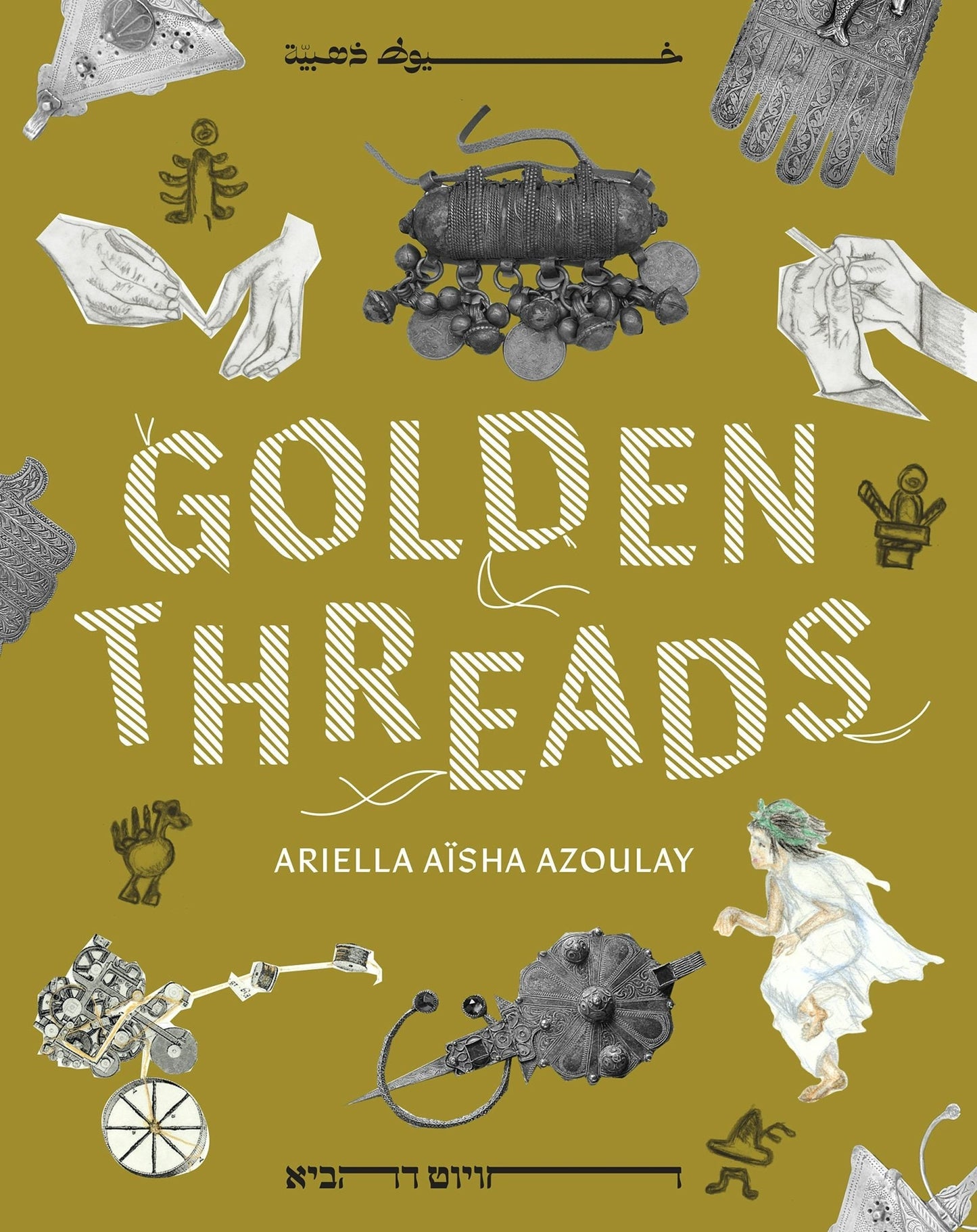
Rachelle is a young girl living in Fès, Morocco in 1920. Surrounded by a warm community of friends, family, and craftspeople—both Jewish and Muslim—Rachelle spends her days playing with other young girls in her neighborhood, trying on her grandmother's amulets, playing jokes on a nosy photographer, and watching her parents as they spin delicate threads made of gold at their jewelry workshop each day. Life in Rachelle's neighborhood, the mellah, is busy, nourishing, and filled with magic. But rumors of a machine (or is it a monster?) coming from across the sea threaten to change the mellah and the lives of its craftspeople forever. Banding together with her grandmother, her parents, and the other jewelry makers, Rachelle and four of her friends work together to put a stop to the machine's arrival—but only time will tell if they can save the vibrant world of the mellah and its beautiful golden threads for good.
Golden Threads draws on a series of inspiring historical episodes in Fès, when Jewish and Muslim artisans organized together against the introduction of a new machine that threatened to replace their manual labor and compromise their cherished way of life. A book for both middle grade readers and for adults reading aloud to younger children, Golden Threads will take people of all ages on a journey into the multi-faith world of Morocco's craftspeople, inspiring generative conversations about art, labor, community, and technology for years to come.


—Michael Rakowitz, artist and author of A House with a Date Palm Will Never Starve
“Golden Threads reignites the rich tapestry of Jewish Muslim relations in 1920s Morocco through vivid storytelling. Ariella Aïsha Azoulay brilliantly blends history with artistry, breathing new life into a vibrant, multi-faith heritage. It is a powerful homage to a world often forgotten, awakening a vital call for its revival.”
—Hadar Cohen, artist and scholar
“Straightforward, innovative, and historically grounded, Golden Threads is a must-read for every Jewish and Muslim household; Azoulay sends a loud yet gentle invitation to parents, in today’s moment of global political violence, to remember and cherish traditions of living together. Inspired by her Algerian father's stories and driven by a will to reclaim lost histories, this illustrated book, set in 1920s Fès, Morocco, follows five young girls from Jewish and Muslim artisan households as they strive to remember histories of social cohabitation and protect their rich ancestral artisanal heritage from foreign abuse and industrial destruction.”
—Dr. Aomar Boum, Professor and Maurice Amado Chair in Sephardic Studies at UCLA, and author of Undesirables: A Holocaust Journey to North Africa
“For families yearning to see a time when Jews and Muslims lived together, supported each other, and celebrated the work of artisans, Golden Threads is one of the few that succeeds in portraying such a time.”
—Lorelei R. Brush, Historical Novel Society
Azoulay wrote her first children's book, Golden Threads, as an invitation to her grandchildren, who were born when the Jewish Muslim world was already destroyed, to inhabit this ancestral world, and believe with others that it can be restored. Golden Threads draws from research Azoulay conducted for The Jewelers of the Ummah: A Potential History of the Jewish Muslim World (Verso, 2024). She lives in Pawtucket, Rhode Island.
Haitham Haddad is a visual artist from Palestine whose work centers on historical and contemporary manifestations of myth and folklore, as well as political tensions between the individual and the collective. He works at the intersection between printmaking, illustration, video, and tattooing. Haddad is the founder and creative director of Studio Mnjnk, a multidisciplinary graphic design studio with a focus on experimental typography and Arab visual culture. His work has been exhibited and featured in numerous museums and cultural institutions, such as the A. M. Qattan Foundation (Palestine), Stedelijk Museum Amsterdam (Netherlands), The Mosaic Rooms (UK), Vier Nul Vier (Belgium), ICD Brookfield Place (UAE), Qalandiya International (Palestine), Bard College (New York), and the Royal College of Art (UK). He currently lives and works in New York.
Hagar Ophir is a multidisciplinary artist trained as a historian, stage designer, and dancer. Her work establishes history as a space to reimagine and actualize alternative possible presents, moving beyond divisions instituted between tenses, nation-states, and ideologies. Ophir often works collaboratively to create knowledge through art and education projects. Her recent projects have appeared in Berlin in two solo exhibitions, Bound with the Living The Archive Room (Diffrakt, 2024) and Recalling History Bundled with the Living (Soma Art, 2023), and in the work Letter of Demand (LABA fellow exhibition, 2023). In 2020, in collaboration with five artists and teachers, Ophir founded mitkollektiv, an intersectional arts education collective, and the art education project Reimagine Jetzt! She co-leads workshops at HKS and Bard College Berlin, and her work has been published in Revista de História da Arte, the Jerusalem Quarterly, and elsewhere. Ophir lives in Berlin.