


Some error occured while loading the Quick View. Please close the Quick View and try reloading the page.
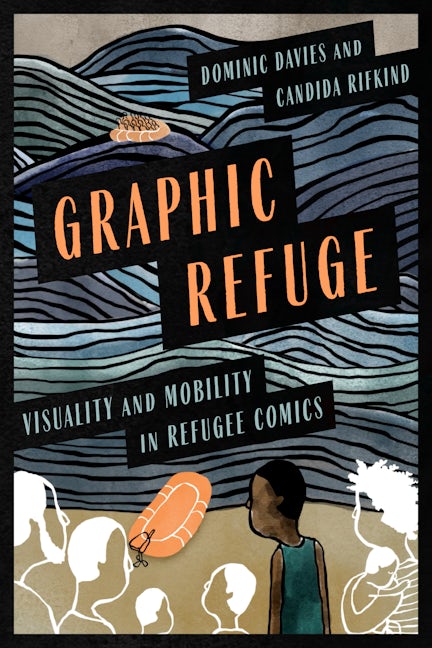
Graphic Refuge is the first in-depth study of comics about refugees, asylum seekers, migrants, and detainees by artists from the Global North and South. Co-written by two leading scholars of nonfiction comics, the book explores graphic narratives about a range of refugee experiences, from war, displacement, and perilous sea crossings to detention camps, resettlement schemes, and second-generation diasporas.
Through close readings of work by diverse artists including Joe Sacco, Sarah Glidden, Don Brown, Olivier Kugler, Jasper Rietman, Hamid Sulaiman, Leila Abdelrazzaq, Thi Bui, and Matt Huynh, Graphic Refuge shows how comics challenge dominant representations of the displaced and bring a radical politics of refugee agency and refusal into view. Rather than simply affirming the “humanity” of the refugee, these comics demand that we apprehend the historical construction of categories such as “citizen” and “refugee” through systems of empire, settler colonialism, and racial capitalism.
Building on scholarship in critical refugee studies, architecture and infrastructure studies, and postcolonial theory, Davies and Rifkind argue that refugee comics move us through this wider recognition and towards more expansive ideas of refuge as a lived political relationship.


Graphic Refuge is a thorough interrogation of graphic-narrative responses to the massive human migration that now challenges a Western world heavily implicated in the wars and climate change that drive it. In their willingness to question the motivations of the artists, the readers, and the terminologies and tropes that burden the refugees, I discern the humanity behind their intellectual rigor: Davies and Rifkind — like us all — have skin in this game. — Joe Sacco
Graphic Refuge is a welcome addition to comics and graphics research and an urgent call to end forced migration....It reinforces the importance of including graphic novels in student literature toolkits, the need to find literature that humanizes and empowers characters, and the growing need for critical perspectives to engage in the world. —Raúl Alberto Mora, Children's Literature in English Language Education
Candida Rifkind (Author) is Professor of English at the University of Winnipeg, where she specializes in alternative comics and Canadian literature. In addition to numerous publications, she co-edited Documenting Trauma: Traumatic Pasts, Embodied Histories & Graphic Reportage in Comics (Palgrave 2020) and Canadian Graphic: Picturing Life Narratives (Wilfrid Laurier UP, 2016).
TABLE OF CONTENTS
Foreword (Vinh Nguyen)
Introduction: Graphic Refuge (Davies and Rifkind)
PART ONE: THE SEA AND THE CAMP
Chapter One: Clandestine Crossings: Refugee Comics at Sea (Davies)
Chapter Two: Refugee Camp Comics and the Postdocumentary Turn (Rifkind)
PART TWO: VISUAL TECHNOLOGIES
Chapter Three: Unknown Knowns: Refugee Comics and the War on Terror (Davies)
Chapter Four: Interactive Refugee Comics and Digital Humanitarianism (Rifkind)
PART THREE: RUINS AND REFUGE
Chapter Five: Remote Sensing: Refugee Comics in Ruins (Davies)
Chapter Six: Diasporic Displacements: Second-Generation Refugee Comics (Rifkind)
Epilogue: Refuge Comics (Davies and Rifkind)
Bibliography