


Some error occured while loading the Quick View. Please close the Quick View and try reloading the page.
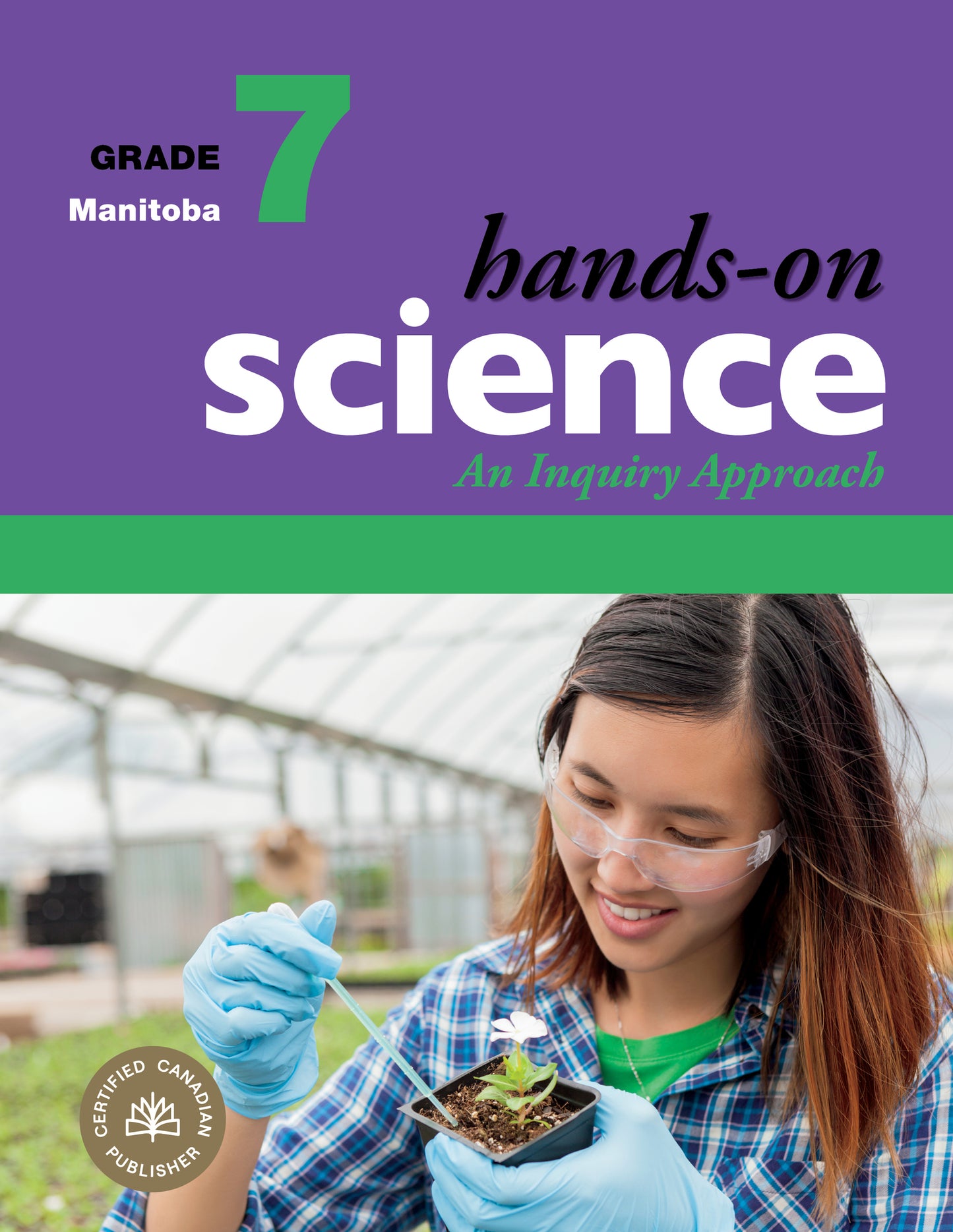
Hands-On Science for Manitoba is filled with a year’s worth of classroom-tested activities. The grade-seven book is custom-written to the Manitoba science curriculum (2000), and divided into four units:
- Interactions Within Ecosystems
- Particle Theory of Matter
- Forces and Structures
- Earth’s Crust
This teacher resource offers a detailed introduction to the Hands-On Science program, which includes its guiding principles, implementation guidelines, an overview of the science skills that grade 7 students use and develop, a classroom assessment plan complete with record-keeping templates, and digital reproducible student materials.


Introduction to Hands-On Science 1
- Program Introduction 1
- The Foundations of Scientific Literacy 1
- Hands-On Science Outcomes 2
- Program Principles 6
- Program Implementation 6
- Classroom Environment 7
- Time Lines 7
- Classroom Management 8
- Science Skills: Guidelines for Teachers 8
- Assessment Plan 14
- The Hands-On Science Assessment Plan 14
- Assessment Sheets 16
Unit 1: Interactions Within Ecosystems 27
- Books for Students 28
- Websites 29
- Introduction 31
- 1 Introduction to Ecology 32
- 2 Ecosystems: Small Places to Big Spaces 35
- 3 Abiotic and Biotic Elements of Ecosystems 38
- 4 How to Use a Microscope 42
- 5 Succession: The Order of Things 45
- 6 Building Blocks in an Ecological
- Food Pyramid 53
- 7 Human Action and Ecosystems 61
- 8 Energy Cycles in Ecosystems and the Importance of Plants 66
- 9 Examining Organisms in Soil 72
- 10 Bacteria 76
- 11 Microorganisms and Food 80
- References for Teachers 83
Unit 2: Particle Theory of Matter 85
- Books for Students 86
- Websites 87
- Introduction 88
- 1 Scientific Theories 90
- 2 Pure Substances and Mixtures 96
- 3 Solutions, Solutes, and Solvents 100
- 4 Rate of Solution 105
- 5 Separating Mixtures and Solutions 108
- 6 Dangerous Mixtures and Solutions and Their Effects on the Environment 114
- 7 Heat and Temperature 119
- 8 Thermometers 123
- 9 Effects of Heating and Cooling on Volume 127
- 10 Changes of State 131
- 11 Heat Transfer 135
- 12 Producing Heat 141
- 13 Design Challenge 145
- References for Teachers 148
Unit 3: Forces and Structures 149
- Books for Students 150
- Websites 151
- Introduction 153
- 1 Classifying Structures 154
- 2 Nature’s Structures 159
- 3 Centre of Gravity 162
- 4 Effects of Internal Forces 167
- 5 Effects of External Forces on Structures 172
- 6 Stress, Fatigue, and Failure 177
- 7 Investigating Beam Bridges 179
- 8 Types of Bridges – Structural Forms and Components 184
- 9 Designing, Constructing, and Testing Bridges 191
- 10 Increasing Strength of Materials 193
- 11 Structural Efficiency 197
- 12 Researching and Evaluating Bridge Designs 200
- 13 Product Research and Design 203
- References for Teachers 206
Unit 4: Earth’s Crust 207
- Books for Students 208
- Websites 209
- Recommended Videos 211
- Introduction 213
- 1 The Continental Drift 214
- 2 Plate Tectonics and Earth’s Structure 218
- 3 Earth’s Changing Surface 222
- 4 Mountain Formation 228
- 5 Earthquakes 233
- 6 Volcanoes 241
- 7 Rocks and the Rock Cycle 247
- 8 Classifying Minerals and Rocks 254
- 9 Erosion and the Landscape 259
- 10 Soil 262
- 11 Resources and their Extraction 269
- 12 Geological Resources 273
- 13 Mining and the Environment 278
References for Teachers 281
Access Digital Resources 282