


Some error occured while loading the Quick View. Please close the Quick View and try reloading the page.
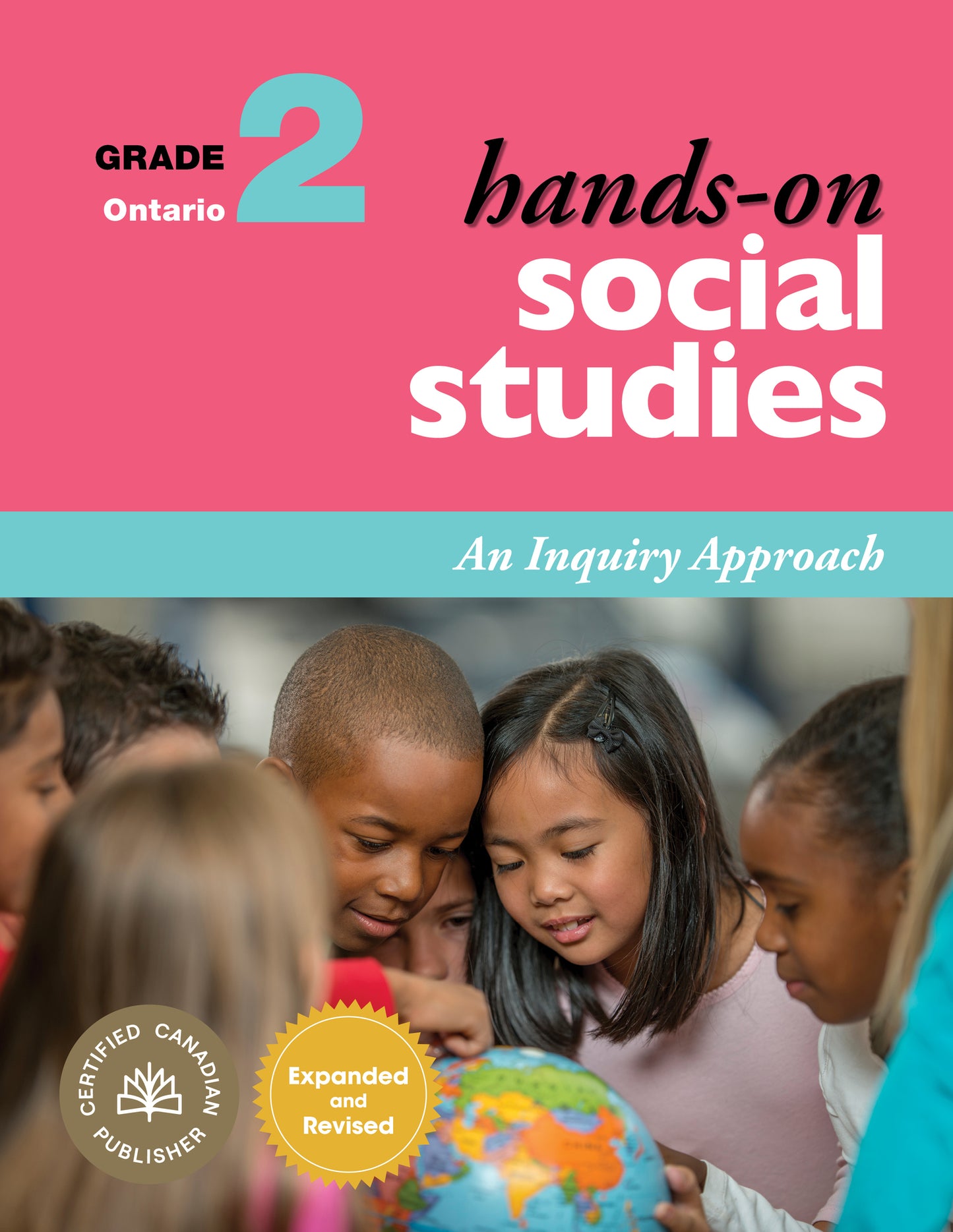
Develop your students’ social studies knowledge, skills, and attitudes with this expanded and revised edition of Hands-On Social Studies for Ontario, Grade 2. With a year’s worth of hands-on, minds-on activities, this resource conveniently includes everything both teachers and students need.
Hands-On Social Studies for Ontario, Grade 2 is divided into two units:
- Changing Family and Community
- Global Communities
Each unit:
- promotes active inquiry, problem solving, and decision making
- aligns with the new Ontario Social Studies curriculum (2023)
- follows the Growing Success document for assessment, evaluating, and reporting
- builds understanding of First Nations, Inuit, and Métis knowledges and perspectives
- develops knowledge of the six foundational concepts of social studies thinking
Save time and money with these stand-out features:
- all five components of the inquiry model
- opportunities for student self-reflection and for activating prior knowledge
- authentic assessment for, as, and of learning
- clearly defined learning goals supported by guided inquiry questions
- access to digital image banks and reproducibles (download instructions included in the appendix)
Perfect for teachers seeking a dynamic, curriculum-aligned resource, this revised edition ensures a well-rounded and engaging social studies experience for grade 2 students.

Price: $147.00
Pages: 212
Publisher: Portage & Main Press
Imprint: Portage & Main Press
Series: Hands-On Social Studies for Ontario
Publication Date:
03 March 2026
Trim Size: 11.00 X 8.50 in
ISBN: 9781774921883
Format: Spiral-Bound
BISACs:
EDUCATION / Teaching / Subjects / Social Science, EDUCATION / Schools / Levels / Elementary, EDUCATION / Teaching / Materials & Devices, EDUCATION / Teaching / Methods & Strategies, Teachers’ classroom resources and material, Lesson plans, Educational: Social sciences, social studies, Educational: Local / integrated studies, Educational: Citizenship and social education, Indigenous peoples

- Introduction to Hands-On Social Studies 1
- About Hands-On Social Studies 2
- What Is Social Studies? 2
- The Goals of Social Studies 2
- The Inquiry Approach to Social Studies 2
- Hands-On Social Studies Curriculum Expectations 3
- Overall Expectations 3
- Concepts of Social Studies Thinking 3
- Big Ideas 3
- Hands-On Social Studies Principles 3
- Cultural Connections 4
- Indigenous Knowledges, Experiences, and
- Perspectives 4
- How to Use Hands-On Social Studies in Your Classroom 8
- Unit Overview 8
- Accommodating Diverse Learners 12
- Classroom Environment 12
- Planning Units (Timelines) 13
- Classroom Management 13
- Classroom Safety 13
- Land-Based Learning 13
- Social Studies Skills: Guidelines for Teachers 14
- Communication 14
- Visuals 14
- Spatial Skills 14
- Vocabulary 18
- Geographic Definition 18
- Research 19
- The Hands-On Social Studies Assessment Plan 20
- Assessment for Learning 21
- Assessment as Learning 21
- Assessment of Learning 21
- Performance Assessment 22
- Culturally Responsive and Relevant Pedagogy and Assessment 22
- Portfolios 23
- Summative Achievement Levels 23
- Important Note to Teachers 23
- References 24
- Social Studies Achievement Chart 25
- Assessment Templates 27
- Unit A: Changing Family and Community Traditions 31
- About This Unit 32
- Unit Overview 36
- Curricular Expectations 37
- Concepts of Social Studies Thinking: Success Criteria 40
- Cross-Curricular Connections 41
- Resources for Students 42
- 1 Launching the Unit: What’s in a Name? 45
- 2 Investigating Countries of Origin 51
- 3 What Is Culture? 56
- 4 Family Timelines 61
- 5 Family Diversity 67
- 6 Family Traditions 72
- 7 Changing Times 76
- 8 Change in First Nations, Inuit, and Métis Communities in Canada 80
- 9 Reclaiming Traditions and Customs 84
- 10 Community Diversity 90
- 11 Changes in My Community 97
- 12 Community Traditions and Celebrations 102
- 13 Celebrations Over Time 106
- 14 Culminating Activity: A Class Celebration 113
- Unit B: Global Communities 119
- About This Unit 120
- Unit Overview 123
- Curricular Expectations 124
- Concepts of Social Studies Thinking: Success Criteria 127
- Cross-Curricular Connections 128
- Resources for Students 129
- 1 Launching the Unit: Our World 133
- 2 Getting Around the World With Atlases, Maps, and Globes 139
- 3 Exploring Cold and Hot Regions of the World 144
- 4 Living in Different Climates 152
- 5 Meeting Our Needs: Clothing 156
- 6 Meeting Our Needs: Shelter 159
- 7 Meeting Our Needs: Food 164
- 8 Meeting Our Needs: Water 168
- 9 Natural Environments and Ways of Life 173
- 10 Plants and Animals Around the World 178
- 11 Daily Life Around the World 182
- 12 Inquiry Through Interview 186
- 13 Culminating Activity: Our World’s Fair 190
- Appendix: Image Banks 195
- About the Contributors 207