


Some error occured while loading the Quick View. Please close the Quick View and try reloading the page.
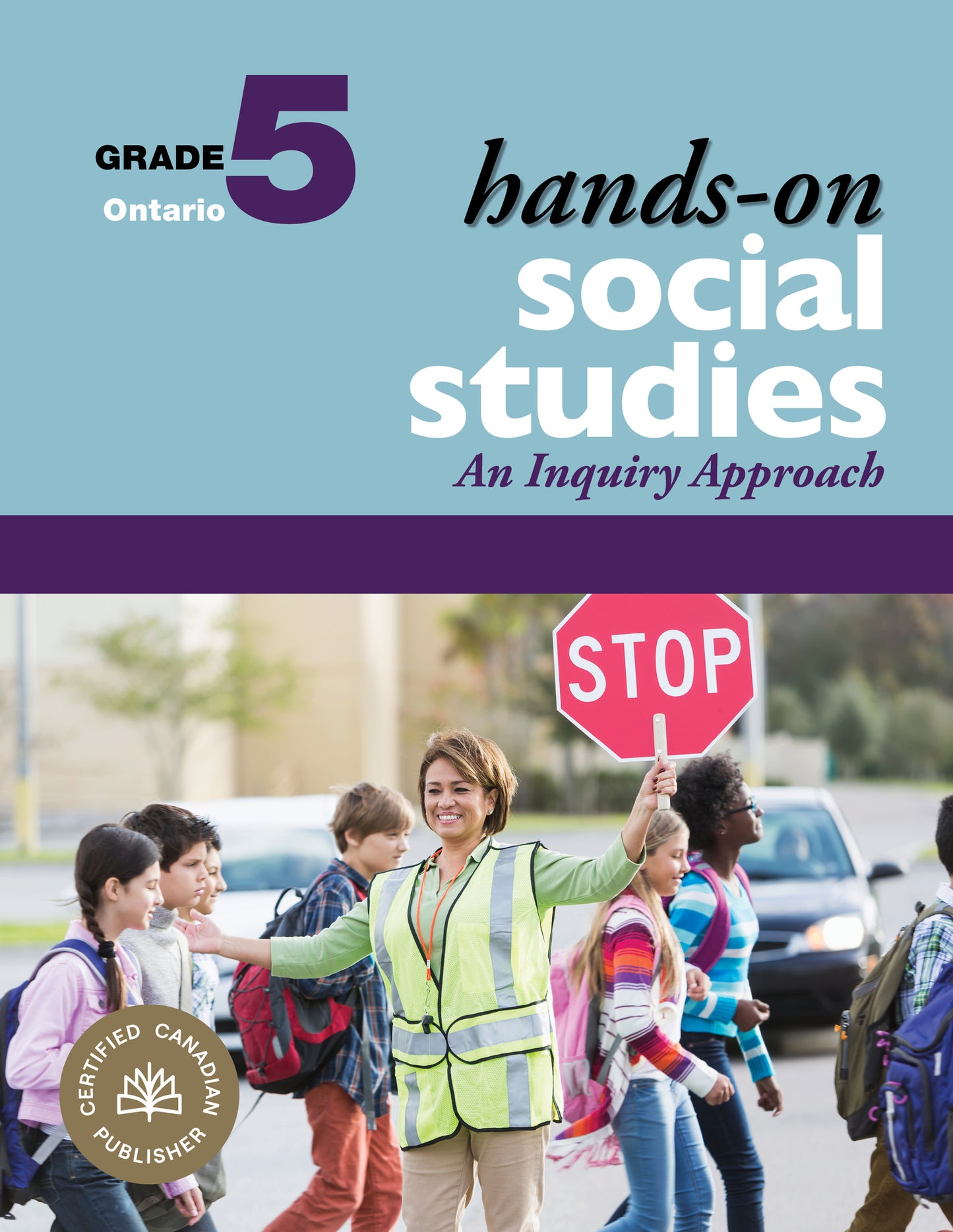
Filled with a year’s worth of classroom-tested hands-on, minds-on activities, this resource conveniently includes everything both teachers and students need.
The grade 5 book is divided into two units:
- CanadaFirst Nations and Europeans in New France and Early
- The Role of Government and Responsible Citizenship
STAND-OUT FEATURES
- focuses on the goals of the Ontario Social Studies curriculum
- adheres to the Growing Success document for assessment, evaluating, and reporting in Ontario schools
- builds understanding of Indigenous knowledge and perspectives
TIME-SAVING, COST-EFFECTIVE FEATURES
- includes the five components of the inquiry model
- opportunities for self-reflection and activating prior knowledge
- authentic assessment for, as, and of learning
- social studies thinking concepts, guided inquiry questions, and learning goals
- support for developing historical thinking skills
- access to digital image banks and digital reproducibles (Find download instructions in the Appendix of the book)

Price: $145.00
Pages: 244
Publisher: Portage & Main Press
Imprint: Portage & Main Press
Series: Hands-On Social Studies for Ontario
Publication Date:
14 August 2020
Trim Size: 11.00 X 8.50 in
ISBN: 9781553798033
Format: Spiral-Bound
BISACs:
EDUCATION / Teaching / Subjects / Social Science, EDUCATION / Schools / Levels / Elementary, EDUCATION / Teaching / Materials & Devices, Teachers’ classroom resources and material, Lesson plans, Sociology

Introduction to Hands-On Social Studies, Grade 5 1
- Program Introduction 2
- What Is Social Studies? 2
- The Goals of Social Studies 2
- The Inquiry Approach to Social Studies 2
- Hands-On Social Studies Curriculum Expectations 3
- Overall Expectations 3
- Concepts of Disciplinary Thinking 3
- Big Ideas 3
- Specific Expectations 4
- Hands-On Social Studies Program Principles 4
- Cultural Connections 4
- Indigenous Knowledge, Experience, and Perspectives 4
- Program Implementation 7
- Program Resources 7
- Lessons 8
- Accommodating Diverse Learners 9
- Classroom Environment 9
- Planning Units (Timelines) 10
- Classroom Management 10
- Social Studies Skills: Guidelines for Teachers 10
- Communication 10
- Vocabulary 14
- Geographic Definition 14
- Research 15
- Assessment for Learning 17
- Assessment as Learning 17
- Assessment of Learning 17
- Performance Assessment 18
- Portfolios 18
- Summative Achievement Levels 19
- Indigenous Perspectives on Assessment 19
- Important Note to Teachers 19
- References 20
- Social Studies Achievement Chart 21
- Assessment Templates 23
- Peoples and Europeans Prior to 1713, in What Would
- Become Canada 35
- About This Unit 36
- Unit Overview 40
- Curricular Expectations 41
- Social Studies Thinking Concepts: Success Criteria 43
- Cross-Curricular Connections 44
- Resources for Students 45
- 1 Launching the Unit: Learning From History 49
- 2 Learning From Primary and Secondary Sources 54
- 3 Indigenous Peoples in What Would Become Canada 59
- 4 Daily Life and Worldviews of
- Indigenous Peoples Before Contact 67
- 5 Early European Explorers 76
- 6 Contact Between Indigenous Peoples and European Explorers 84
- 7 Perspectives on First Contact 89
- 8 Historically Significant People 93
- 9 Life in New France 100
- 10 The French, the Haudenosaunee, and the Wendat 107
- 11 The Fur Trade: Part One 114
- 12 The Fur Trade: Part Two 120
- 13 Culminating Inquiry: Impact of Interactions 125
- References for Teachers 132
- About This Unit 136
- Unit Overview 140
- Curricular Expectations 141
- Social Studies Thinking Concepts: Success Criteria 143
- Cross-Curricular Connections 144
- Resources for Students 145
- 1 Launching the Unit: Social and Environmental Issues 154
- 2 Rights, Freedoms, and Responsibilities 159
- 3 Rights and Responsibilities 164
- 4 Canadian Charter of Rights and Freedoms 169
- 5 What Is Good Citizenship? 173
- 6 Indigenous Governments 179
- 7 Levels of Government in Canada 185
- 8 Investigating Different Perspectives 191
- 9 Creating Spatial Journals: Analyzing and Constructing Maps 197
- 10 Citizens and Government Working Together 202
- 11 Inquiry Project Part One: Setting the Stage for Success 209
- 12 Inquiry Project Part Two: Evaluating Resources and Gathering and Organizing Information 215
- 13 Inquiry Project Part Three: Interpreting, Analyzing, Evaluating, and Communicating Information 220
References for Teachers 225
Appendix: Image Banks 231
About the Contributors 244