


Some error occured while loading the Quick View. Please close the Quick View and try reloading the page.
The home and the museum are typically understood as divergent, even oppositional, social realms: whereas one evokes privacy and familial intimacy, the other is conceived of as a public institution oriented around various forms of civic identity. This meticulous, insightful book draws striking connections between both spheres, which play similar roles by housing objects and generating social narratives. Through fascinating explorations of the museums and domestic spaces of eight representative Israeli communities—Chabad, Moroccan, Iraqi, Ethiopian, Russian, Religious-Zionist, Christian Arab, and Muslim Arab—it gives a powerful account of museums’ role in state formation, proposing a new approach to collecting and categorizing particularly well-suited to societies in conflict.


“There are many books that attempt to place museums in a national and a subnational context, but Having and Belonging’s innovative methodology and careful research set it apart. It makes a valuable contribution not only to museology but also to studies of immigration, nationalism, and ethnicity.” · Steven Lavine, California Institute of the Arts
“This is a well-written and highly original work combining studies of material culture, life histories, museums, and migration. It offers a kaleidoscopic perspective on the many communities that comprise Israeli society, with an analysis that is multilayered and empathetic.” · Dienke Hondius, Vrije Universiteit Amsterdam
Judy Jaffe-Schagen obtained her doctorate in history from Vrije Universiteit Amsterdam. She has extensive experience communicating the results of new scholarship to the public through museum exhibitions and related media. Currently, in affiliation with the Amsterdam School for Heritage and Memory Studies, she is researching the role of museums and memorials in helping migrant groups to become acknowledged and respected within society.
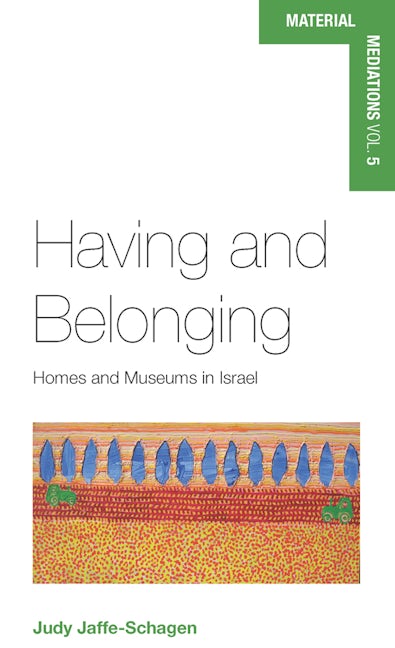
A Note about the Cover
Illustrations
Preface: Switzerland?
Acknowledgments
Chapter 1. Establishing collections, building a nation
Chapter 2. Exhibiting belief: religious objects in a secular institute
Mrs Marantz and the Israel Museum
Chapter 3. More than one story to tell
Mrs Sapir-Bergstein and Beit Hatfutsot, the Museum of the Jewish People
Chapter 4. A migration museum and its visitors
Mrs Kaduri and the Babylonian Jewry Heritage Center
Immigrants and their museum
Chapter 5. Indigenous curation provides a second glance
Mr Yeshayahu and Bahalachin, the Ethiopian Jews Cultural Center
Chapter 6. Medals rather than high art
Mr Pens and the Museum of the Jewish Soldier in World War II
Chapter 7. On colors and borders
Mrs Romem and People of Israel website
Chapter 8. A holiday as object
Mrs Salameh and Beit HaGefen
Chapter 9. The geographical position of art and home
Mrs Abu Ilaw and the Umm el Fahem art gallery
Intermezzo
Chapter 10. Belonging: Mechanisms of inclusion and exclusion
To Conclude: Switzerland once more
Notes
Bibliography
Index