


Some error occured while loading the Quick View. Please close the Quick View and try reloading the page.
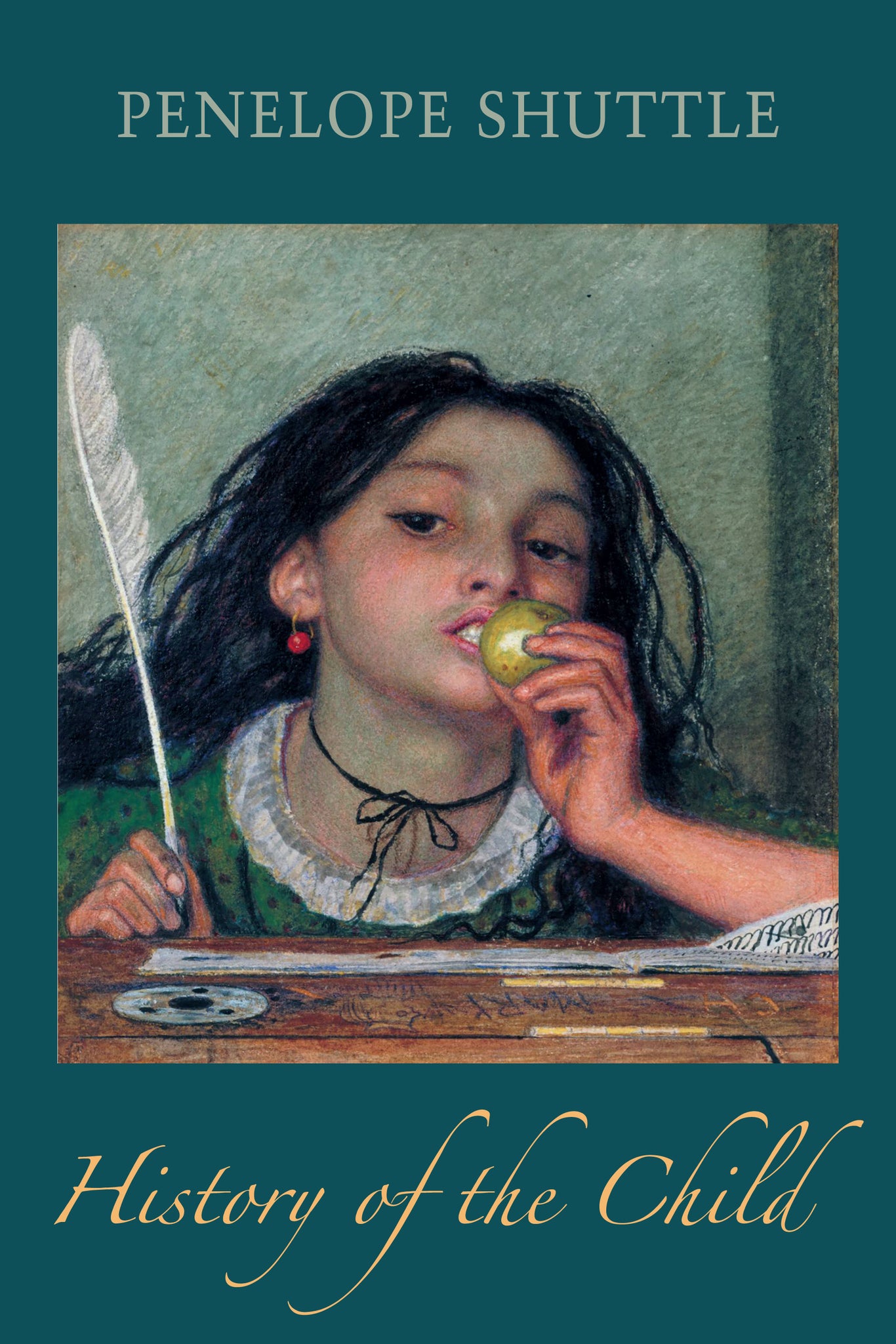
Penelope Shuttle’s History of the Child is a highly evocative exploration of childhood, memory, and imagination, blending personal and historical perspectives. The book’s themes include parenting, grief, nature, emotional recovery and connections to the past, guided by the idea of childhood as a transformative and rebellious space.
The first of the book’s four sections features poems about Katherine of Aragon, the Vestal Virgins, Stanley Spencer and Wallace Stevens, with a focus on grief, nature, and animals. The second, Book of Lullabies, steps closer to the theme of the child, with poems about memory, inwardness, climate change, sexuality in older age, and the natural world. The third part, History of the Child, is a journey back to Penelope Shuttle's own childhood, blending personal memories with imagined perspectives to explore psychological crises, emotional recovery, and the traumas of childhood. It introduces an ‘alternative girl child self’, inspired by Persian legends, by her late husband Peter Redgrove’s dream of such a girl (‘my death, and she is my soul’), and by a friend’s fanciful wish. The culminating fourth section is a playful sequence about a little table, inspired by her mother and her childhood. The table symbolises connection to her mother, who lived to be 100 years old, and their shared history.
History of the Child is guided by themes of memory, imagination, foreboding, magic, history and humour, and seeks to articulate the essence of ‘being’ through fiery language and elemental imagery. She draws inspiration from Donald Winnicott’s concept of the ‘potentive space’ where play, fantasy and reality intersect.


‘The capacious and playful latest from Shuttle (Lyonesse) offers twin poles of memory and imagination, taking place in part among the scenes, recollections, and visions of childhood […] She captures the blending of love and loss, of personal grief and environmental anxiety, that comes with growing up […] Quietly witty and slyly allusive, this dispenses poignant reflections on the poet’s personal history.’ – Publishers Weekly, on History of the Child
'Shuttle’s style is both spare and vivid: the lines are often short, the language accessible [...] Shuttle’s language often evokes shades of the folkloric, referencing myth, fable and pagan history. The titular child is a faerie child, more mischievous, shape-shifting and malevolent than sweet and charming, more Grimm’s fairy tales than bedtime-cosy [...] Shuttle leaves us with a mercurial being, and a mercurial collection, best read, in my experience at least, in a sort of ‘eyes half-shut’ way, where meaning and connection are left to find their own shape in the reader’s mind.' – Diana Cant, The Alchemy Spoon, on History of the Child
'Playful, mercurial, and poignant, Shuttle’s collection understands childhood as the first country of poetry, where language enchants, deceives, and saves us by turns.' – Ali Choudhary, Newcastle Poetry Festival blog, on History of the Child
On Lyonesse:
‘... a singular, arresting and moving book... two collections in one, hinged by a theme of loss. Lyonesse is Cornwall’s mythical kingdom – its Paradise Lost... It is this kingdom that has fired – watered – Shuttle’s imagination and produced an extraordinary flow of work... Shuttle’s Lyonesse is fresh, clear and convincing. It gives grief geography, an address. I believe in its direct dispatches from a submerged front line.’ – Kate Kellaway, The Observer, Poetry Book of the Month for July 2021
'Shuttle uses these threads of history to craft a world rich with everyday colour, but, like ours, ultimately dominated by the threat of environmental change... haunting and atmospheric poems... a deeply moving collection.' – Maggie Wang, Poetry Wales, on Lyonesse
‘… Penelope Shuttle, in her wonderfully clarifying Lyonesse, paints a picture of mythic lands submerged under seas and the loss, personal and environmental, that follows.’ – Rishi Dastidar, The Guardian (Best poetry books of 2021)