


Some error occured while loading the Quick View. Please close the Quick View and try reloading the page.
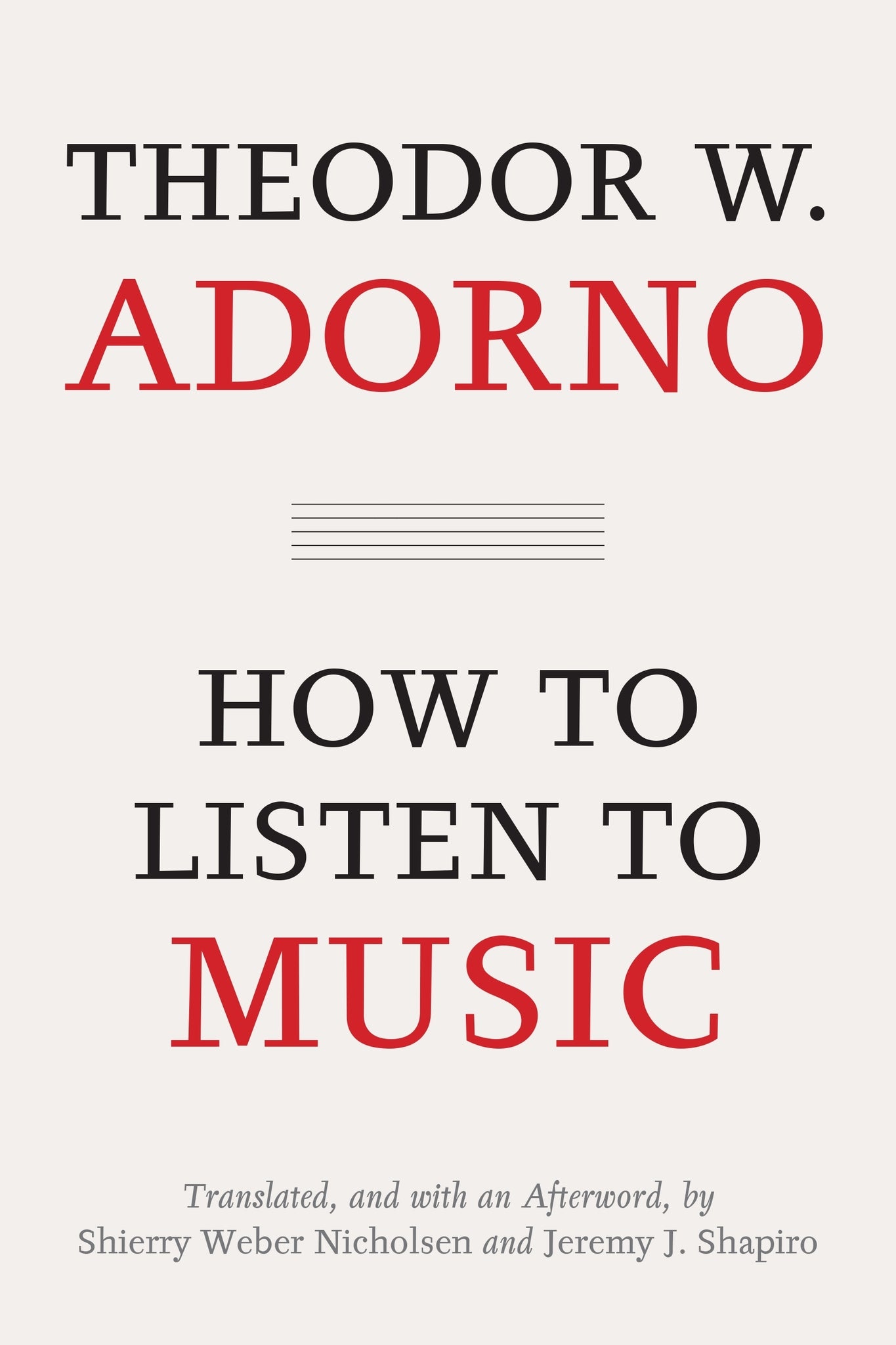
What happens when we stop listening for what we already know and begin following music on its own terms? In three lectures presented in schools and on the radio in the 1950s and 1960s, Theodor W. Adorno offers a practical guide.
Rather than cataloging forms, styles, and influences, Adorno asks readers to attend to music as it unfolds. A phrase recalls what came before, a new gesture alters what we have heard, and tension gathers or falls away. Hearing these relationships is what Adorno calls “structural listening.” The listener does not change the work, but connects its parts as it unfolds. Listening becomes a form of co-composing.
Adorno takes readers beneath familiar forms and formulas to what he calls music’s “subcutaneous” level, where motifs and phrases answer, develop, and reshape one another. This method is especially illuminating for the atonal and twelve-tone works of the Second Viennese School, often regarded as forbidding or inaccessible. Yet Adorno also uses it to uncover affinities across classical, romantic, and modernist traditions. Drawing on passages by Bach, Mozart, Beethoven, Schubert, Schoenberg, Berg, Mahler, Ravel, and others, he shows how close attention can make structure and beauty more vivid.
For Adorno, listening closely also has a social meaning. It resists the distracted consumption of isolated fragments and strengthens attention, imagination, and independent judgment. Written for nonspecialists and rich with musical examples, How to Listen to Music presents Adorno as a teacher who wants readers not only to know more about music, but to hear more in it.


“The three lectures presented in How to Listen to Music offer fresh insights into the fundamental yet often only implicit theory of listening that underlies Adorno’s musicological reflections. With eloquence and calm sophistication, the translators do not simply demonstrate how Adorno’s thoughts on the listening experience are in fact quite accessible, at least for the reader willing to take the time, but also indicate precisely why these reflections matter.”---John T. Hamilton, Harvard University
Theodor W. Adorno (1903-1969) was a German philosopher, social theorist, music critic, and composer, and a leading figure of the Frankfurt School. Best known for his critiques of mass culture and modern society, Adorno was also one of the twentieth century’s most influential thinkers on classical and modern music. His books include Dialectic of Enlightenment, Minima Moralia, Negative Dialectics, Aesthetic Theory, and Philosophy of New Music.
Shierry Weber Nicholsen (Translator)
Shierry Weber Nicholsen is a psychoanalyst and independent scholar who has translated works by Adorno and other Frankfurt School thinkers. She is the author of Exact Imagination, Late Work and The Love of Nature and the End of the World.
Jeremy J. Shapiro (Translator)
Jeremy J. Shapiro is professor emeritus at Fielding Graduate University. He has translated works by Herbert Marcuse and Jürgen Habermas and is coauthor of Mindful Inquiry in Social Research.