


Some error occured while loading the Quick View. Please close the Quick View and try reloading the page.
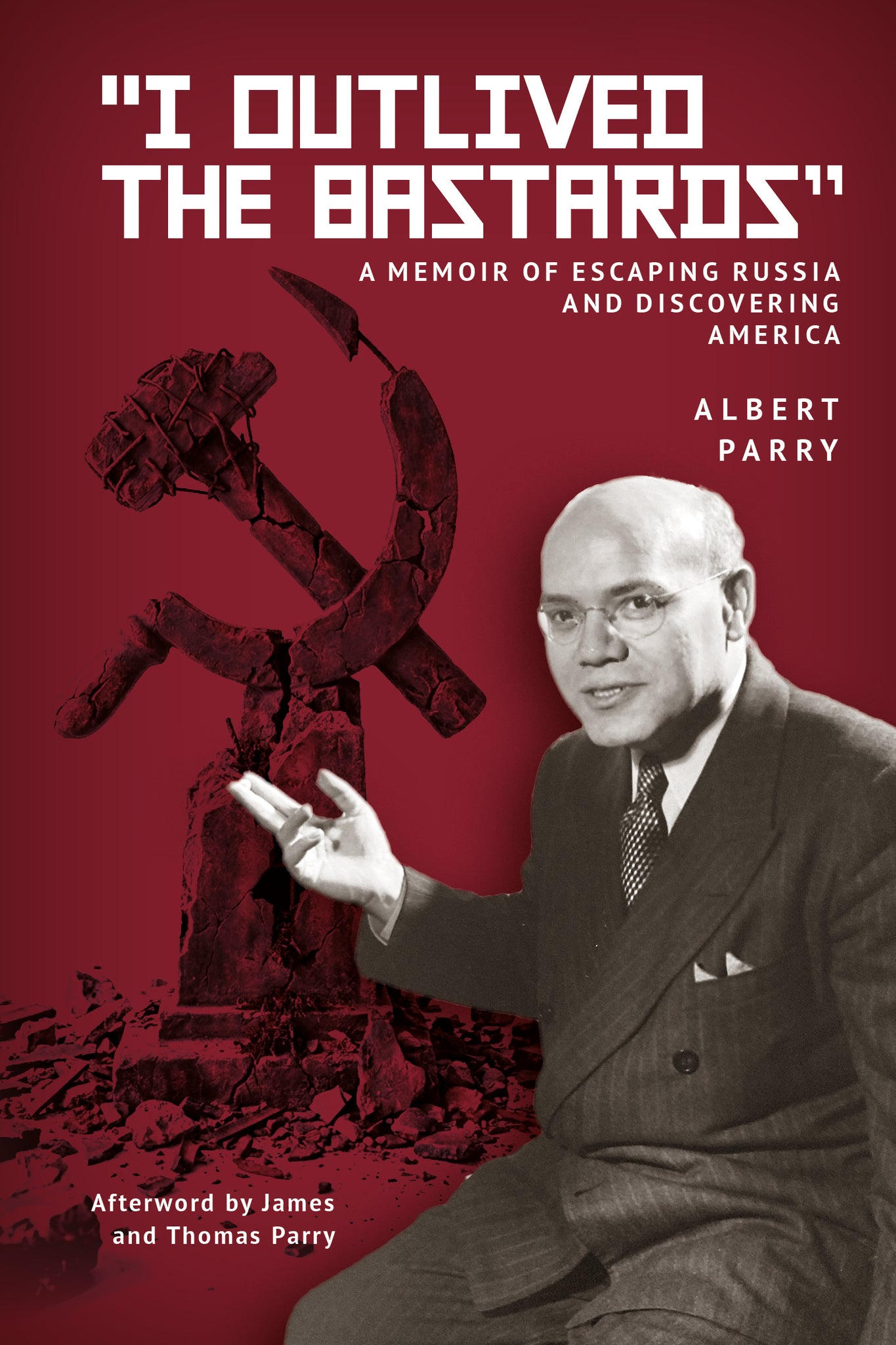
Born in Russia in 1901 as Abram Paretsky, Albert Parry came of age in a world on the brink of immense change. As a teenager, he went from dating Joseph Stalin’s future wife to escaping a firing squad under a hail of bullets during the Russian Civil War. Fleeing Russia in 1920, he arrived in America the following year with little more than his wits.
Reinventing himself as Albert Parry, he built a successful career as a freelance writer in the 1920s and 1930s before earning a PhD from the University of Chicago in 1938. Opposing isolationism before Pearl Harbor, he went on to work with the American and British intelligence agencies during World War II. After the war, at Colgate University, he founded the first undergraduate Russian Studies program in the United States.
Over the course of his life, he moved through a world of revolution, exile, and cultural upheaval—crossing paths with John Dos Passos, Theodore Dreiser, Sinclair Lewis, H. L. Mencken, Richard Wright, and Vladimir Nabokov—and even being thrown off a Hollywood set by Greta Garbo.Part adventure, part intellectual journey, this memoir captures a life lived along the fault lines of the 20th century—from war and ideology to art, literature, and espionage. With the insight of a historian and the voice of a born storyteller, Parry reflects on identity, freedom, and the value of courageous political belief.
He died just four months after the collapse of the Soviet Union, having the last word: “I outlived the bastards.” A fitting epitaph for a remarkable man.


“One of the miracles of researching during the later twentieth century was the opportunity to speak to those who had navigated its rapids and survived the grinding wheels of its totalitarianism with their humanity intact. Those moments are all-but gone now but may be revisited in memoirs like this: the autobiography of Russian-born historian Albert Parry. The years recorded here take Parry from youth in Rostov-on-Don to mid-life work for the Office of Strategic Services (predecessor to the CIA). Along the way he escaped a firing squad and shared a date with the future wife of Joseph Stalin and becomes a sterling critic of Soviet cruelty and a foot soldier in the battle against American isolationism. A picaresque chronicle that reminds the reader of the personhood behind the casualty statistics in history’s bloodiest years.”
- Nicholas J. Cull, author of Selling War: The British Propaganda Campaign against American “Neutrality” in World War II
“This memoir reads like a novel and is impossible to put down. Parry's sharp eye and acid tongue bring to life a gallery of colorful characters and stories – tragic, touching, and funny – spanning worlds from Bolshevik revolutionaries to New York bohemians to Chicago academics. His discussion of the moral dilemmas facing an émigré writer with relatives in peril back home and of the fierce wartime clashes between America Firsters and interventionists speaks powerfully to the ethical challenges we face today.”
- Slava Gerovitch, author of From Newspeak to Cyberspeak and Soviet Space Mythologies
“Parry’s vivid and engrossing memoir traces his life from his near execution in Civil War Russia to his perilous escape from his homeland to the United States, where, after barely subsisting at a variety of jobs – from jewelry salesman to journalist – he finally found his true niche in academia. A great virtue of the memoir is Parry’s lively and detailed depiction of the places he lived and people he met (ranging from General Tukhachevsky to Adlai Stevenson), his creation of a colorful panorama of social and political life in his native Rostov-on-the-Don and his adopted country. In addition his description of the persecution suffered by his brother and mother sheds light on the oppression in his native country, underlined by the grim fate of other Russian acquaintances, most notably Boris Pilnyak. In summary, Parry’s memoir illuminates not only his remarkable life, but also his turbulent times.”
- Edythe Haber, Professor Emerita, University of Massachusetts Boston
Born in Russia in 1901 as Abram Paretsky, he escaped Russia in 1920 and came to America in 1921. Changing his name to Albert Parry, in 1947, at Colgate, he started the first undergraduate Russian Studies program in America. Dying four months after the collapse of the USSR, he boasted, “I outlived the bastards.” His memoir recounts the life of a historian who lived history.
Introduction
Chapter 1 I Am Taken to Be Shot
Chapter 2 Rostov: Strident, Prosperous, Polyglot
Chapter 3 My Family and Me
Chapter 4 My Brother’s End
Chapter 5 Prelude to Farewell
Chapter 6 Farewell
Chapter 7 Stowaway
Chapter 8 Do You Know my Uncle?
Chapter 9 Bullet in the Back
Chapter 10 Americanization
Chapter 11 Diamonds Going Begging
Chapter 12 Pete—Father—Hollywood
Chapter 13 So Pink the Sheet
Chapter 14 Men of Muscle
Chapter 15 Men of Spirit
Chapter 16 Sundry Other Talents
Chapter 17 My Mother and Some American Authors
Chapter 18 Not Another Conrad
Chapter 19 Introducing Nabokov to America
Chapter 20 Back to College at Thirty-Four
Chapter 21 Richard Wright and Others
Chapter 22 On Pearl Harbor’s Eve
What Happened to Some of the People Mentioned in this Memoir
Afterword
Index