


Some error occured while loading the Quick View. Please close the Quick View and try reloading the page.
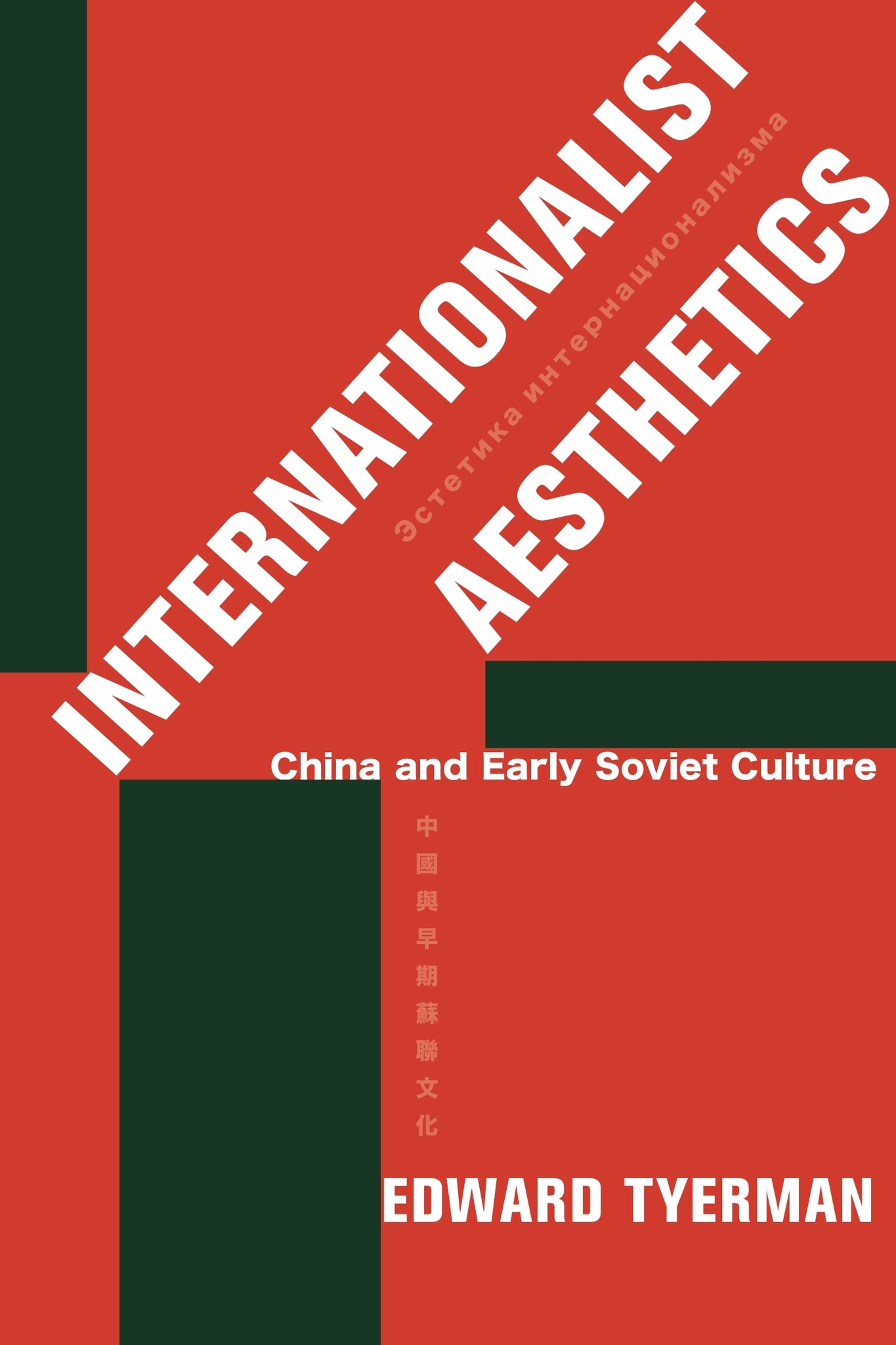
Winner, 2022 AATSEEL Best Book in Literary Studies, American Association of Teachers of Slavic and European Languages
Honorable Mention, 2022 Aldo and Jeanne Scaglione Prize for Comparative Literary Studies, Modern Language Association
Following the failure of communist revolutions in Europe, in the 1920s the Soviet Union turned its attention to fostering anticolonial uprisings in Asia. China, divided politically between rival military factions and dominated economically by imperial powers, emerged as the Comintern’s prime target. At the same time, a host of prominent figures in Soviet literature, film, and theater traveled to China, met with Chinese students in Moscow, and placed contemporary China on the new Soviet stage. They sought to reimagine the relationship with China in the terms of socialist internationalism—and, in the process, determine how internationalism was supposed to look and feel in practice.
Internationalist Aesthetics offers a groundbreaking account of the crucial role that China played in the early Soviet cultural imagination. Edward Tyerman tracks how China became the key site for Soviet debates over how the political project of socialist internationalism should be mediated, represented, and produced. The central figure in this story, the avant-garde writer Sergei Tret’iakov, journeyed to Beijing in the 1920s and experimented with innovative documentary forms in an attempt to foster a new sense of connection between Chinese and Soviet citizens. Reading across genres and media from reportage and biography to ballet and documentary film, Tyerman shows how Soviet culture sought an aesthetics that could foster a sense of internationalist community. He reveals both the aspirations and the limitations of this project, illuminating a crucial chapter in Sino-Russian relations. Grounded in extensive sources in Russian and Chinese, this cultural history bridges Slavic and East Asian studies and offers new insight into the transnational dynamics that shaped socialist aesthetics and politics in both countries.


— Roy Chan, author of The Edge of Knowing: Dreams, History, and Realism in Modern Chinese Literature
Edward Tyerman has produced the most sophisticated and rigorous study to date of Soviet-Chinese cultural interactions in the 1920s and beyond. Internationalist Aesthetics is a feat of both scholarship and conceptualization and is a must-read for all those seriously interested in leftist internationalism or transnational cultural encounters.
— Katerina Clark, author of Eurasia Without Borders: The Dream of a Leftist Literary Commons, 1919–1943
A tour de force of scholarship that examines the possibilities and contradictions of the radical early Soviet project of transforming subjectivity from a completely new perspective: the Soviet engagement with China. Relying on his broad and deep knowledge of two different cultural contexts, Tyerman reveals the Soviet aspiration to create an “internationalist, anti-imperialist community” through the transformation of sensory experience across cultures.
— Elizabeth Papazian, author of Manufacturing Truth: The Documentary Moment in Early Soviet Culture
This scintillating study explores the efforts of Soviet cultural producers in the 1920s to construct ‘China’ as a site for imagining a socialist 'international aesthetics.' With insight and sympathy, Tyerman conveys the idealism involved in this project while showing that it was undercut by assumptions about the universality of the Soviet experience.
— S.A. Smith, author of Revolution and the People in Russia and China: A Comparative History
This is a pathbreaking work. With great nuance and superbly insightful close readings, Internationalist Aesthetics shows the rise of this aesthetic, as well as its decline, and ponders its legacies for both Soviet culture and global cultural production.
— Nicolai Volland, author of Socialist Cosmopolitanism: The Chinese Literary Universe, 1945-1965
Tyerman carve[s] out huge new areas of inquiry . . . The scholarship is fine-grained.
— Caryl Emerson
Ambitious, complex, and skilfully executed, Tyerman’s study is a true journey of discovery.
— Iva Glisic
A phenomenal intellectual achievement . . . Internationalist Aesthetics is a staggeringly erudite, formidably argued and fundamentally important book.
— Julian Graffy
A timely interdisciplinary study . . . abounds in rich factual and theoretical interpretations.
— Victor Zatsepine
Ground-breaking, erudite and sophisticated . . . an impressive example of scholarship that cuts across, and brings into conversation, multiple fields, disciplines, and intellectual and aesthetic debates to shed light on the significance and use of China in the formation of early Soviet revolutionary culture of the 1920s.
— Susanna Lim
This masterfully curated tour of the many Chinas documented, imagined, and crafted by some of the most creative minds in the Soviet cultural milieu of the 1920s is a definitive treatment of a topic that so far has evaded systematic elucidation.
— Elizabeth McGuire
Internationalist Aestheticsis a well-crafted and insightful study that will inspire future scholarship.
— Emily Wilcox
Original and highly revealing . . . [this book] represents a welcome addition to the study of Chinese-Russian cultural relations.
— Qiang Zhai
Ambitious, sophisticated, and wide-ranging.
This is a very close textual analysis of important sources, some of which are not easily accessible, and
thus this study will be useful for those interested in these sources.
[A] remarkable book, the first of its kind in English . . . Tyerman’s splendidly detailed and yet very readable study deserves the attention of Sinologists as well as Slavists. It should find a place in many libraries.
— Arnold McMillin
Acknowledgments
Introduction: China and Early Soviet Culture
1. Sight, Sound, and Similarity: Soviet Writers Travel to China
2. Translating China Onstage: Roar, China! and The Red Poppy
3. Through an Internationalist Lens: China in Early Soviet Cinema
4. Confessions and Collaborations: Authority, Agency and Factographic Internationalism in Den Shi-khua
Epilogue: International Literature, National Form, and Missed Connections
Notes
Bibliography and Sources
Index