


Some error occured while loading the Quick View. Please close the Quick View and try reloading the page.
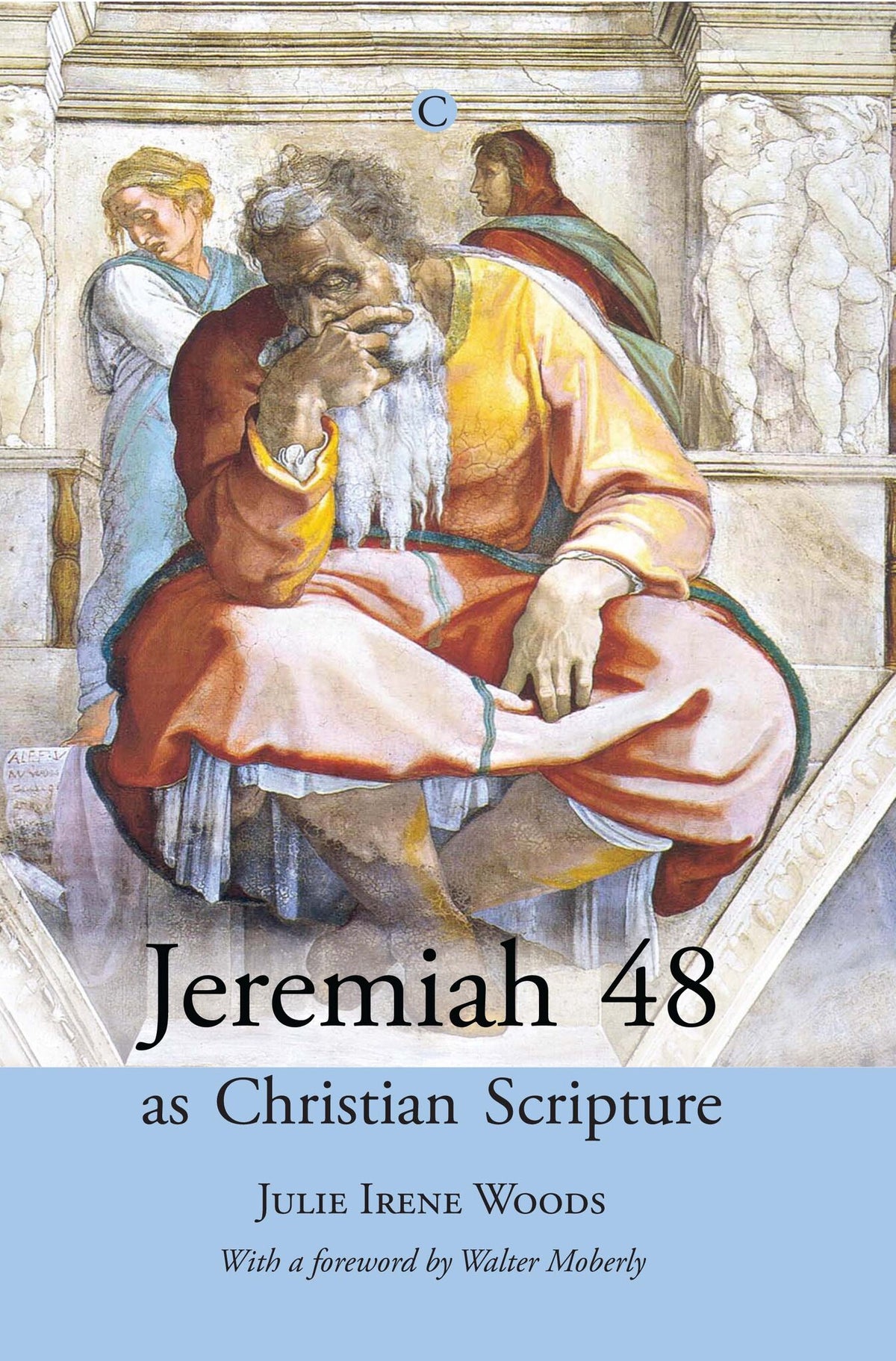
An insightful contribution to Old Testament studies, showing how the bloodthirsty oracle of Jeremiah 48 contains a positive Christian reading.
“All Scripture is God-breathed” – and yet some parts seem rather less God-breathed than one might imagine, or even like. The prophecy concerning Moab in Jeremiah 48 is one such text, since it appears to equate the Lord’s work with bloodshed and curses those who withhold their swords. How, if at all, might such a passage inform the Christian community of faith?
In this sophisticated study Julie Woods identifies some salient features of Jeremiah’s Moab oracle by means of a careful analysis and comparison of both the Septuagint and the Masoretic Text of Jeremiah 48. She also explores the implications of links between the Moab oracles in Jeremiah 48 and
Isaiah 15-16.
The focus then moves to theological hermeneutics via an examination of some recent Christian interpretations of the oracle (from Walter Brueggemann, Ronald Clements, Terence Fretheim, Douglas Jones, and Patrick Miller). Building on the observations of these scholars and the conclusions reached from her own textual analyses, Woods provides an innovative Christian reading of the oracle (including two imaginative film scripts to bring the text to life). Perhaps one of the more surprising proposals is that Easter is the ultimate horizon of Jeremiah 48.
“All Scripture is God-breathed” – and yet some parts seem rather less God-breathed than one might imagine, or even like. The prophecy concerning Moab in Jeremiah 48 is one such text, since it appears to equate the Lord’s work with bloodshed and curses those who withhold their swords. How, if at all, might such a passage inform the Christian community of faith?
In this sophisticated study Julie Woods identifies some salient features of Jeremiah’s Moab oracle by means of a careful analysis and comparison of both the Septuagint and the Masoretic Text of Jeremiah 48. She also explores the implications of links between the Moab oracles in Jeremiah 48 and
Isaiah 15-16.
The focus then moves to theological hermeneutics via an examination of some recent Christian interpretations of the oracle (from Walter Brueggemann, Ronald Clements, Terence Fretheim, Douglas Jones, and Patrick Miller). Building on the observations of these scholars and the conclusions reached from her own textual analyses, Woods provides an innovative Christian reading of the oracle (including two imaginative film scripts to bring the text to life). Perhaps one of the more surprising proposals is that Easter is the ultimate horizon of Jeremiah 48.

Price: $39.95
Pages: 370
Publisher: Boydell & Brewer Inc.
Imprint: James Clarke
Publication Date:
28 July 2011
Trim Size: 9.02 X 5.98 in
ISBN: 9780227173787
Format: Paperback
BISACs:
HISTORY / Wars & Conflicts / World War II / General

This monograph, the author's doctoral thesis from the University of Durham, proposes, as its title suggests, a way of reading Jer 48 within a Christian context and relating to it from a Christian perspective. ... Woods provides several comparative charts where she lists the MT, NRSV English translation, Ziegler's critical edition of the LXX, and NETS English translation. She highlights the importance of the location within each version of the oracle against Moab for the overall interpretation of the material, as well as the significance of the verses 40-41, attested only in MT. ... Woods proposes seeing Moab's fate as a metaphor of an individual Christian's walk with God as well as of the life of the church. We as Christians can or even should identify with sinful Moab and recognize that our sole hope is in God's grace and in his redemption, brought about on the cross. Moreover, we should side with God in his weeping over sinful nations and show compassion when misfortune befalls another party. Woods should be commended for providing a way forward foe Christian readers of Jer 48.
— Lena-Sofia Tiemeyer, School of Divinity, University of Aberdeen, in:Expository Times Vol. 123 (11), August 2012
For centuries Christian communities have wrestled with the question of applicability of the Bible to the life of faith. Can all of the Bible be read as Christian Scripture? With stout hearted determination and exegetical finesse Woods sets out to demonstrate that even such hard texts as the oracle concerning Moab found in Jeremiah 48 can and should be taken with interpretive seriousness. She marshals all of the tools of critical scholarship to furnish the reader with a first-rate piece of scholarly work that is simultaneously academically rigorous and spiritually enriching. [...] Here is an example of an erudite scholar working out the implications of critical scholarship in a way that would enable Christian communities worldwide to read their sacred Scriptures with more precision and rigorous imagination.
— Bacho V. Bordjadze
An adroit aspect of this study is its comparing on one hand each commentator's approach to the passage, the insights he finds in it, and the emphases he draws from it, with on the other hand the characteristics that appear elsewhere in his work on the Old Testament.
— John Goldingay
Julie Woods explores Jeremiah 48 as Christian Scripture. She emphasises the undercurrent of lament, looks at the difference between the Masoretic and Septuagint texts (more than is often the case in the OT), compares this oracle against Moab with a similar one in Isaiah, analyses recent theological interpretations of this chapter, and suggests ways to engage with it.
— Lena-Sofia Tiemeyer, School of Divinity, University of Aberdeen, in:Expository Times Vol. 123 (11), August 2012
For centuries Christian communities have wrestled with the question of applicability of the Bible to the life of faith. Can all of the Bible be read as Christian Scripture? With stout hearted determination and exegetical finesse Woods sets out to demonstrate that even such hard texts as the oracle concerning Moab found in Jeremiah 48 can and should be taken with interpretive seriousness. She marshals all of the tools of critical scholarship to furnish the reader with a first-rate piece of scholarly work that is simultaneously academically rigorous and spiritually enriching. [...] Here is an example of an erudite scholar working out the implications of critical scholarship in a way that would enable Christian communities worldwide to read their sacred Scriptures with more precision and rigorous imagination.
— Bacho V. Bordjadze
An adroit aspect of this study is its comparing on one hand each commentator's approach to the passage, the insights he finds in it, and the emphases he draws from it, with on the other hand the characteristics that appear elsewhere in his work on the Old Testament.
— John Goldingay
Julie Woods explores Jeremiah 48 as Christian Scripture. She emphasises the undercurrent of lament, looks at the difference between the Masoretic and Septuagint texts (more than is often the case in the OT), compares this oracle against Moab with a similar one in Isaiah, analyses recent theological interpretations of this chapter, and suggests ways to engage with it.
List of Tables
Foreword by Walter Moberly
Acknowledgments
Abbreviations
Introduction
1. An Overview of the Field of Jeremiah’s Oracles Against the Nations
2. A Comparison of Jeremiah’s Oracle Concerning Moab in MT (ch. 48) and LXX (ch. 31)
3. Jeremiah 48 in the Light of Isaiah 15-16
4. An Analysis of Fretheim’s, Miller’s, and Brueggemann’s Readings of Jeremiah 48
5. An Analysis of Jones’ and Clements’s Readings of Jeremiah 48
6. The Curious Curse in Jeremiah 48:10
7. A Christian Reading of Jeremiah 48
Coda 1: Literary Storyboard of the Film of Jeremiah 48 (6th century context)
Coda 2: Literary Storyboard of the Film of Jeremiah 48 (with a Christian Frame of Reference)
Conclusion
Bibliography
Scripture Index
General Index
Foreword by Walter Moberly
Acknowledgments
Abbreviations
Introduction
1. An Overview of the Field of Jeremiah’s Oracles Against the Nations
2. A Comparison of Jeremiah’s Oracle Concerning Moab in MT (ch. 48) and LXX (ch. 31)
3. Jeremiah 48 in the Light of Isaiah 15-16
4. An Analysis of Fretheim’s, Miller’s, and Brueggemann’s Readings of Jeremiah 48
5. An Analysis of Jones’ and Clements’s Readings of Jeremiah 48
6. The Curious Curse in Jeremiah 48:10
7. A Christian Reading of Jeremiah 48
Coda 1: Literary Storyboard of the Film of Jeremiah 48 (6th century context)
Coda 2: Literary Storyboard of the Film of Jeremiah 48 (with a Christian Frame of Reference)
Conclusion
Bibliography
Scripture Index
General Index