


Some error occured while loading the Quick View. Please close the Quick View and try reloading the page.
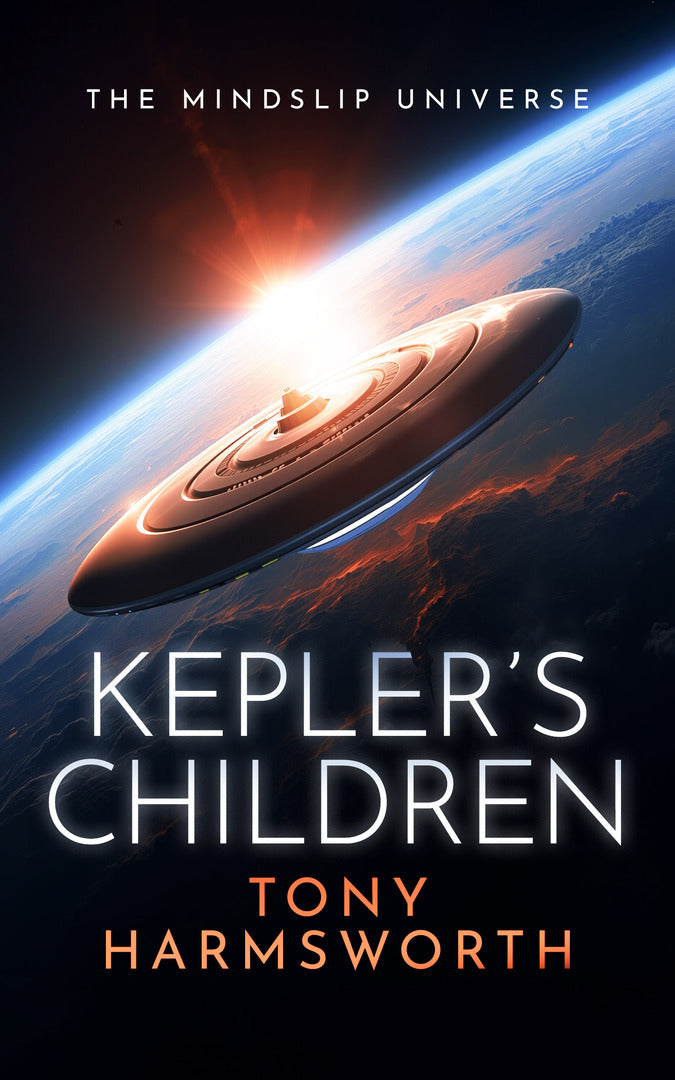
When humanity’s last generation ship reaches a habitable new world, what happens if it's already occupied? A tense, high-stakes hard science fiction thriller of survival and fragile first contact, where empathy may be the only thing that keeps them human.
Eighty years in deep space. One chance at a new home.
Humanity’s last remnants cross the stars aboard the generational ship Kepler, fleeing a dying Earth. Selected from millions for their brilliance, siblings Geoffrey and Caroline Arnold-Pointer join a crew of two thousand sent into the void, leaving everything behind for a future they may never live to see.
But the journey is a pressure cooker. Micrometeor strikes, disease, fires, and unrest turn survival into ruthless maths, where every decision saves some and costs others. Keeping the ship intact is hard enough. Keeping a society intact may be impossible.
When Kepler finally reaches a lush world the crew names Hacienda, hope fractures again. The planet is already home to an intelligent alien species, and first contact becomes a fragile test of empathy, fear, and restraint. With a rogue human faction pushing for conquest, one misstep could end humanity’s only chance at a future.
Kepler’s Children, book three of the Mindslip Universe, blends big ideas with intimate stakes as a new generation fights to keep hope alive without becoming the thing they fled.
___________________________________
Praise for the Mindslip Universe:
★★★★★ "Ground-breaking brilliance"
★★★★★ "This one will make you think!"
★★★★★ "Amazing. Clever. GENIUS!"
★★★★★ "Unique… captivating, emotionally engaging… it will stay with me for a long time."
★★★★★ "It is a real page turner and would make an excellent movie or mini-series."
★★★★★ "Mind-bending plot"
★★★★★ "Most intriguing and different sci-fi book I've ever read."
★★★★★ “A brilliant, original concept, flawlessly executed.”
★★★★★ “Kept me thinking long after I finished.”
★★★★★ “Utterly original and compelling—read it straight through.”
★★★★★ “A unique idea handled with intelligence and heart.”
★★★★★ “I finished and immediately wanted to talk about it.”


Biography: Tony is now retired from his career in tourism, but is still considered to be one of the foremost authorities on the mystery at Loch Ness. He conceived designed, created and co-founded the Official Loch Ness Monster Exhibition Centre; was administrative coordinator of Operation Deepscan during 1986/7; created the Macbeth Experience multi-media exhibition in Perthshire, became Bursar of Fort Augustus Abbey on Loch Ness where he designed and wrote the highly acclaimed Fort Augustus Abbey Heritage Centre and also the Loch Ness Story Diorama; invented the award-winning board game, Nessie Hunt; scripted the Polygram video Loch Ness Monster Story; wrote Mysterious Monsters of Loch Ness, and Loch Ness The Monster, the latter being reprinted on eight occasions. His Loch Ness, Nessie and Me book, containing over 300 pages and more than 200 photographs and illustrations, is considered essential reading for anyone interested in the truth about Loch Ness. It has also been described as the most comprehensive book ever written on the subject.
The last paragraph should give you confidence that Tony can tell a good story!
Although born and brought up in England, he is descended from King Robert the Bruce. His mixed heritage has resulted in him being a rather strange combination of Tottenham Hotspur and Scotland supporter. Neither team seem to ever win anything! Although, perhaps, this year? As this last sentence demonstrates, he is also a great optimist!
Tony has a background in sales and industry holding down management posts with Loyds, Top Rank, Granada, Wella and Lenthéric Morny (BAC). These posts were in Manchester and the south of England. He moved to Drumnadrochit in 1978 to follow up several years' interest in Loch Ness. In 1980 it was his idea to set up the Loch Ness Exhibition and he went on to have a very successful career designing visitor centres, exhibitions and multi-media presentations.
He now writes science fiction full time and if the reviews are to be believed, he is very good at it. His style is similar to that of John Wyndham and Arthur C Clarke, but some reviewers say his work is similar to Asimov, Heinlein and Bradbury too.