


Some error occured while loading the Quick View. Please close the Quick View and try reloading the page.
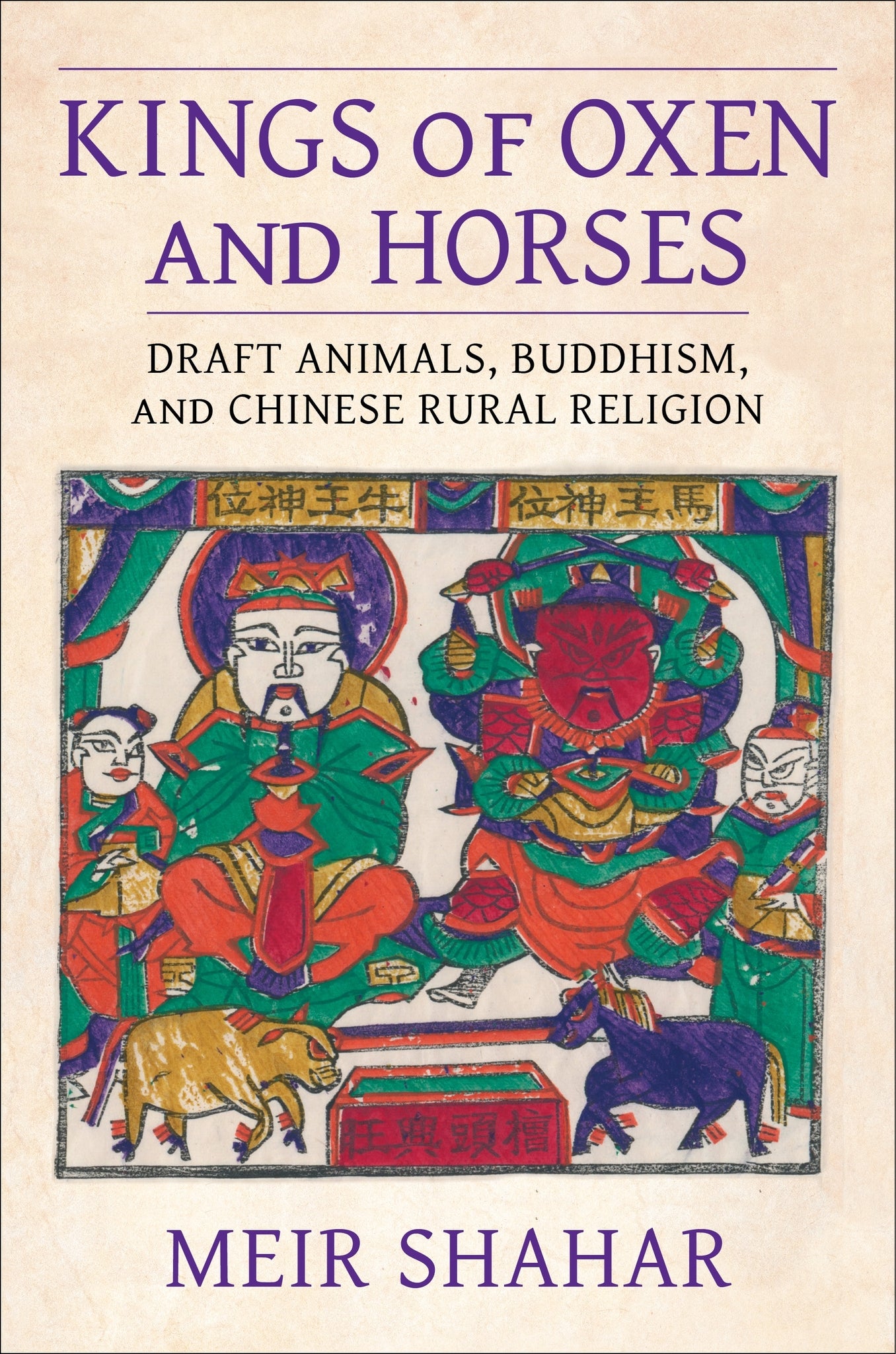
For centuries in China, people beseeched deities to protect the draft animals on which they relied. Across social classes—from peasants plowing the fields to merchants transporting goods through soldiers riding into battle—animals were essential to daily life and so took on a central place in the religious imagination. Prayers and rituals for animal well-being were most frequently addressed to the Horse King, divine protector of horses, donkeys, and mules, or the Ox King, who watched over oxen and buffaloes.
Kings of Oxen and Horses is a history of these two gods: their myths, their rituals, and their worshipers. It examines the place of draft animals in Chinese and Buddhist religious traditions and, in so doing, sheds new light on human interaction with nonhuman animals more broadly. Meir Shahar traces the history of the Horse and Ox Kings from late imperial China back to ancient India, revealing the long-term Buddhist influence on Chinese rural religion. He explores the myth of the draft animal as incarnate god, showing how Buddhism transmitted a belief in the sanctity of cattle and a taboo on beef from India to China. Shahar considers the ties between humans and their animal companions through the prism of religious practice, and he draws illuminating comparisons to other world religions. Bridging the gap between animal studies and religious studies, this book is a major contribution to both.


— Journal of the American Academy of Religion
Kings of Oxen and Horses ultimately reveals the long-lasting and nuanced impact of Indian Buddhism on Chinese religious practices, an impact that affected not only how people understood themselves but also how they understood their animals.
— H-Buddhism
[Shahar] excels at widening how we look at ‘Chinese’ animals.
— T’oung Pao
...a fascinating forage through an extremely broad range of primary sources and secondary research… . [Kings of Oxen and Horses]is extremely well-written and full of insight and information. …there is much to enjoy in and learn from this book.
— Journal of Chinese History
Shahar is a brilliant and versatile scholar…Kings of Oxen and Horses is written with gusto and clarity, reads extremely well, and makes accessible many new sources and provocative ideas to specialists and nonspecialists alike.
— Journal of the American Society for Premodern Asia
In this remarkable book, Meir Shahar takes readers on a guided tour of China’s haunted and holy territories, from urban cities to the countryside and from the distant past to the present day. Kings of Oxen and Horses is a lively and essential exploration of human-animal relationships in the Buddhist, Daoist, and rural religious traditions of China.
— Benjamin Brose, author of Embodying Xuanzang: The Postmortem Travels of a Buddhist Pilgrim
Using a wide spectrum of sources and keen storytelling, Shahar deftly reveals a forgotten and neglected world: the thriving cults of the Horse King in northern China and the Ox King in southern China. Shahar’s extensive research transports the reader out of the armchair and into the field, giving a vivid sense of the scope and practice of rural religion, the overwhelming importance of domestic animals in everyday life, and the extensive influence that Buddhism had on Chinese religion.
— Keith N. Knapp, coeditor of The Cambridge History of China: Volume 2, The Six Dynasties, 220-589
Shahar’s richly illustrated book is a gem in a growing body of studies on the nonhuman animal in Chinese history and religious culture. Tracing the pedigree of tutelary horse- and ox-protecting deities to India and medieval Tantric Buddhism, Shahar’s analysis, supported by fascinating fieldwork findings, underscores the need to study "Chinese" animals beyond ethnic, geographical, and political borders.
— Roel Sterckx, author of The Animal and the Daemon in Early China
Acknowledgments
Introduction
1. Iconographic Prelude
Part I: The Horse King
2. The Horse King’s Ancestry
3. The Horse King’s Cult
4. Legends of an Equine God
Part II: The Ox King
5. The Ox King and the Beef Taboo
6. The Human Ox
7. The Divine Ox
8. The Chinese Ox and the Indian Cow
9. The Ox King Festival
10. A Daoist Relation
Epilogue
Appendix A: Bovine-Healing Scriptures Addressed to the Ox King
Appendix B: Bovine-Healing Scriptures Not Addressed to the Ox King
Appendix C: Equine-Healing Scriptures Addressed to the Horse King
Abbreviations
Notes
Works Cited
Index