


Some error occured while loading the Quick View. Please close the Quick View and try reloading the page.
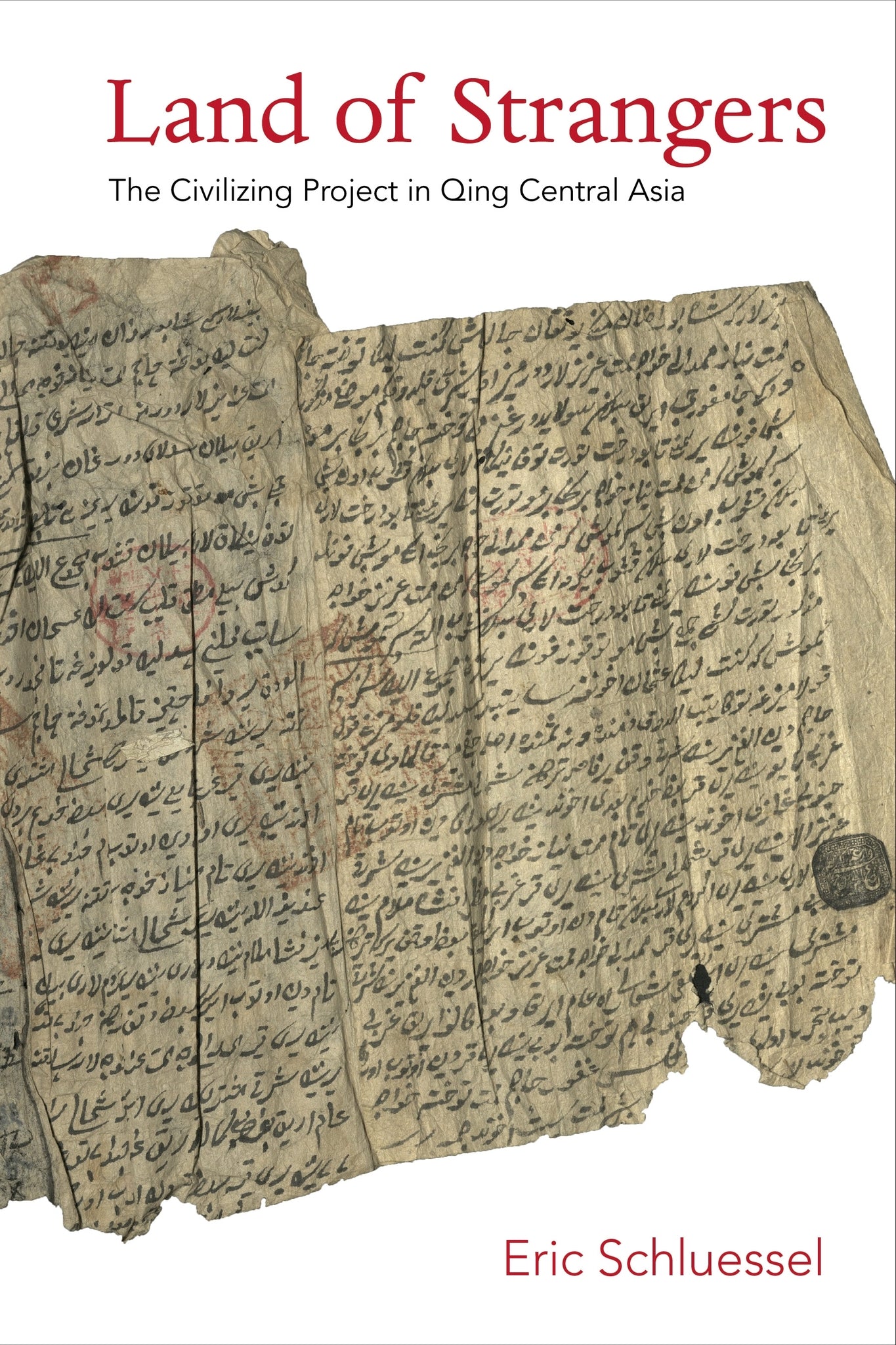
At the close of the nineteenth century, near the end of the Qing empire, Confucian revivalists from central China gained control of the Muslim-majority region of Xinjiang, or East Turkestan. There they undertook a program to transform Turkic-speaking Muslims into Chinese-speaking Confucians, seeking to bind this population and their homeland to the Chinese cultural and political realm. Instead of assimilation, divisions between communities only deepened, resulting in a profound estrangement that continues to this day.
In Land of Strangers, Eric Schluessel explores this encounter between Chinese power and a Muslim society through the struggles of ordinary people in the oasis of Turpan. He follows the stories of families divided by war, women desperate to survive, children unsure where they belong, and many others to reveal the human consequences of a bloody conflict and the more insidious violence of reconstruction. Schluessel traces the emergence of new struggles around essential questions of identity, showing how religious and linguistic differences converged into ethnic labels. Reading across local archives and manuscript accounts in the Chinese and Chaghatay languages, he recasts the attempted transformation of Xinjiang as a distinctly Chinese form of colonialism. At a time when understanding the roots of the modern relationship between Uyghurs and China has taken on new urgency, Land of Strangers illuminates a crucial moment of social and cultural change in this dark period of Xinjiang’s past.


— Tobie Meyer-Fong, author of What Remains: Coming to Terms with Civil War in Nineteenth-Century China
Eric Schluessel combines prodigious linguistic skills with exhaustive archival research and conceptual sophistication to bring the Turpan oasis to life in all its human complexity. Land of Strangers is a fine-grained account of history from below, unlike anything we have on any part of Central Asia. A stellar achievement.
— Adeeb Khalid, author of Making Uzbekistan: Nation, Empire, and Revolution in the Early USSR
Through this theoretically rich exploration of Qing philosophy and practice of colonial rule, we see how violence and forced intimacy shape enduring group identities in Xinjiang. Using his multilingual skills to draw on diaries, memorials, and documents from court cases, Schluessel uncovers the interactions of everyday life among colonizing Chinese, intermediaries, and colonized Uyghurs in late Qing Xinjiang.
— Marianne Kamp, author of The New Woman in Uzbekistan: Islam, Modernity, and Unveiling Under Communism
In this fine monograph, Eric Schluessel describes the local articulation and hardening of boundaries between people in late Qing Xinjiang. Using Turkic, Manchu, and Chinese sources on Turpan, he introduces (among others) local elites, Hunanese Confucian statecraft ideologues, mediatory tongchi interpreters, and Chinese-speaking Muslim brokers. His narratives describe culture clashes, identity negotiation, gender ideologies, colonial discipline, and naming practices, persuasively and subtly connected to today’s troubled conditions.
— Jonathan N. Lipman, author of Familiar Strangers: A History of Muslims in Northwest China
A valuable contribution to our understanding of the actions of the modern Chinese state to pacify Xinjiang through this same combination of force and cultural transformation first attempted by the Xiang Army one hundred and fifty years ago.
He uncovers many fascinating stories about the people who mediated the relationship between rulers and ruled, concluding with a nuanced discussion of comparative colonialism...Highly recommended.
Writing a 'history from below' of any society in any historical period is no easy task, but Land of Strangers has offered an outstanding example of such history and has provided illuminating insights into this method of exploring modern China and
Eurasia.
— Yuanchong Wang, University of Delaware
Acknowledgments
A Note on Conventions
Introduction
1. The Chinese Law: The Origins of the Civilizing Project
2. Xinjiang as Exception: The Transformation of the Civilizing Project
3. Frontier Mediation: The Rise of the Interpreters
4. Bad Women and Lost Children: The Sexual Economy of Confucian Colonialism
5. Recollecting Bones: The Muslim Uprisings as Historical Trauma
6. Historical Estrangement and the End of Empire
Conclusion
Notes
Bibliography
Index