


Some error occured while loading the Quick View. Please close the Quick View and try reloading the page.
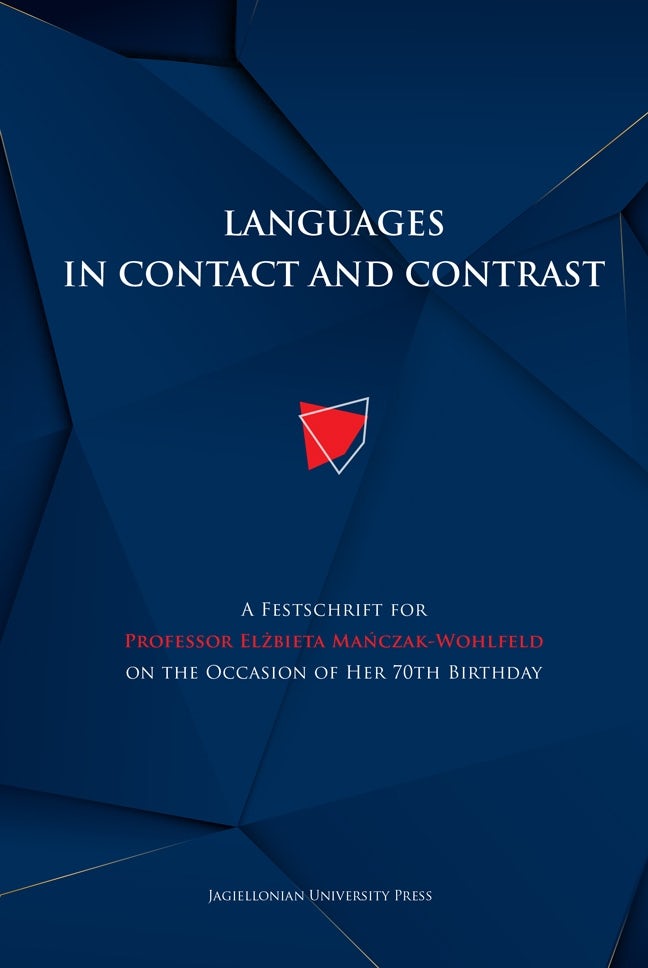
The Festschrift is a collection of papers written in honour of Professor Elżbieta Mańczak-Wohlfeld to mark the occasion of her 70th birthday.
Professor Elżbieta Mańczak-Wohlfeld is one of the leading authorities in the field of language contact, and has pursued research on the influence of English on Polish and other European languages, Polish-English contrastive studies, as well as various aspects of English grammar. She has authored more than 160 publications, including four books, as well as course books and academic papers. She has also edited and co-edited dictionaries of English borrowings in Polish.
The Festschrift volume comprises papers from the world of linguistics which have been authored by eminent scholars from Poland and abroad. The chapters included in the volume focus on various issues, including those from the area of contact linguistics. The topics covered in the research papers comprise, for instance, the influence of English on different languages, such as Polish, Danish, Afrikaans, Swedish, Spanish, German and Japanese, as well as on Asian languages and cultures. The authors investigate Celtic borrowings in Polish, anglicisms in Serbian, or Yiddish borrowings in contemporary American English. The contributions also discuss the phenomenon of Ponglish, i.e., the communication code used by Poles living in the UK, the presence of foreign languages in the linguistic landscape of Kraków, as well as the problem of multilingualism in Europe, the relation between language, culture and identity, and the influence of globalisation on both Polish language and culture. Finally, selected chapters address a range of phenomena related to Karaim, Russenorsk, and Turkish.


Anna Tereszkiewicz, PhD, is Assistant Professor in the Institute of English Studies at the Jagiellonian University in Krakow, Poland. Her main research interests involve broadly defined computer-mediated communication, the discourse of social media, news discourse and professional communication. Her recent studies concern online news genres, online citizen journalism as well as online corporate communication.
Magdalena Szczyrbak, PhD, is Assistant Professor at the Institute of English Studies, Jagiellonian University, Kraków, Poland. Her research interests are mainly in the areas of discourse analysis and corpus-assisted discourse studies applied to legal discourse and, in particular, to the study of stance-related and evaluative patterns in legal genres. Her most recent studies focus on the use of mental and communication verbs in courtroom examinations and judicial opinions, and their role in epistemic and evidential marking. She is currently researching stance-related interaction patterns in jury trials with a special emphasis on the strategies pursued in expert witness examinations. Professor Szczyrbak is a member of several professional associations (International Language and Law Association, American Pragmatics Association, Polish Linguistic Society) and she is a certified Polish-English translator and court interpreter.
PREFACE
PROFESSOR ELŻBIETA MAŃCZAK-WOHLFELD’S PUBLICATIONS
TABULA GRATULATORIA
Arleta Adamska-Sałaciak
BILINGUAL LEARNERS’ DICTIONARIES IN THE LEXICOGRAPHIC LANDSCAPE
Gisle Andersen
FEEL FREE TO … A COMPARATIVE STUDY OF PHRASEOLOGICAL BORROWING
Urlich Busse
WHAT’S IN A NAME? DOES THE PROLIFERATION OF PEJORATIVE TERMS SUCH AS DENGLIS(C)H AND SIMILAR ITEMS IN GERMAN ATTEST TO NEO-PURISTIC ATTITUDES TOWARDS ANGLICISMS?
Elżbieta Chrzanowska-Kluczewska
ENGLISH IN CONFRONTATION WITH LANGUAGES AND CULTURAL HERITAGE OF ASIAN COUNTRIES: PROMOTION OR THREAT?
Andrii Danylenko
SLAVIC DIRЪ IN THE ARAB-MUSLIM GEOGRAPHICAL LITERATURE
Marta Dąbrowska
LINGUISTIC LANDSCAPES: THE MULTILINGUAL CITYSCAPE OF KRAKÓW
José Andrés Alonso de la Fuente
ON RUSSENORSK -OM IN PARTICULAR AND ETYMOLOGY AND CREOLISTICS IN GENERAL
Michał Garcarz
PONGLISH IN THE BRITISH ISLES: A FEW SOCIOLINGUISTIC REMARKS ON THE ISSUE
Adam Głaz
LANGUAGE CONTACT AND IDENTITY: THREE POSSIBLE SCENARIOS
Henrik Gottlieb
EUROPEAN ECHOES OF ENGLISH, SOUTH AFRICAN STYLE?
Damian Herda
OPEN SPELLING OF NOMINAL COMPOUNDS IN CONTEMPORARY SWEDISH AND THE QUESTION OF ENGLISH INFLUENCE
Jaime Hunt
TO -S OR NOT TO -S? PLURAL MARKING ON ANGLICISMS IN SPOKEN GERMAN
Keisuke Imamura
CLASSIFICATION OF PSEUDO-ANGLICISMS IN JAPANESE
Maria Jodłowiec
UNDERDETERMINACY, INDETERMINACY AND SPEAKER’S INTENTIONS
Halina Kurek
GLOBALISATION AND LINGUISTIC AND CULTURAL CHANGES IN POLAND WITHIN THE LAST SEVENTY YEARS
Biljana Mišić Ilić
PLAYFUL PLEAS(E): FORMAL AND FUNCTIONAL ADAPTATIONS OF ENGLISH PLEASE IN SERBIAN
Michał Németh
GUSTAF PERINGER’S KARAIM BIBLICAL MATERIAL REVISITED. A LINGUISTIC COMMENTARY ON A TEXT SAMPLE FROM 1691
Andrzej Pawelec, Magdalena Sitarz
YIDDISH BORROWINGS IN AMERICAN ENGLISH: SLAVIC CONNECTIONS
Elizabeth Peterson
LINGUISTIC TRESPASSING: OBSERVATIONS ON MULTILINGUAL EUROPE
Barbara Podolak
WHY IS HE WHO TELLS THE TRUTH CHASED OUT OF NINE VILLAGES: THE NUMBER NINE IN TURKISH LANGUAGE AND CULTURE
Virginia Pulcini
ENGLISH CYBER- WORDS ACROSS EUROPEAN LANGUAGES
Maciej Rak
BELIEFS AND CUSTOMS IN THE PHRASEMATICS OF THE PODTATRZE (SUB-TATRA) REGION
Félix Rodriguez González, Jesús Castañón Rodríguez
GRAPHIC AND ORTHOTYPOGRAPHIC ASPECTS OF ANGLICISMS IN THE FIELD OF SPORTS
Marta Ruda
LANGUAGE CONTACT AND NULL SUBJECTS: THE PAST TENSE IN KASHUBIAN
Marek Stachowski
SLAVIC LANGUAGES IN CONTACT, 3: THE METHODOLOGICAL IMPORTANCE OF BALKAN SLAVIC FOR TURKISH HISTORICAL DIALECTOLOGY, OR CROATIAN AND SERBIAN neimar, BULGARIAN maimar(in) ‘CHIEF ARCHITECT’
Piotr Stalmaszczyk
INDIRECT LANGUAGE CONTACT AND THE CELTIC ELEMENTS IN POLISH
Magdalena Szczyrbak
(I’M) JUST SAYING AND (TAK) TYLKO MÓWIĘ: A PARALLEL CORPUS STUDY
Anna Tereszkiewicz
NEWS ON INSTAGRAM – THE USE OF THE SOCIAL MEDIUM BY THE GUARDIAN AND GAZETA WYBORCZA
Mateusz Urban, Kamil Stachowski
VOWEL ADAPTATION IN ENGLISH WORDS IN SLOVAK
Jadwiga Waniakowa
FOREIGN INFLUENCES IN POLISH DIALECTAL PLANT NAMES
Maciej Widawski
HIPSTERSKIE FASHIONISTKI KEŻUALOWO DRINKUJĄ NA KLABINGU W LĄDKU... ENGLISH BORROWINGS IN INFORMAL POLISH AND THEIR LEXICAL FIELDS
Ewa Willim
ON MAXIMALITY MODIFICATION IN THE PSYCH DOMAIN: EVIDENCE FROM POLISH
Alicja Witalisz
FORMAL VARIANCE IN POLISH ADJECTIVAL ANGLICISMS
LIST OF CONTRIBUTORS