


Some error occured while loading the Quick View. Please close the Quick View and try reloading the page.
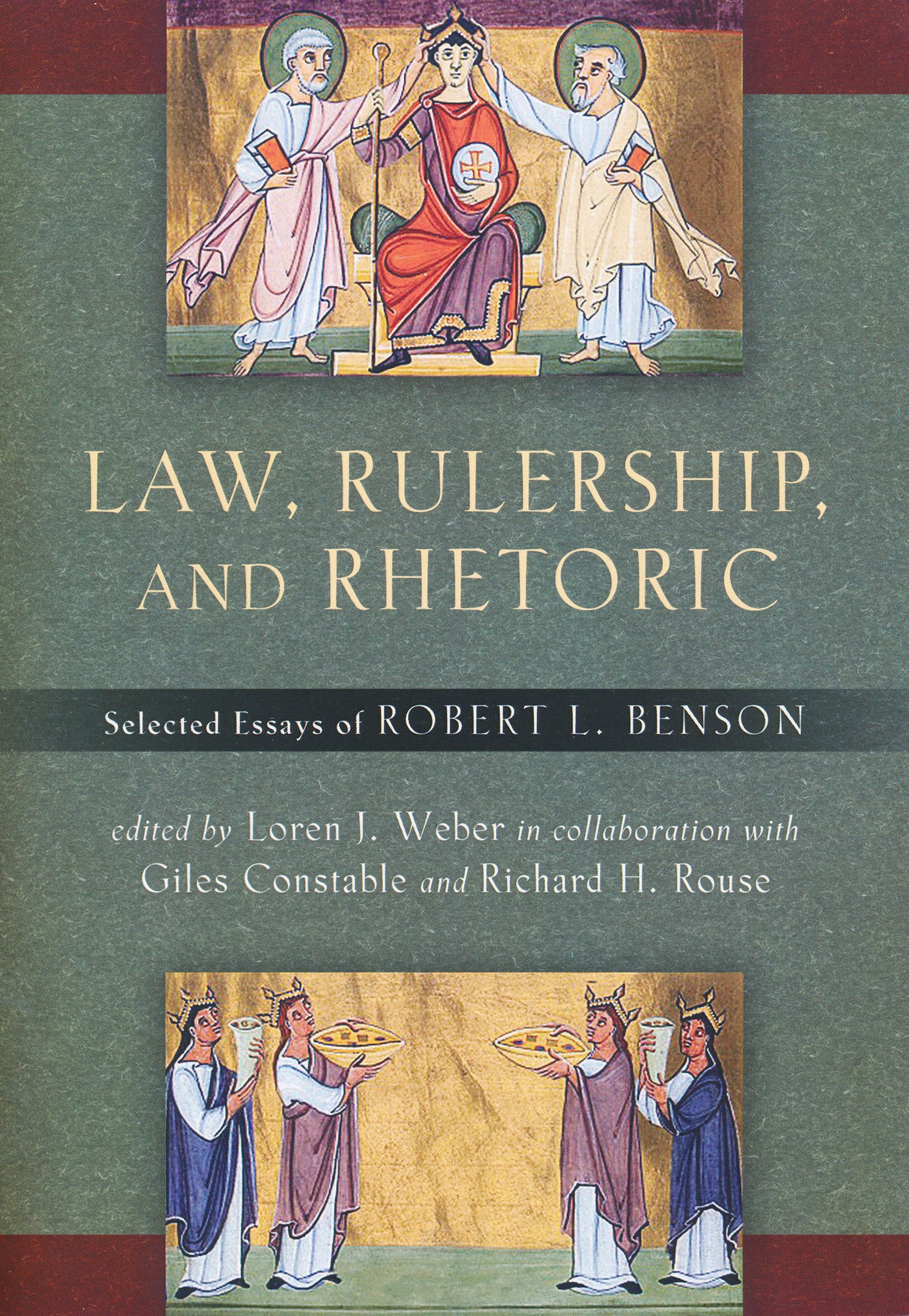
Robert L. Benson (1925–1996), professor of history at the University of California, Los Angeles, was one of the most learned and original medievalists of his generation. At his untimely death he left behind a considerable body of unpublished writings, many of which he had revised and refined and in some cases presented in lectures and at conferences over many years. The best and most significant of these previously unpublished writings are collected in this volume.
The essays in Law, Rulership, and Rhetoric span Benson’s entire career from 1955 to 1994. They comprise a rich collection covering a vast range of topics in political, intellectual, legal, and ecclesiastical history, rhetoric, and historiography. Art historians will find the three essays on medieval images of rulership and medieval art valuable, and literary scholars will be interested in the essays on, among others, Boncompagno da Signa. The volume concludes with several occasional, historiographical essays, including a spirited defense of Ernst Kantorowicz against Norman Cantor and an entertaining talk on “the medievalist as literary hero.” The volume begins with a brief biographical sketch and appreciation of Benson by Horst Fuhrmann.


“It is a testament to the strength of Robert L Benson’s scholarly personality and to his intellect that the contours of both are so clearly and consistently visible in this eclectic collection. This collection represents an effort not only to memorialize Benson but also to present his thoughts on a subject he had mastered more thoroughly than his published record would indicate.” —H-net Reviews
“If Benson’s relatively slim published output has long stood as an unrepresentative indication of his place among twentieth-century medieval historians, the dedicated work of Weber, Constable, and Rouse has helped to secure, and to enhance, Benson’s important legacy as both an heir to Kantorowicz and a path-breaker in his own right.” —Comitatus
“. . . the volume has plenty to offer political and legal historians and those interested in broader questions about medieval political culture and the semiotics of power. Finally, Benson’s witty, erudite, and sometimes poignant reflections on being a medieval historian in the modern world make this book an engaging read for any medievalist.” —Parergon
"Law, Rulership, and Rhetoric: Selected Essays of Robert L. Benson makes an original contribution by bringing forward Benson's unpublished essays, thus revealing in important new ways Benson's significance for medieval history. Scholars in several fields—art history, Church history, political history, and legal history—should find these essays of interest. This treasury of studies is full of valuable insights roaming across Benson’s scholarly interests." —Robert Somerville, Columbia University
"The varied lectures, draft studies, and informal talks in this volume were written between 1955 and 1994, yet they are full of newfound treasures. Robert L. Benson was a leader in the transformative new age of medieval studies in North America that began with the diasporas of World War II. After his death, the editors carefully sifted through his files to see whether there were unpublished studies of value. They found the astonishing wealth gathered and expertly redacted here into five areas related to medieval political power and its modern analysis. Apart from Benson’s conclusions, his methods of working across disciplines—notably, art and iconography, rhetoric and philology, Roman and canon law, and scriptural exegesis—remain fresh and instructive. And a self-portrait of the man himself is there through insights both into his high sense of the historian’s vocation, and into the passions that, haunting and imperative, still inflame his work." —Karl F. Morrison, Lessing Professor of History and Poetics (Emeritus), Rutgers University
"Canon law, emperors, popes, and a medieval showman or trickster who taught the ars dictandi at Bologna are examined in these collected studies. These scholarly masterpieces may be counted among the best for the relevant subjects. Few medievalists today could produce such amusing, erudite, and elegant essays as Robert Benson." —Johannes Fried, Professor of Medieval History (Emeritus), Goethe-Universität, Frankfurt
Richard H. Rouse is professor emeritus of history at the University of California, Los Angeles.
Giles Constable is professor emeritus of medieval history at the Institute for Advanced Study, Princeton.
Loren J. Weber is a partner with O'Melveny & Myers LLP. He was previously lecturer of history at the University of California, Los Angeles.
Foreword: In Memory of Robert L. Benson (1925–1996) Horst Fuhrmann
Editor’s Preface
List of Abbreviations
Part 1. Thought and Culture
1. Urbs et orbis: An Ancient Roman Topos in Medieval Political Language
2. Bishop, Metropolitan, and Primate: A Study on the Conceptions of Office and Hierarchy in the Eleventh and Twelfth Centuries
3. Self-Knowledge and Consciousness of Self: Aspects of Spirituality in the Meditations of Guigo I of the Charterhouse
4. The Strange Affair of the Abbess Margaret, or What a Medieval Historian Does
5. Miserrimi miserorum: Boncompagno on the Evils of Old Age
Appendix: Boncompagno, De malo senectutis et senii
Part 2. Art and Rulership
6. The Politics of Symmetry: Sacerdotium and Regnum in the Mirror of Medieval Art (800–1200)
7. Images of David in Psalters and Bibles: Medieval Interpretations of Biblical Kingship as Mirrored in Art
8. Images of Rulership on a Romanesque Chalice from Trzemeszno
Part 3. Medieval Rulership
9. In Praise of the Franks: Rhetorical Influences on the Early Germanic Monarchies
10. A Critique of Fritz Kern’s Gottesgnadentum und Widerstandsrecht im Früheren Mittelalter
11. The King as Novus David: Political Uses of the Old Testament in the Early Middle Ages
12. Imperator oeconomus Ecclesiae: Notes on a Decretistic Theory of the Imperial Office
Part 4. Frederick Barbarossa
13. The Treaty of Constance: Prelude and Epilogue
14. The Clash at Besançon (October 1157)
15. Frederick Barbarossa as “Lord of the World”
Part 5. Medieval History in Modern Perspective
16. Norman Cantor and “The Nazi Twins”: On Inventing the Middle Ages
17. Comment on a Paper by Thomas F. Mathews, “How Art History Mistook Christ for the Emperor”
18. The “Mythic” in Studies of Frederick II Hohenstaufen
19. The Medievalist as Hero
Index of Manuscripts Cited
General Index