


Some error occured while loading the Quick View. Please close the Quick View and try reloading the page.
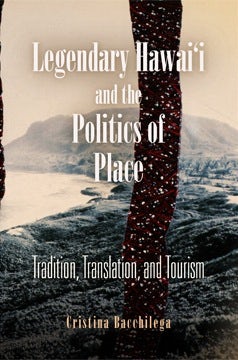
Hawaiian legends figure greatly in the image of tropical paradise that has come to represent Hawai'i in popular imagination. But what are we buying into when we read these stories as texts in English-language translations? Cristina Bacchilega poses this question in her examination of the way these stories have been adapted to produce a legendary Hawai'i primarily for non-Hawaiian readers or other audiences.
With an understanding of tradition that foregrounds history and change, Bacchilega examines how, following the 1898 annexation of Hawai'i by the United States, the publication of Hawaiian legends in English delegitimized indigenous narratives and traditions and at the same time constructed them as representative of Hawaiian culture. Hawaiian mo'olelo were translated in popular and scholarly English-language publications to market a new cultural product: a space constructed primarily for Euro-Americans as something simultaneously exotic and primitive and beautiful and welcoming. To analyze this representation of Hawaiian traditions, place, and genre, Bacchilega focuses on translation across languages, cultures, and media; on photography, as the technology that contributed to the visual formation of a westernized image of Hawai'i; and on tourism as determining postannexation economic and ideological machinery.
In a book with interdisciplinary appeal, Bacchilega demonstrates both how the myth of legendary Hawai'i emerged and how this vision can be unmade and reimagined.


Preface
1. Introduction
2. Hawai'i's Storied Places: Learning from Anne Kapulani Landgraf's ''Hawaiian View'
3. The Production of Legendary Hawai'i: Out of Place Stories I
4. Emma Nakuina's Hawaii: Its People, Their Legends: Out of Place Stories II
5. Stories in Place: Dynamics of Translation and Re-Cognition
Notes
Works Cited
Index
Acknowledgments