


Some error occured while loading the Quick View. Please close the Quick View and try reloading the page.
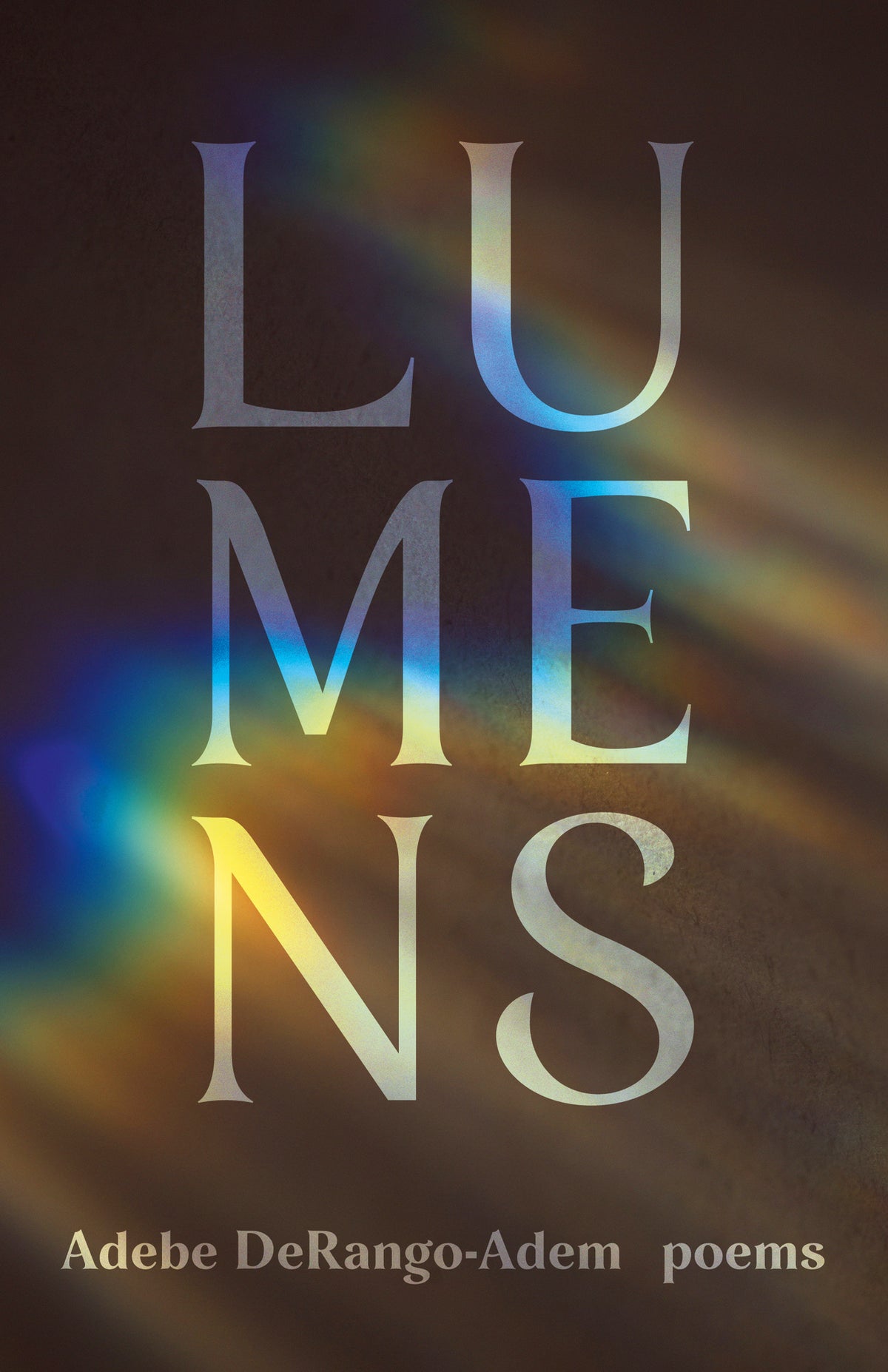
Lumens liberates the racist symbolic order rooted in whiteness-as-goodness in history's nomenclature of light, situating dark(ness) as the genesis of meaning.
Both poetry collection and shadow-historiography, Lumens embarks on an Enlightenment quest in reverse. These poems question the violent racial metaphysics that enabled Europe's rendering of Africa as ontological nothingness—in order to keep the fantasy of white supremacy alive. Echolocating voices buried and liminally illumined through time, Lumens reveals the colonial violence embedded in the quest "to know," aided and abetted by the act of keeping Black and Indigenous futurities in the dark.
Inspired by writers like Claudia Rankine, Toni Morrison, and M. NourbeSe Philip who take risks with form, white space, and sound, Lumens is attuned to the musicality of language, brought forth through the polyphony of a multilingual upbringing. DeRango-Adem's brilliant poetics patent a new claim to being as she dares to unknow the truths she was told: one outside discourses of captivity and liberation, inventing a mode of reasoning from the shadows.


Praise for Lumens
"The poems in Lumens perform a dialectical smoke show with 'light' and 'dark' as the gauzy antipodes of a floating Pan-Africanist dream world. Here are ambitious lyrics unafraid to buttonhole the metaphysical, the pataphysical and the existential all at once. With a little humour and a lot of panache, these poems exhort us to collectively celebrate our arrival as soul survivors. After reading Lumens I feel 'ready to let the day carry me / in its mouth / by the teeth.'"—Shane Book, author of All Black Everything
"Lumens is a work of phantasmagoric power, a fugue equal parts daydark and nightlight composed by a poet daring 'to step forward in [a] backwards country' and unjust world, reader in tow, and face modernity’s uncomfortable truths head on."—Jim Johnstone, author of The King of Terrors
"From a soulful quietude pollinated by history to an illuminating science of the everyday, an ancient spirit moves through Lumens. Language springs up wild then tamed like a garden in full—and full spectrum—bloom, winding through the ages with wisdom and heart."—Lillian Allen, Poet Laureate of Toronto
Praise for Adebe DeRango-Adem's previous work
“Ex Nihilo troubles the waters of identity, opens the borders of literary precedence and official “canon” and is straight from the hip. It is fierce, streetwise poetry, with “a beauty of incongruence.”—Anne Waldman, author of Mesopotopia
“There is a true poet at work here, and there is a rare fineness of feeling on display in these poems. A delightful gathering by an exciting new voice.”—Lorna Goodison, author of Mother Muse
“Terra Incognita gives urgent voice to the difficult grace of multiplicity. Adebe DeRango-Adem writes through waves of angelic intransigence, her stained verse-light submerged in the stormy waters of an inability to forget.”—Charles Bernstein, author of Topsy-Turvy
“Vox Humana compels the reader to engage with the fragment and with the sounded breath of words seeping through cracks in the text; in so doing it requires that the reader trust the movement of breath, word, and fragment and demands a new way of reading. Vox Humana does what poetry intends—it creates new ways of seeing all that has always been (not) there.”—M. NourbeSe Philip, author of Zong! and Bla_K
Adebe DeRango-Adem is the author of five full-length poetry books to date. Her poem, "Vox Genus / Provectus," was selected by poet Sonia Sanchez as the winner of the 2021 Boston Review Annual Poetry Contest. In 2023, her fourth poetry collection Vox Humana (Book*hug Press, 2022) won the Raymond Souster Award. In the same year, her poem "Aria Apocalypta" from Lumens was longlisted for the CBC Poetry Prize. In 2024, her poem "Song of Sheba" was featured on Toronto public transit and presented at the Aga Khan Museum in Toronto for Nuit Blanche. She lives in Toronto.