


Some error occured while loading the Quick View. Please close the Quick View and try reloading the page.
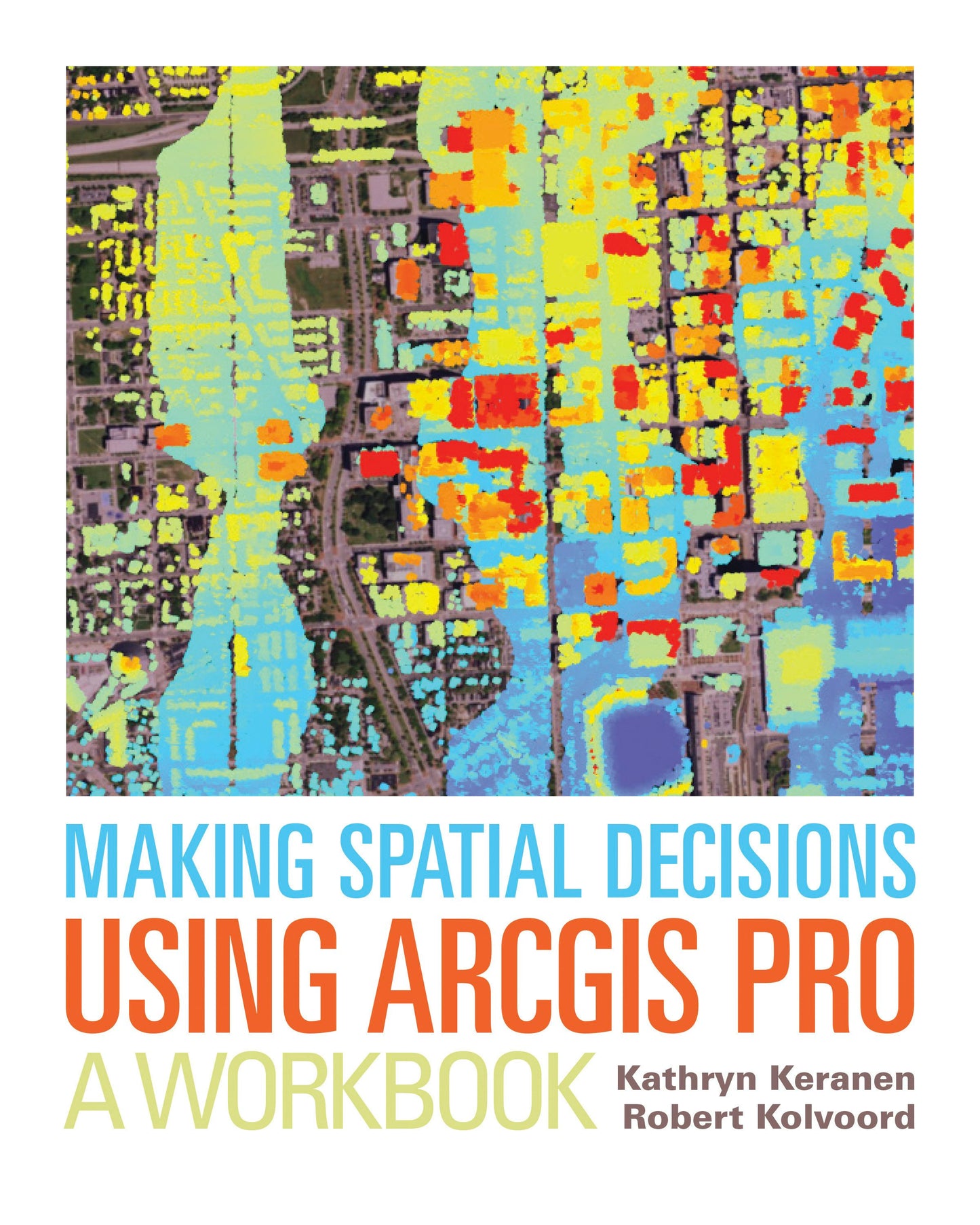
"How can we protect...?" "Where do we allocate...?" "What's the extent and pattern of...?" You have questions in a spatial context; Making Spatial Decisions Using ArcGIS Pro has answers based in The Science of Where™.
Making Spatial Decisions Using ArcGIS Pro is a textbook that provides the user with a broad overview of the capabilities of using ArcGIS Pro to use geospatial tools to solve real-world problems. This book takes full advantage of the integrative nature of ArcGIS Pro and its advanced capabilities to seamlessly unite cloud-based and desktop GIS. The lessons included in this book have been adapted and updated from lessons from Keranen and Kolvoord's popular first three Esri Press books: Making Spatial Decisions Using GIS, Making Spatial Decisions Using GIS and Remote Sensing, and Making Spatial Decisions Using GIS and Lidar.
Note: This e-book requires ArcGIS software. You can download the ArcGIS Trial at http://www.esri.com/arcgis/trial, contact your school or business Esri Site License Administrator, or purchase a student or individual license through the Esri Store.


About the Authors
Acknowledgements
Introduction
Module 1: Hazardous emergency decisions
Project 1: An explosive situation in Springfield, Virginia
Project 2: Skirting the spill in Mecklenburg County, North Carolina
Module 2: Hurricane damage decisions
Project 1: Coastal flooding from Hurricane Katrina
Project 2: Hurricane Wilma storm surge
Module 3: Law enforcement decisions
Project 1: Crime in the nation’s capital
Project 2: Analyzing crime in San Diego, CA
Module 4: Composite Images
Project 1: Creating multispectral imagery of the Chesapeake Bay
Project 2: Multispectral Composite Bands of the Las Vegas Area
Module 5: Unsupervised Classification
Project 1: Unsupervised classification of the Chesapeake Bay
Project 2: Calculating unsupervised classification of Las Vegas, Nevada
Module 6: Supervised Classification
Project 1: Calculating supervised classification of the Chesapeake Bay
Project 2: Calculating supervised classification of Las Vegas, Nevada
Module 7: Basic Lidar Skills
Project 1: Basic lidar skills using Baltimore, MD data
Project 2: San Francisco, CA
Module 8: Location of Solar Panels
Project 1: James Madison University, Harrisonburg, Virginia
Project 2: San Francisco University, San Francisco, California
Module 9: Forest Vegetation Height
Project 1: George Washington National Forest, Virginia
Project 2: Michaux State Forest, PA
Appendix A: Image and Data Credits
Book Resources