


Some error occured while loading the Quick View. Please close the Quick View and try reloading the page.
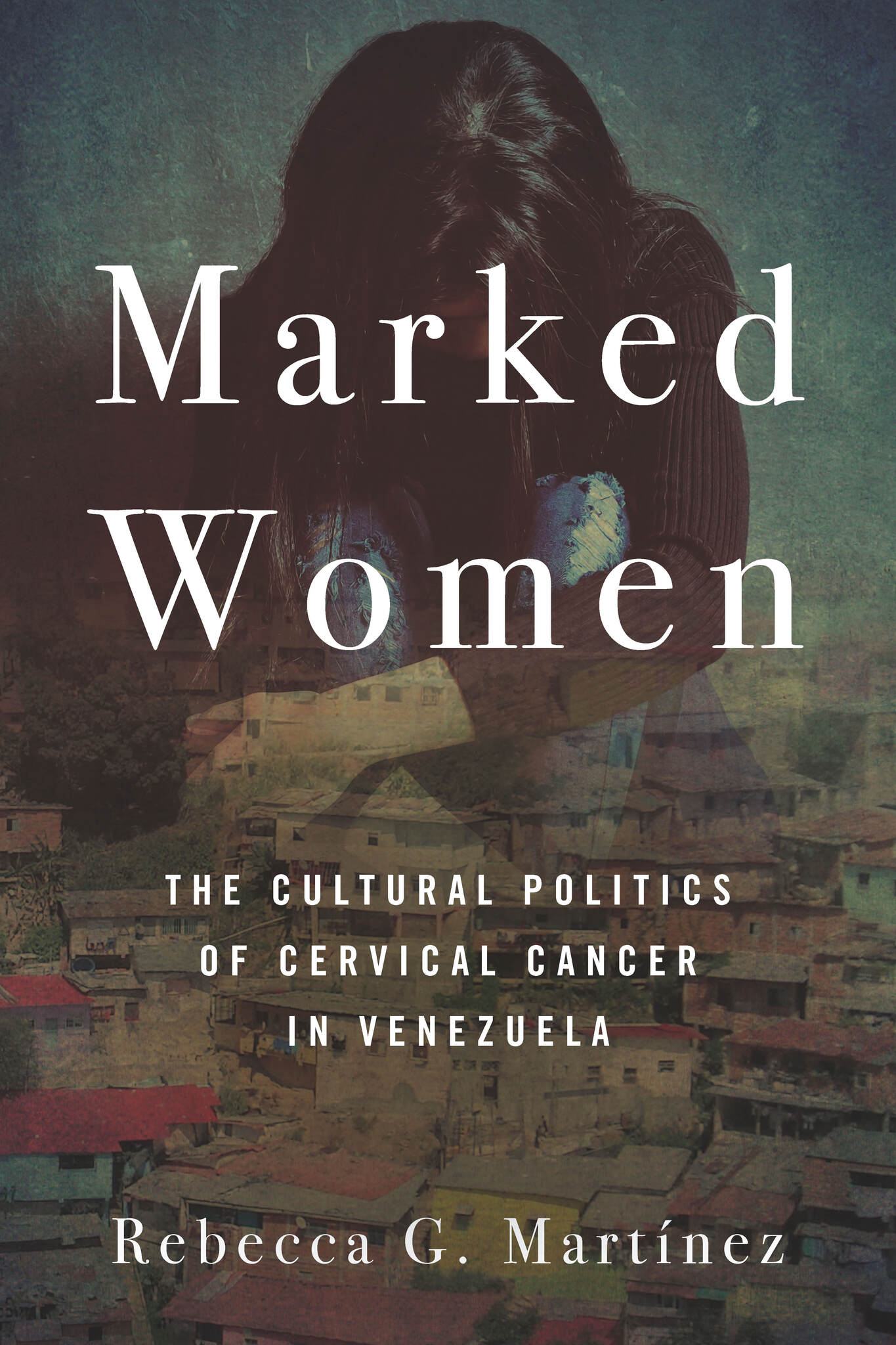
Cervical cancer is the third leading cause of death among women in Venezuela, with poor and working-class women bearing the brunt of it. Doctors and public health officials regard promiscuity and poor hygiene—coded indicators for low class, low culture, and bad morals—as risk factors for the disease.
Drawing on in-depth fieldwork conducted in two oncology hospitals in Caracas, Marked Women is an ethnography of women's experiences with cervical cancer, the doctors and nurses who treat them, and the public health officials and administrators who set up intervention programs to combat the disease. Rebecca G. Martínez contextualizes patient-doctor interactions within a historical arc of Venezuelan nationalism, modernity, neoliberalism, and Chavismo to understand the scientific, social, and political discourses surrounding the disease. The women, marked as deviant for their sexual transgressions, are not only characterized as engaging in unhygienic, uncultured, and promiscuous behaviors, but also become embodiments of these very behaviors. Ultimately, Marked Women explores how epidemiological risk is a socially, culturally, and historically embedded process—and how this enables cervical cancer to stigmatize women as socially marginal, burdens on society, and threats to the "health" of the modern nation.


— Leo R. Chavez
"Marked Women is richly detailed and lucidly written. Rebecca Martínez masterfully develops her arguments with honesty and great compassion, situating her analyses at the intersections of disease, sexuality, morality, and citizenship. Her insights into the disparate power dynamics responsible for the persistent stigmatizing of cervical cancer in Venezuela provide new, much-needed perspectives on this tragic global health phenomenon."
— Carole H. Browner
"Rebecca Martínez's remarkable ethnographic eye and ear discern how pathologies of public health infrastructures and professional socialization inscribe gender and class stereotypes not only on bodies but on popular perceptions of poor women and the cervical cancers that too often kill them."
— Clara Mantini-Briggs
"In this excellent work of feminist medical anthropology, Martínez (women's and gender studies, Univ. of Missouri) focuses on the ways neoliberalism has affected health care in Venezuela....The transcriptions of the patients' responses are informative, disturbing, and often upsetting, but their articulation of their feelings draws readers into their narratives. They are not just ethnographic material but real women with real lives. The book is appropriate for upper-division undergraduate and graduate courses in gender studies, anthropology, and Latin American studies."
— H. Aquino
"Martínez presents an ethnography of cervical cancer that powerfully analyses biomedical and public health practice first in the neoliberal context of the 1990s and then in the socialism of Hugo Chávez and Nicolás Maduro...This reader very much hopes that Martínez continues her work, particularly at this historical moment of intense political and humanitarian crisis in Venezuela."––Tita Chico, The Year's Work in Critical and Cultural Theory
This chapter provides descriptions of the two hospitals where the ethnographic research was conducted: Hospital Oncológico Padre Machado and Hospital Oncológico Razetti. Women whose stories are a central part of this project, as well as those of the doctors who treat them, are introduced through vignettes. Demographic profiles are included of patients and doctors interviewed at both hospitals. A concise but important understanding of race in Venezuela is also included. Venezuela is a country that has embraced a mythical ideology of café con leche, meaning that racism is deemed nonexistent because the country's people are considered racially "mixed": like black coffee with milk. However, race, class, and gender all figure into the social construction of cervical cancer risk.
An epidemiological profile of cervical cancer risks found in the medical literature is compared to those perceptions of risk mentioned by doctors and patients. The doctors mentioned epidemiologically supported risks such as multiple sexual partners and sex at an early age, as well as risks that are not supported epidemiologically, such as lack of hygiene and lack of culture. In articulating risk, doctors focus on social class, culture, hygiene, and morality in their profiles of risk. The women's risk factors concentrated on the effect of economic disadvantage on medical care access, though not in relation to behavior (promiscuity and uncleanliness), as can be discerned from many of the doctors' discussions of cervical cancer.
This chapter investigates the role of public health education in the prevention of cervical cancer, analyzing the public health literature designed to educate women about this disease. This literature is contextualized by addressing popular ideas about the relationship among class, culture, and health, including interviews with public health officials, articles in national newspapers, and scholarly research on class and violence in Venezuela. Threats to progress, modernity, and Venezuelan culture are pervasive themes in discourses about poverty and disease. Just as important, the discourse surrounding cervical cancer in Venezuela must be understood within a social, economic, and political climate that over the past three decades has been unstable and, at times, quite volatile. A cultural politics of disease has emerged in which culture (and cultural difference) is significant for understanding and explaining the problem of cervical cancer by the media, the public health arena, and the medical community in general.
This chapter focuses on the medical examination itself, with emphasis placed on relationships of power in this very physical—bodily—manifestation of the patient-doctor interaction. The body is an important site for understanding how distinctions, of class, in particular, are produced, inscribed, and represented in the bodies of women (e.g., the state of her cervix, cleanliness). Special attention is paid to the ways in which the patients are treated as objects of medical knowledge and manipulation: the ways they are positioned, inspected, and talked to (or not). In doing so, the structural problems that contribute to a lack of resources at the public hospital including little space, improper equipment, and insufficient time to interact adequately with patients and better inform them of their medical conditions are underscored. Women's narratives of their medical treatment, which are, at times, acted on to contest and circumvent some disciplinary forms, are also analyzed.
The chapter looks at how the diverse women in the hospital are disciplined and regulated. This category of women includes female patients, nurses, secretaries, doctoras (female doctors), technicians, and the female anthropologist. At the same time, emphasis is placed on how the women negotiate and contest that process. Women's agency is thus illuminated. For patients, their agency includes ways of finding out information about their own health that is not directly shared with them by medical personnel. The patient-doctor interaction is a space where patients have little power, but they also look for ways to negotiate and resist their lack of power. Moreover, a section is also devoted to sexual harassment in the field by providing the narrative experience of the researcher. All of these women's experiences converge to highlight agency in the face of the patriarchal hospital setting.
The epilogue focuses on 2008 fieldwork during the Chávez administration. It considers some changes that have taken place in health care under the socialism of the Chávez administration. Cultural politics of health function very differently under the neoliberalism of the 1980s and 1990s compared to the Chávez era. Tracing the social configurations of this disease from the neoliberalism of the 1990s to the era of socialism, the epilogue maps out the ways in which class, gender, and race shape disease as a product of cultural politics. During the Chávez era, the government focused on health care and the development of Misión Barrio Adentro as transformation for the nation through the Bolivarian Revolution. Public health attention to cervical cancer in this context has emphasized structural change as opposed to individual behaviors. In other words, the very definitions of disease are formed within specific social, cultural, and historical moments.
The introduction of the book provides an overview of the ethnographic project. It outlines a brief history of the neoliberal period in which this ethnography is situated in order to provide necessary context for the fieldwork findings. Importantly, the political context with International Monetary Fund and World Bank regulations set the stage for the structural adjustments that will greatly affect the public health sector. The focus on individualism that neoliberalism embraces also helps situate analysis of patient-doctor interactions and public health educational pamphlets. The introduction also outlines the chapters so they reader has a preview of the topics covered in the book.