


Some error occured while loading the Quick View. Please close the Quick View and try reloading the page.
CHOICE: OUTSTANDING ACADEMIC TITLE
How do the literatures and cultures of oppressed societies survive and flourish in spite of the overdetermining conditions of precarity and injustice of which they are a product and against which they protest? Might the symptom of oppression become simultaneously the agent of its critique? Melancholy Acts offers richly nuanced reflections on these questions through a series of wide-ranging engagements with Arab thought, literature, and film in the aftermath of the 1948 dispossession of Palestinians and the 1967 military defeat of Arab armies.
Melancholy Acts offers a psychoaffective theory of cultural production that arises out of the disjunction between political impoverishment and cultural resistance to colonial and neoliberal oppression. Such a theory allows the author to trace the melancholy disposition of Arabic literary and filmic productions and to discern the precarious rhetorical modes of their critical intervention in a culture that is continually strained to its breaking point. Across six chapters, Melancholy Acts reads with rigor and sensitivity contentious topics of Arab contemporaneity such as secular modernity and manhood, Arab nationalism and leftism, literary and artistic iltizām, or commitment, Islamism, and martyrdom. The book tracks the melancholy politics that inform the literary and cultural projects of a multitude of Arab novelists (Ghassan Kanafani and Naguib Mahfouz); poets and playwrights (Mahmoud Darwish, Nizar Qabbani, and Saadallah Wannous); filmmakers (Nouri Bouzid, Moufida Tlatli, Youssef Chahine, and Hany Abu Assad); alongside the work of such intellectuals as Hussein Muruwwa, Malek Bennabi, Karima Lazali, George Tarabishi, and Fethi Benslama, from within the Arab world, as well as such non-Arab thinkers as Freud, Lacan, Adorno, Fanon, Spivak, Butler, and Žižek.
Melancholy Acts charts a fresh and bold new approach to Arabic and comparative literature that combines in interlaced simultaneity a high sensitivity to local idioms, as they swerve between symptom and critique, with nuanced knowledge of the geopolitics of theory and psychoanalysis.


In Melancholy Acts, Nouri Gana travels between Algeria and Tunisia to Palestine and Egypt, examining the impact of European colonization and Israeli apartheid on Arab culture. Gana is unique among today’s critics in firmly grounding his literary and psychoanalytic discussions of poetry and fiction, theory and film in current and past events, and in emphasizing the role that Euro-American invasions and economic neocolonialism play in the making of a defeatist melancholy within the Arab psyche. Gana’s book is a powerful call for Arab thinkers and artists to turn melancholy into a discourse of empowerment and a ‘decolonial project of emancipation.’ In its call to action and in its incisive analyses, Melancholy Acts is a must read.
. . .[T]the book comprises one of the most significant readings of Arab contemporaneity that we have.
Melancholy Acts is a powerful expression of the Arab world’s literary and cinematic production, which has endured and obstinately defied colonial and postcolonial occupation, Western encroachments, and autocratic regimes. . . It would be a valuable reference for postcolonial and cultural studies, comparative literature, and film, among others. Highly recommended.
Nouri Gana’s Melancholy Acts: Defeat and Cultural Critique in the Arab World offers a profound and innovative examination of the emotional and political complexities shaping the Arab world. . . By combining rigorous theoretical analysis with close readings of cultural texts, Melancholy Acts offers a fresh perspective on the role of melancholy in Arab cultural and political life, challenging traditional notions of melancholic passivity and offering new ways of thinking about the intersections of affect, culture, and politics in the Arab world, towards, as he beautifully concludes, a decolonial project of emancipation.
Nouri Gana’s Melancholy Acts is an all-too-timely sustained examination of loss and melancholia as a form of resistance in the Arab world from the 1948 Nakba to the 1967 Naksa and after. . . Gana does specifically for Arab populations what Franz Fanon accomplished more broadly for postcolonial populations by drawing attention to the forms of resistance resulting from the postcolonial psychological condition.
Melancholy Acts expands the theoretical and literary parameters of colonial trauma and its afterlife, extending to oft-neglected contexts, and is thus indispensable to postcolonial scholars.
Note on Translation and Transliteration | ix
Introduction: Melancholy Acts | 1
1 Melancholy Formations: From Nakba to Naksa and Beyond | 45
2 Melancholy Forms: Poetry in the Aftermath of Catastrophe | 89
3 Enduring Left Melancholy: Recasting the Crisis of the Nasserite Intellectual | 123
4 Melancholy Manhood: Modernity and Neopatriarchy in Tunisian Cinema | 158
5 Melancholy Ends: Palestinian Film and Narrative Martyrdom | 195
6 Melancholy Islam: Jihad, Jouissance, and Female Clairvoyance | 234
Epilogue: Melancholy Critique | 277
Acknowledgments | 293
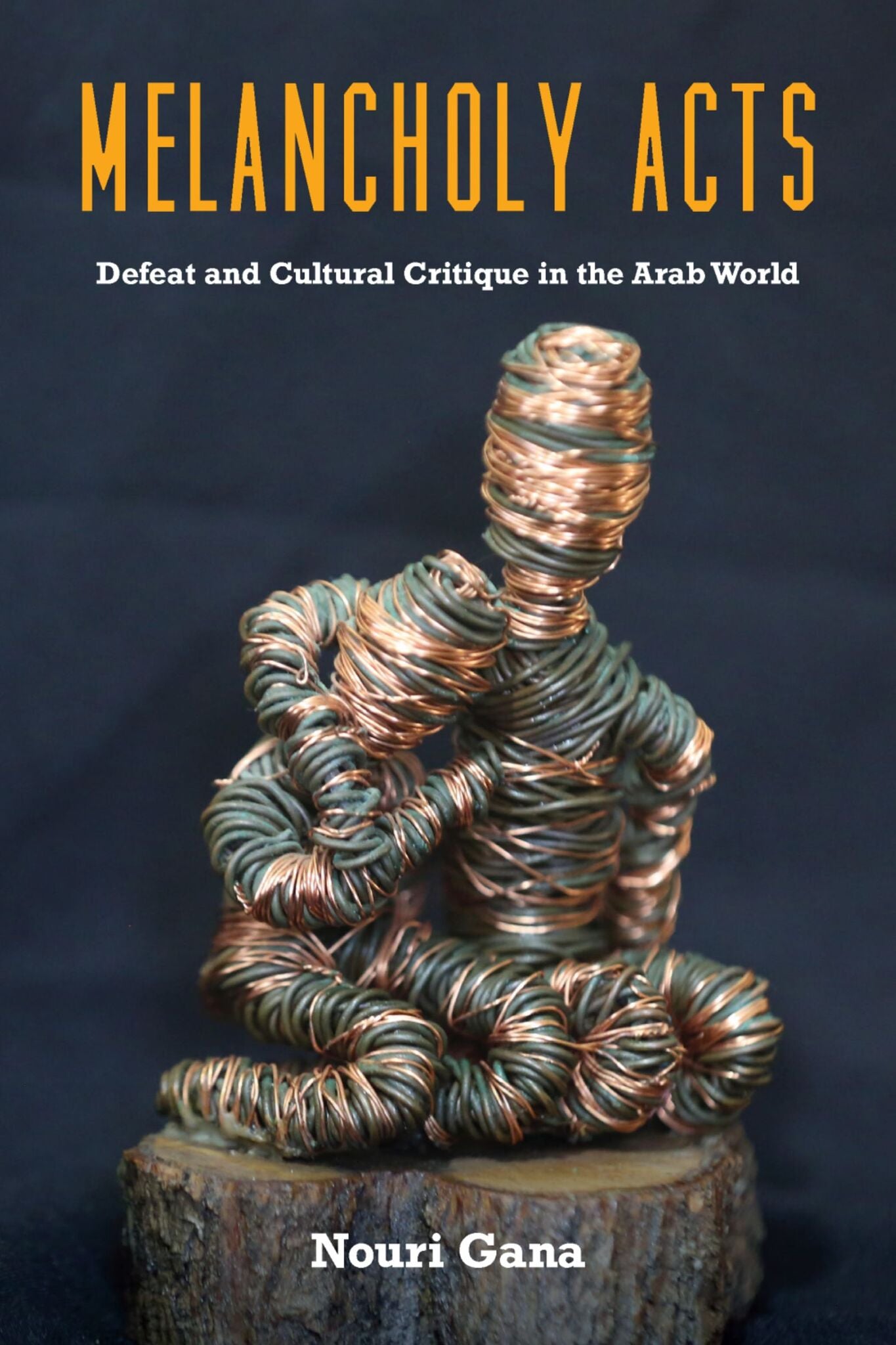
The Unsheltering Sky: A Note on the Cover Art | 297
Bibliography | 299
Index | 313