


Some error occured while loading the Quick View. Please close the Quick View and try reloading the page.
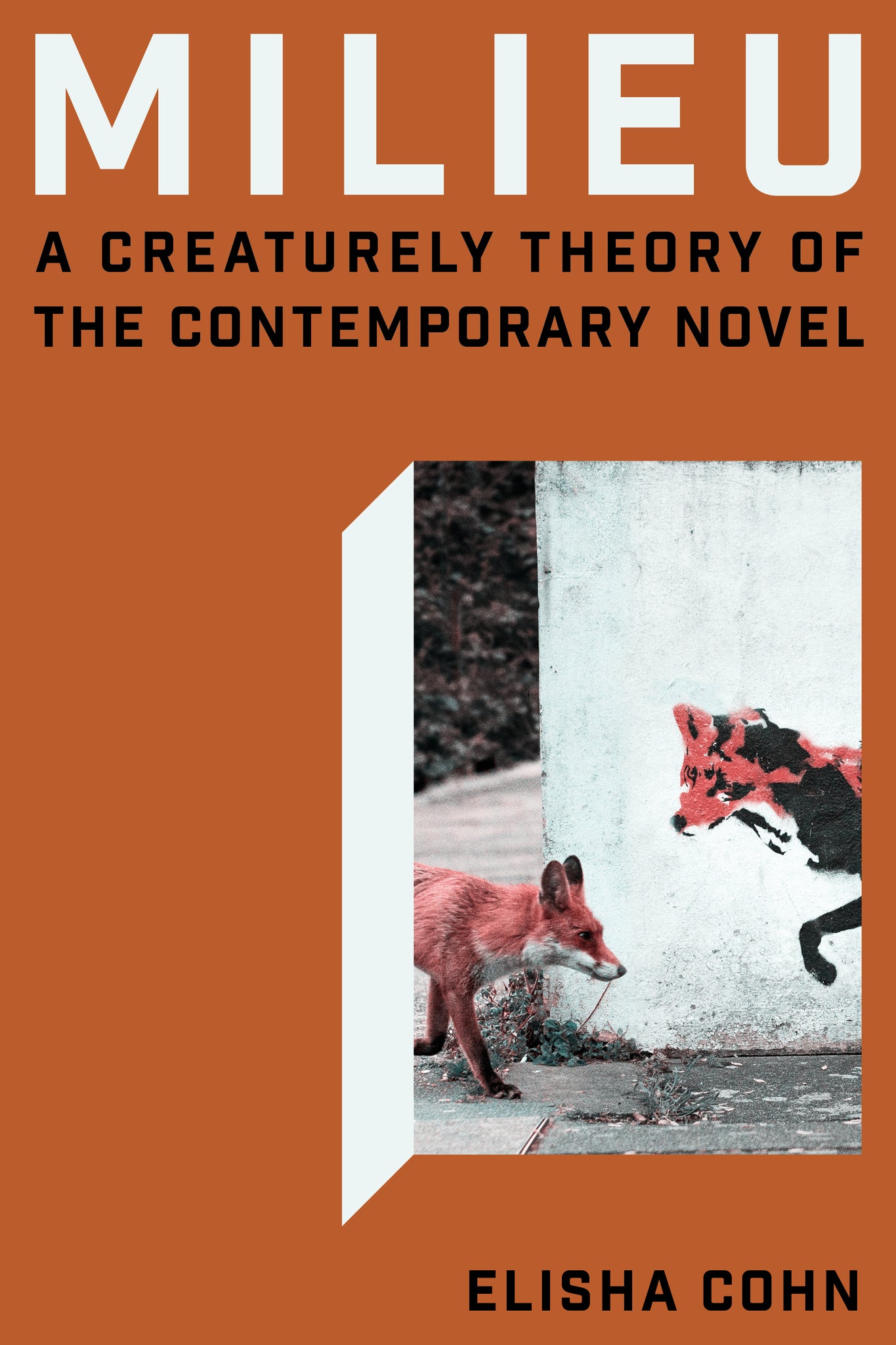
In this creaturely theory of the novel, Elisha Cohn rethinks the status of animals in recent global fiction, arguing that literary representation of animals should matter to any reader invested in the novel as a form, and showing how literary style makes knowable our imperiled multispecies worlds.
Cohn argues that the animal lives of contemporary fiction move beyond allegories of globalization's fracture of subjectivity by emphasizing the creaturely dimensions of narrative. This shift in focus registers through recent fiction's fascination with milieus: environments made perceptible through sentience that humans share with other creatures. Showing how theories of milieu—from Jacob von Uexküll, George Canguilhem, and Sylvia Wynter to recent studies in comparative cognition—converge with and are conceptually indebted to Indigenous and Black ontologies, Cohn argues that the milieu not only explains the centrality of animals to contemporary fiction, but also promotes dialogue across disciplines invested in anti-hierarchic accounts of embodied life. Each chapter foregrounds formal resonances in texts from the mid-1990s through the present, including work by Téa Obreht, Yoko Tawada, NoViolet Bulawayo, Sigrid Nunez, Jesmyn Ward, Linda Hogan, Lucy Ellmann, Amitav Ghosh, and Aminatta Forna. Throughout, Cohn compellingly argues for the centrality of narrative voice in avoiding, deferring, or complicating modes of figuration and critical interpretation that confirm human privilege.


"Milieu is an essential contribution to debates about what literature can do in response to the current ecological crisis. With unflinching rigor, Cohn offers the milieu as an indispensable concept for theorizing contemporary global fiction." —Antoine Traisnel, University of Michigan
"The power of Milieu lies in its ability to use the seemingly minor subgenre of contemporary novels about animals to unfold an impressive interdisciplinary synthesis of strands of novel theory and interspecies ethics that frequently seem incompatible with one another. Cohn's work should be welcomed not only as a corrective to current modes of interpreting literary animals but also in its own right as a vital contribution both to novel theory and to the politics of collective flourishing in our more-than-human world." —John MacNeill Miller, H-Environment
"Anyone who sees fiction as a place where the nonhuman can find expression alongside alternatives to human-centeredness will find Cohn's theory of contemporary fiction as milieu inspiring; anyone who believes that fiction has a unique role to play in changing perceptions and building multispecies worlds will be grateful to Cohn for this wise book, which, like milieu itself, is capacious, generous, and worldly." —David P Rando, Interdisciplinary Studies in Literature and Environment
"Cohn's study of milieu begins from the question of how we can understand the experience of animals, and how that understanding can change our own sense of the milieu we share, helping us to recognize it as a narrative form, one that contains multiple world-forms that overlap with or jostle against each other." —Katarzyna Bartoszyńska, CLCWeb
1. Breaking the Zoo
2. Speaking Otherwise
3. Dog Friends
4. Cat Kin
5. Wilder Things
Coda