Skip to product information
1 of 0

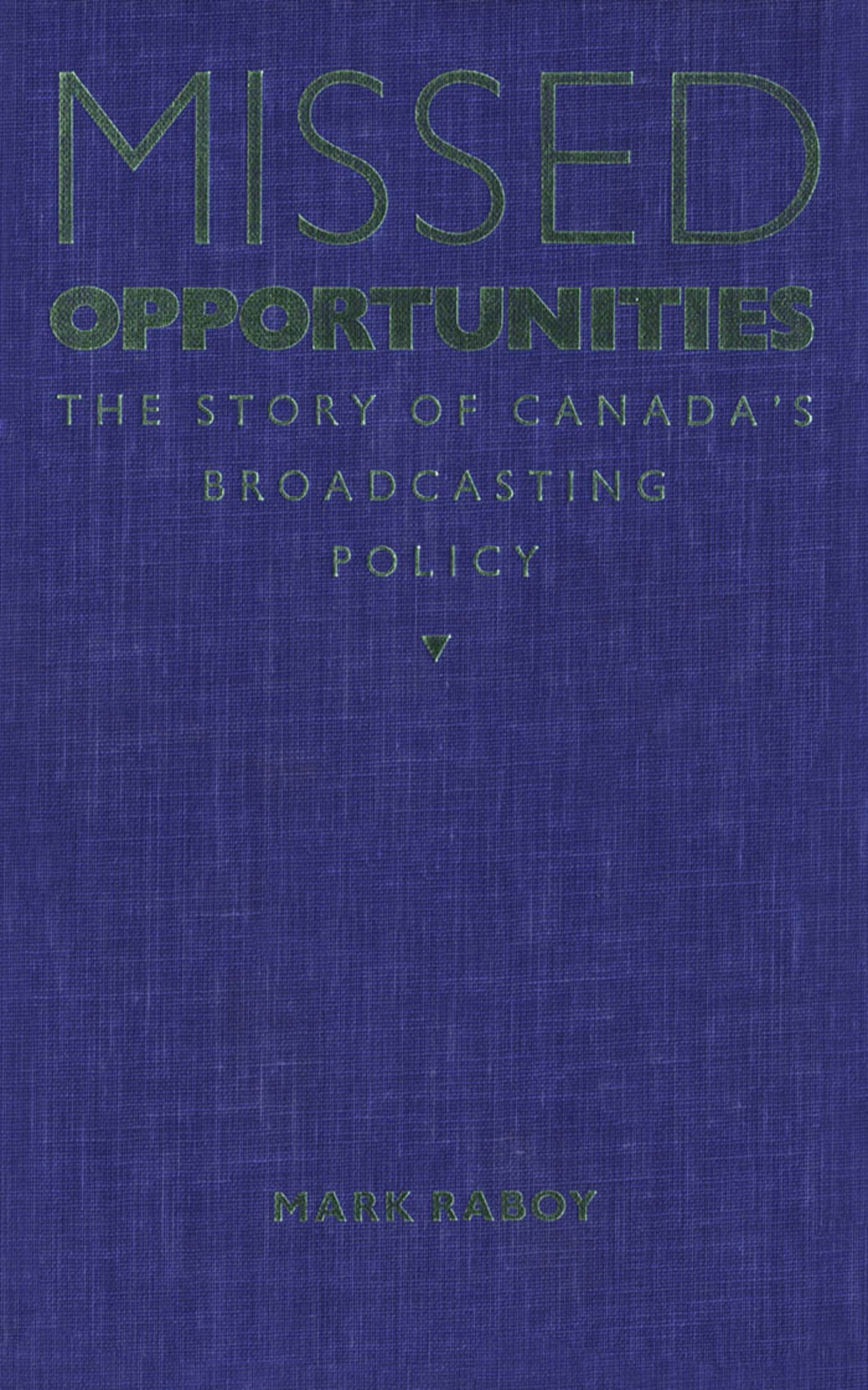
Missed Opportunities

Regular price $39.95
Regular price $0.00 Sale price $39.95
Sold out
In Missed Opportunities, Marc Raboy reveals the short-sightedness behind the traditional view of Canadian broadcasting policy as an instrument for promoting a national identity and culture. He argu...
Read More
  • 01 May 1990
View Product Details

In Missed Opportunities, Marc Raboy reveals the short-sightedness behind the traditional view of Canadian broadcasting policy as an instrument for promoting a national identity and culture. He argues that Canadian broadcasting policy has served as a political instrument for reinforcing a certain image of Canada against insurgent challenges, such as maintaining the image of Canada as a political entity distinct from the United States and acting against internal threats, most notably from Quebec. It has served as a vehicle for the development of private broadcasting industries and to further the general interests of the Canadian state. Most of the time, Raboy maintains, this policy has been the object of vigorous public dispute.

Toward the end of his career, Graham Spry used the phrase "missed opportunities" in reference to Canadian broadcasting. Raboy shows which opportunities have been missed and clarifies the relationship between the evolution of Canadian broadcasting policy over the past sixty years and the changes in Canadian society during the same period.

files/i.png Icon
Price: $39.95
Pages: 488
Publisher: McGill-Queen's University Press
Imprint: McGill-Queen's University Press
Publication Date: 01 May 1990
ISBN: 9780773507753
Format: Paperback
BISACs: SOCIAL SCIENCE / Sociology / General, SOCIAL SCIENCE / Media Studies
REVIEWS Icon
"[This book] is the first to cover the full period from 1928 to the present ... It is also the only fully developed work to question the received wisdom among nationalists about the `proper' role of broadcasting in this country and the only one to include in it the very important Quebec perspectives on the question ... It is substantial, well-documented, and presents a point of view that deserves far more attention." Edwin R. Black, Department of Political Studies, Queen's University. "adds several new dimensions to the study [of broadcasting] ... The arguments about the `public' and about broadcasting in general are both made with a deft touch and a light hand. The research itself makes the case and the supporting documentation is thorough." Liora Salter, Department of Communications, Simon Fraser University.