


Some error occured while loading the Quick View. Please close the Quick View and try reloading the page.
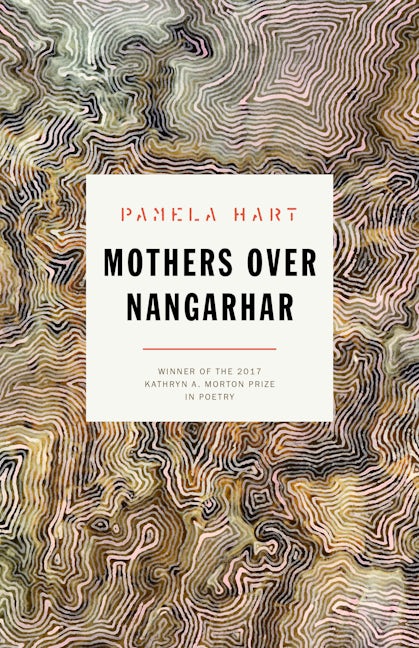
Mothers Over Nangarhar is an unusual and powerful war narrative, focusing less on the front lines of combat and more on the home front, a perspective our American cultural canon has largely ignored after 222 years at war. In her stunning poetry debut, Pamela Hart concentrates on the fears and psychological battles suffered by parents, lovers, and friends during a soldier’s absence and return home, if indeed there’s a return. With honest grit and compassionate imagination, Hart describes her own experience having a son overseas, incorporating lyric meditations, photography, news articles, support group meetings, family interviews, oral histories, and classic literature to construct a documentary-style narrative very much situated in the now. Blending reality with absurdism and guided openly by a Calvino kind of logic, Hart reveals to us a crucial American point of view.

Price: $15.95
Pages: 80
Publisher: Sarabande Books
Imprint: Sarabande Books
Series: Kathryn A. Morton Prize in Poetry
Publication Date:
08 January 2019
Trim Size: 8.50 X 5.50 in
ISBN: 9781946448262
Format: Paperback
BISACs:
POETRY / Women Authors, POETRY / Subjects & Themes / Places, POETRY / Subjects & Themes / Family, POETRY / American / General

Vulture, “4 Poetry Collections That Change the World”
The Millions, “Must-Read Poetry: January 2019”
Winner of the 2017 Kathryn A. Morton Prize
"Rich with literary, political, and geographical references, Hart’s debut collection details the journey of a mother whose son is serving in Afghanistan. . . . Hart’s drive to keep looking and listening while 'the long war goes on' reads like a fundamental act of compassion."
—Publishers Weekly
"In her debut poetry collection, Hart brings a new, salient voice to our home front in times of war. . . . An artist by training, Hart creates word images that allow us to contemplate private and public pain. Certain lines stand out in these glowing poems: 'Like the Spartan women, we polish / our sons in the concrete firmament.' Or: 'My syntax breaks to lake ice / Who am I to translate the exodus of birds.' . . . [F]inely crafted poems."
—Booklist
“This honest and compassionate debut from the mother of a soldier adopts a rarely seen focus in the annals of wartime literature, turning attention toward the home front rather than the combat front.”
—Publishers Weekly
"Hart is also publishing a book of poems, Mothers over Nangarhar, inspired by her work."
—O, The Oprah Magazine
"Though the canon abounds with war poets — Homer, Wilfred Owen, Robert Graves, Walt Whitman — fewer describe the complexities of the home front. Pamela Hart works to correct this by telling the stories, including her own, of the parents, spouses, and children of those who serve. 'This isn’t a story of war,' she writes. 'This is the mother on the idea of a son at war.'"
—Jonathan Russell Clark, Vulture, "New Year, New Verse: 4 Poetry Collections That Change the World"
"Hart captures the paradox of a service member’s family: Hope keeps them alive, but hope is exhausting. Hart’s book ponders the mixture of pride and love for a son, fear for his safety, anxiety and guilt over violence. 'He was small and almost perfect at birth,' she writes. 'Did I raise him up to be a warrior.' There is no question mark here because, Hart knows, there is no answer."
—Nick Ripatrazone, The Millions, "Must-Read Poetry: January 2019"
"[W]hat was once only imagined is subsequently brought to devastating life. . . . [Mothers Over Nangarhar] is an homage to military families, for whom the Long War has ceased to end, despite being far removed from most Americans’ daily consciousness."
—Laura Kasinof, Poetry Foundation
"Reading this extraordinary book gives you a vision of the home front view of war. It is loved and highly recommended."
—Amir Shefayee, Medium
"Though language cannot encompass the enormity of war’s influence, it can still bring us as close as possible to expressing the inexpressible. This Hart does masterfully through an array of voices, all of whom echo and reecho what it means to survive and communicate war."
—Lindsey Weishar, Ploughshare
"War poetry often speaks from the deployed soldier’s point of view. Hart’s collection presents an essential counterpoint, giving voice to the networks of civilians whose lives are forever altered by the experiences of their loved ones. She reveals the paradox of helplessness and complicity. These are voices on a precipice, voices not-yet in mourning, but already aware of the need to be 'like an ocean' ready to 'carry [the soldiers’] broken parts.'”
—Emily Pérez, Rhino
"An intense and singularly intimate approach that reorients the canon of war literature towards the mothers who lose everything."
—MAKE Literary Productions
"[A] powerful debut collection."
—Sarah Lawrence Fall 2019 Alumni Magazine, print
"Not in a long time have I read poems about soldiers that so powerfully combine the beauty of language with the melancholy of war, a testimony to the truth that wars live on death and the burden falls on those who bore and loved a soldier and will never escape the grief of loss."
—Bill Moyers
“… Mothers Over Nangarhar moves through its mazy, crazed world of intimate and global conflict, exterior and interior pain, searching and assured. It is a beautiful, strong, and vulnerable work for our beautiful, strong, and increasingly vulnerable world.”
—Rowan Ricardo Phillips, June 2017
"Mothers Over Nangarhar is like no book of poetry I’ve read. It tells of the mothers whose 'beautiful and dangerous' children and partners fight our world’s wars. Their emotions are difficult to imagine, but we don’t need to imagine them, since these poems deliver them with lyric precision directly to our hearts. The stories the book includes are both eternal ('the long war goes on') and heartbreakingly particular ('There was the time I told your cradle I was done / Locked you in the van then shopped at Walgreens'), and Pamela Hart is a storyteller aware of all of a story’s implications: 'Can he kill is a story. Will the mother blame herself could be another.' Mothers Over Nangarhar is a document, a warning, a lament—beautiful and dangerous."
—Kathleen Ossip, author of The Do-Over
"Hart’s poems work like a 'contour drawing' that recognizes the disconnect between the object of study and the art that is produced; they never take their gaze off of their subject, but continue to circle the unknown closer and closer. This book feels extremely universal in its ruminations on loss and fear, but also deeply personal: 'My pencil working its way into the story if a son.'"
—Hannah Bradley, The Arkansas International
“‘I am writing backward to figure out forward,’ Pamela Hart writes in Mothers Over Nangarhar and in so doing Hart has charted her own connection to war through the birth and journey of her son, noting how ‘like the Spartan women, we polish/ our sons in the concrete firmament.’ With Sun-Tzu, Farid Attar, Rimbaud, and the oral testimonies of those with loved ones serving in distant war zones woven into the meditation beside her own experiences, Hart reveals and maps the layered psychological strata of the stateside terrain, war’s home front. This collection is part of a necessary dialogue on war and conflict that stretches from one generation to another now, and yet rarely makes the nightly news or the kitchen table. Thankfully, Hart refuses to add to the silence and instead has given us Mothers Over Nangarhar.”
—Brian Turner
The Millions, “Must-Read Poetry: January 2019”
Winner of the 2017 Kathryn A. Morton Prize
"Rich with literary, political, and geographical references, Hart’s debut collection details the journey of a mother whose son is serving in Afghanistan. . . . Hart’s drive to keep looking and listening while 'the long war goes on' reads like a fundamental act of compassion."
—Publishers Weekly
"In her debut poetry collection, Hart brings a new, salient voice to our home front in times of war. . . . An artist by training, Hart creates word images that allow us to contemplate private and public pain. Certain lines stand out in these glowing poems: 'Like the Spartan women, we polish / our sons in the concrete firmament.' Or: 'My syntax breaks to lake ice / Who am I to translate the exodus of birds.' . . . [F]inely crafted poems."
—Booklist
“This honest and compassionate debut from the mother of a soldier adopts a rarely seen focus in the annals of wartime literature, turning attention toward the home front rather than the combat front.”
—Publishers Weekly
"Hart is also publishing a book of poems, Mothers over Nangarhar, inspired by her work."
—O, The Oprah Magazine
"Though the canon abounds with war poets — Homer, Wilfred Owen, Robert Graves, Walt Whitman — fewer describe the complexities of the home front. Pamela Hart works to correct this by telling the stories, including her own, of the parents, spouses, and children of those who serve. 'This isn’t a story of war,' she writes. 'This is the mother on the idea of a son at war.'"
—Jonathan Russell Clark, Vulture, "New Year, New Verse: 4 Poetry Collections That Change the World"
"Hart captures the paradox of a service member’s family: Hope keeps them alive, but hope is exhausting. Hart’s book ponders the mixture of pride and love for a son, fear for his safety, anxiety and guilt over violence. 'He was small and almost perfect at birth,' she writes. 'Did I raise him up to be a warrior.' There is no question mark here because, Hart knows, there is no answer."
—Nick Ripatrazone, The Millions, "Must-Read Poetry: January 2019"
"[W]hat was once only imagined is subsequently brought to devastating life. . . . [Mothers Over Nangarhar] is an homage to military families, for whom the Long War has ceased to end, despite being far removed from most Americans’ daily consciousness."
—Laura Kasinof, Poetry Foundation
"Reading this extraordinary book gives you a vision of the home front view of war. It is loved and highly recommended."
—Amir Shefayee, Medium
"Though language cannot encompass the enormity of war’s influence, it can still bring us as close as possible to expressing the inexpressible. This Hart does masterfully through an array of voices, all of whom echo and reecho what it means to survive and communicate war."
—Lindsey Weishar, Ploughshare
"War poetry often speaks from the deployed soldier’s point of view. Hart’s collection presents an essential counterpoint, giving voice to the networks of civilians whose lives are forever altered by the experiences of their loved ones. She reveals the paradox of helplessness and complicity. These are voices on a precipice, voices not-yet in mourning, but already aware of the need to be 'like an ocean' ready to 'carry [the soldiers’] broken parts.'”
—Emily Pérez, Rhino
"An intense and singularly intimate approach that reorients the canon of war literature towards the mothers who lose everything."
—MAKE Literary Productions
"[A] powerful debut collection."
—Sarah Lawrence Fall 2019 Alumni Magazine, print
"Not in a long time have I read poems about soldiers that so powerfully combine the beauty of language with the melancholy of war, a testimony to the truth that wars live on death and the burden falls on those who bore and loved a soldier and will never escape the grief of loss."
—Bill Moyers
“… Mothers Over Nangarhar moves through its mazy, crazed world of intimate and global conflict, exterior and interior pain, searching and assured. It is a beautiful, strong, and vulnerable work for our beautiful, strong, and increasingly vulnerable world.”
—Rowan Ricardo Phillips, June 2017
"Mothers Over Nangarhar is like no book of poetry I’ve read. It tells of the mothers whose 'beautiful and dangerous' children and partners fight our world’s wars. Their emotions are difficult to imagine, but we don’t need to imagine them, since these poems deliver them with lyric precision directly to our hearts. The stories the book includes are both eternal ('the long war goes on') and heartbreakingly particular ('There was the time I told your cradle I was done / Locked you in the van then shopped at Walgreens'), and Pamela Hart is a storyteller aware of all of a story’s implications: 'Can he kill is a story. Will the mother blame herself could be another.' Mothers Over Nangarhar is a document, a warning, a lament—beautiful and dangerous."
—Kathleen Ossip, author of The Do-Over
"Hart’s poems work like a 'contour drawing' that recognizes the disconnect between the object of study and the art that is produced; they never take their gaze off of their subject, but continue to circle the unknown closer and closer. This book feels extremely universal in its ruminations on loss and fear, but also deeply personal: 'My pencil working its way into the story if a son.'"
—Hannah Bradley, The Arkansas International
“‘I am writing backward to figure out forward,’ Pamela Hart writes in Mothers Over Nangarhar and in so doing Hart has charted her own connection to war through the birth and journey of her son, noting how ‘like the Spartan women, we polish/ our sons in the concrete firmament.’ With Sun-Tzu, Farid Attar, Rimbaud, and the oral testimonies of those with loved ones serving in distant war zones woven into the meditation beside her own experiences, Hart reveals and maps the layered psychological strata of the stateside terrain, war’s home front. This collection is part of a necessary dialogue on war and conflict that stretches from one generation to another now, and yet rarely makes the nightly news or the kitchen table. Thankfully, Hart refuses to add to the silence and instead has given us Mothers Over Nangarhar.”
—Brian Turner
Pamela Hart is writer in residence at the Katonah Museum of Art where she teaches and manages an arts-in-education program called Thinking Through the Arts. She was awarded an NEA poetry fellowship in 2013. She recently received the Brian Turner Literary Arts prize for poetry. Her poems have been published in a variety of journals including the Southern Humanities Review, Bellevue Literary Review and Drunken Boat. Toadlily Press published her chapbook, The End of the Body. She is poetry editor and mentor for the Afghan Women’s Writing Project.
CONTENTS
Title Page
War Partita 4
Cities & Signs & War 6
River of Painted Rocks 7
War Games 8
Flynn’s Pond 9
To the Person Who 10
At the Shooting Range 11
Women & War Sestina 12
The Cut 13
In the Red Cross Parking Lot 14
Sometimes We Talk About Nothing 15
The Shawl 16
The Matins Project 17
II
Contour Drawing 19
Museum 20
Land Navigation 21
Birds Rising 22
How to Make a Diorama 23
The Women 24
Graces Watches the News 25
During War We Email Our Soldiers 26
In the Car 27
Globe Skimmer 28
Numerous Gray Areas 29
In Which I Talk to the Mother of Crazy Horse 30
Landay 31
Praise Song 32
Exhalation 33
III
Field Notes from Home 35
Some Principles of Return 38
Kevlar Poem 39
Soldier Undated World War I 40
Rules of Engagement 41
The Map is not the Territory 42
The Ruby Ring 43
As Thetis 44
IV
Looking at Monet’s Water Lilies 46
On the Orange Jumpsuit 47
CONTENTS
Title Page
War Stories 50
My Soldier 51
Night Vision 52
Over Nangarhar 53
Drone Song 54
Private Jonathon Lee Gifford’s Mother 55
Kevlar Poem II 56
Regarding the Improvised Explosive Device 57
Negative Capability 59
Birds Gather on Empty Ground 60
V
Tea With the Vietcong Soldier’s Wife 62
Before After 63
Everything is Everywhere 64
Obon 65
Stray Dog Story 66
Not the Same 67
Memorial 68
M16/ M4 69
On the Soldier’s Birthday 70
Jalalabad 71
Transmigration 72