


Some error occured while loading the Quick View. Please close the Quick View and try reloading the page.
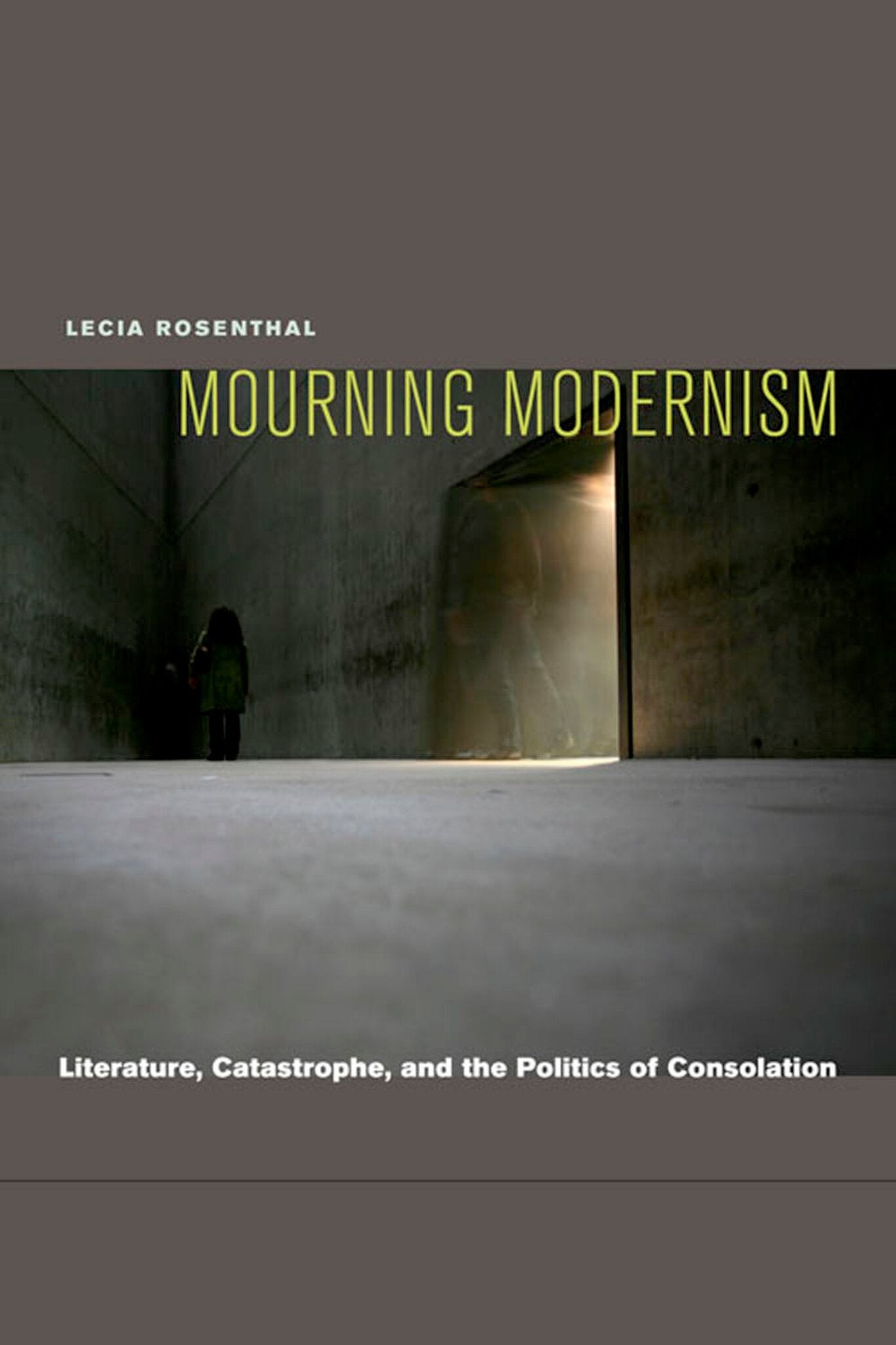
Mourning Modernism: Literature, Catastrophe, and the Politics of Consolation examines the writing of catastrophe, mass death, and collective loss in 20th-century literature and criticism. With particular focus on texts by Virginia Woolf, Walter Benjamin, and W.G. Sebald, Mourning Modernism engages the century’s signal preoccupation with “world-ending,” a mixed rhetoric of totality and rupture, finitude and survival, the end and its posthumous remainders. Fascinated with the threat of apocalypse, the century proliferates the spectacle of world-ending as a form of desire, an ambivalent compulsion to consume and outlive the “end of all.” In conversation with recent discussions of the century’s passion for the real, and taking on the century’s late aesthetics of subtraction, Mourning Modernism reads the century’s obsession with negative forms of ending and outcome. Drawing connections between the current interest in the category of trauma and the tradition of the sublime, Mourning Modernism reframes the terms of the modernist experiment and its aesthetics of the breaking-point from the lens of a late sublime.

Price: $65.00
Pages: 192
Publisher: Fordham University Press
Imprint: Fordham University Press
Publication Date:
February 1, 2011
Trim Size: 9.00 X 6.00 in
ISBN: 9780823233977
Format: Hardcover
BISACs:
LITERARY COLLECTIONS / European / General, PHILOSOPHY / General

Lecia Rosenthal’s intricate argument traces the engagement with catastrophe in the work of three exemplary figures, Woolf, Benjamin, and Sebald. She also offers a compelling diagnosis of modernism’s stubborn insistence that catastrophe must offer some form of gain. Rosenthal’s brilliance lies in her refusal to console us. This is a demanding, provocative, and deeply rewarding book.---—Martin Harries, New York University
Boldly written and well researched. Rosenthal brings together unexpected materials, drawing convincing lines of connection between seemingly disparate authors and texts. In style, argument, and method, Rosenthal produces knowledge unavailable within convential scholarship. Juxtaposing Benjamin and Sebald with Virginia Woolf produces explosive results.---—Gayatri Chakravorty Spivak, Columbia University
“One cannot read Mourning Modernism without concluding that Rosenthal is on to something, specifically at those moments when she makes catastrophe the object not only of aversion, but of desire.... Mourning Modernism does a good job of demonstrating how a certain apocalyptic imaginary in twentieth-century thought dovetails with more familiarly modernist concerns. In this way, it presents a vision of twentieth-century culture at its absolute limits. The challenge to think beyond these limits is still with us.”
Boldly written and well researched. Rosenthal brings together unexpected materials, drawing convincing lines of connection between seemingly disparate authors and texts. In style, argument, and method, Rosenthal produces knowledge unavailable within convential scholarship. Juxtaposing Benjamin and Sebald with Virginia Woolf produces explosive results.---—Gayatri Chakravorty Spivak, Columbia University
“One cannot read Mourning Modernism without concluding that Rosenthal is on to something, specifically at those moments when she makes catastrophe the object not only of aversion, but of desire.... Mourning Modernism does a good job of demonstrating how a certain apocalyptic imaginary in twentieth-century thought dovetails with more familiarly modernist concerns. In this way, it presents a vision of twentieth-century culture at its absolute limits. The challenge to think beyond these limits is still with us.”
Lecia Rosenthal is an Independent Scholar.