


Some error occured while loading the Quick View. Please close the Quick View and try reloading the page.
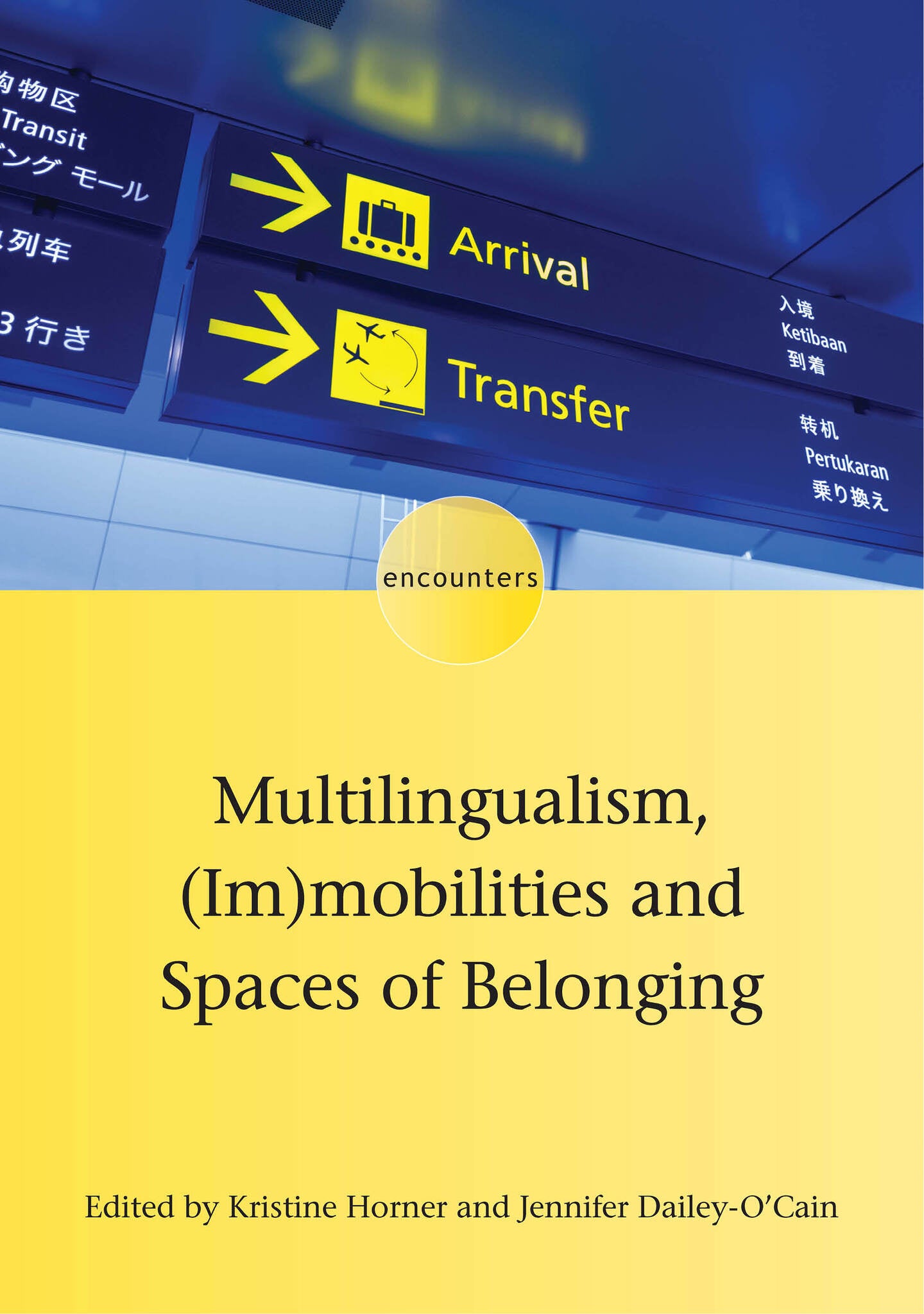
Certain forms of mobility and multilingualism tend to be portrayed as problematic in the public sphere, while others are considered to be unremarkable. Divided into three thematic sections, this book explores the contestation of spaces and the notion of borders, examines the ways in which heritage and authenticity are linked or challenged, and interrogates the intersections between mobility and hierarchies and the ways that language can be linked to notions of belonging and aspirations for mobility. Based on fieldwork in Africa, Asia, Australasia and Europe, it explores how language functions as both site of struggle and as a means of overcoming struggle. This volume will be of particular interest to scholars taking ethnographic and critical sociolinguistic approaches to the study of language and belonging in the context of globalisation.


The politics of belonging: Who belongs? Who does not? Who decides? This much-needed book invites us to explore such questions by looking into the complex intersectionality of space, language, identity and power. Insightful contributions are brought together to provide rigorous and lucid sociolinguistic analyses of processes of mobility and forms of immobility in rich and varied sites.
This book uniquely challenges notions of identity, authenticity, (un)belonging and (im)mobility. Several theories and methodologies, from linguistic landscapes to discourse analysis, address contexts of borders, transnational migration, and super-mobility. In dealing with some of today’s most burning issues, including place as shifting rather than fixed, the book stresses unpredictability as key to understanding today’s world.
With a broad spectrum of research conducted in a wide range of contexts, this volume presents a vivid picture of multilingualism, (im)mobilities and spaces of belonging. It will serve as a highly recommended resource to readers who wish to understand the pivotal issue of language, empowerment and boundary making as well as breaking from a social-spatial perspective in the era of late modernity.
This book offers a refreshing and much-welcomed collection of research into currently relevant topics like mobility, social stratification, and their dynamics with language (use). With a focus on qualitative research and (partially) unconventional, innovative methods, this book successfully offers meaningful insight into social dynamics, reinforcing the importance of interdisciplinary approaches.
— Manuela Vida-Mannl, Dortmund University, Germany
This book will be welcomed by (early-career) researchers as a much-needed exploratory proposal to engage into the critique of ethnocentric approaches toward (im)mobilities, (un)belongings and multilingualisms by thinking of ways to frame these within the political economy of citizenship mobility regimes as exclusionary tools of power.
— Maria Sabaté-Dalmau, Universitat de Lleida, Spain
Kristine Horner is a sociolinguist at the University of Sheffield, UK, whose research focuses on the politics of language, language ideologies and multilingualism. She is the co-author (with Jean-Jacques Weber) of Introducing Multilingualism: A Social Approach (2017, Routledge).
Jennifer Dailey-O’Cain is a sociolinguist at the University of Alberta, Canada, with a research focus on everyday language in use, but always with an eye toward how this use relates to broader social phenomena such as identity, ideology, and globalisation. She is the author of Trans-National English in Social Media Communities (2017, Palgrave MacMillan).
Introduction: Kristine Horner and Jennifer Dailey-O’Cain: Multilingualism, (Im)mobilities and Spaces of Belonging
Section I: Contested Spaces: Language, Borders and (Un)belonging
Chapter 2. James Hawkey: The Border as a Site of Sociolinguistic Inquiry: Findings from Northern Catalonia
Chapter 3. Mark Payne: Ethnolinguistic Landscaping in Sheffield: The invisible Repertoires of the Slovak Roma
Chapter 4. Yolandi Ribbens-Klein: The Embodiment of Place: Boorlinge, Inkommers and the Struggle to Belong
Chapter 5. Mike Baynham: Contested Spaces: A Commentary
Section II: Trajectories and Heritage: Language, Authenticities and (Un)belonging
Chapter 6. Antonia Rubino: Authenticity, Agency and Mobility in the Discourse of Italian Migrants in Australia
Chapter 7. Katharina König: Speaking with or without an Accent: Language Ideologies and the ‘Problem’ of Linguistic Super-Mobility
Chapter 8. Jessica Bradley and James Simpson: Negative Translanguaging Space: Mobility and Immobility in Inner-City Leeds
Chapter 9. Samantha Litty and Joseph Salmons: Trajectories and Heritage: A Commentary
Section III: Mobilities and Struggle: Language, Hierarchies, and (Un)belonging
Chapter 10. Sarah Muller, Clea Schmidt and Jean-Jacques Weber: Perceived Legitimacy and Translanguaging: Exploring the Interconnectedness of Pedagogy and Policy
Chapter 11. Mi Yung Park: Gender Ideologies and Korean Language Learning: Experiences of Female Marriage-Migrants in Rural South Korea
Chapter 12. Bernardino Tavares and Kasper Juffermans: Language and (Im)mobility as a Struggle: Cape Verdean Trajectories into Luxembourg
Chapter 13. Ana Deumert: Mobilities and Struggle: A Commentary