


Some error occured while loading the Quick View. Please close the Quick View and try reloading the page.
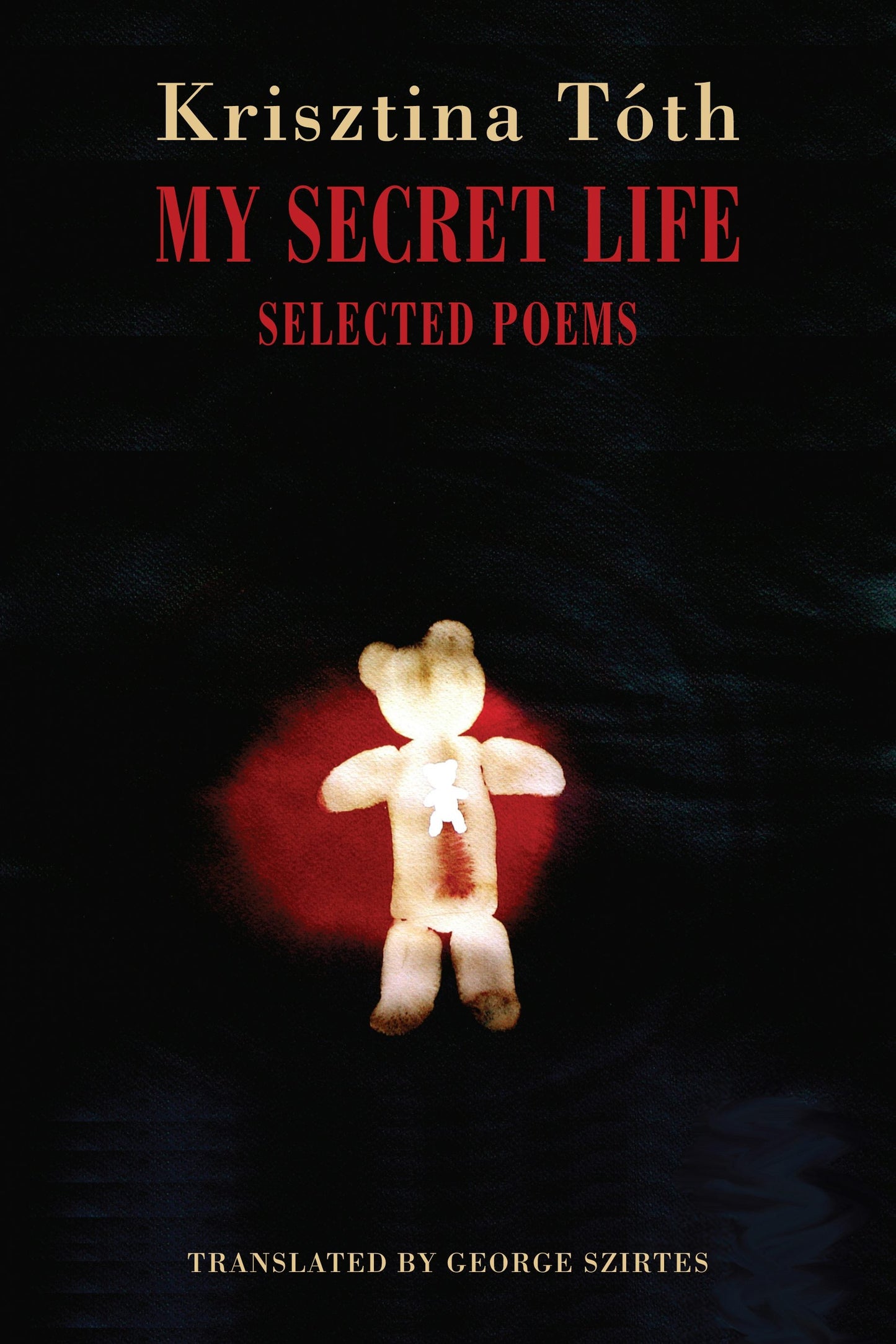
My Secret Life is the first book in English translation of the poetry of Krisztina Tóth, one of the leading Hungarian poets of the generation who began publishing in the late 1980s. The recipient of many awards, Krisztina Tóth is also renowned for her fiction which has been translated into many languages including English. The poems in My Secret Life were selected by her from three of her nine published collections, with the addition of some new or previously uncollected poems.
Tóth is, and has been for several years, a major figure in Hungarian writing and, being a major figure with an important public voice, she has also been, and is now, subject to unrelenting attacks by the government-funded, government-supporting, gutter press. She has been self-exiled in England but is moving to Switzerland shortly. Originally attacked for suggesting that a couple of standard pieces of literature might be removed from the school syllabus and replaced by writing by living women authors, her life has become the subject of the sort of storm of defamation already practised on others perceived to be threatening the values of the government.
Shortlisted for the Warwick Prize for Women in Translation 2025


'Her work has the nervous energy of the times but is shaped by a deep and disciplined intelligence. Her subjects are invariably human. They are concerned with love, family, friendship, loss, and a kind of existential disaffection. Tragic in one sense but ever inventive, full of life’s minute yet highly resonant particulars, they seem to extend into an almost cinematic narrative about the cruelties of factory farming, murder, ageing, the treatment of women as sex toys and death itself. She is a bravura formalist when she needs to be. Her vigour and scope are enormous.' — George Szirtes
'Krisztina Toth’s luminous and haunting poetry tells the story of a self, in public and private.' – Susan Bassnett, Véronique Tadjo and Boyd Tonkin, Judges of the Warwick Prize for Women in Translation 2025
'Poems pulsating with sensual power, deeply painful poems, about everything that is regarded as very personal.[…] Not with her themes, not with her tone does she prove to be an innovator. In this respect she remains faithful to the great, intellectual current of Hungarian poetry, a current that is not very old. It can be traced back to the beginning of the twentieth century […] Krisztina Tóth proves herself to be an innovator within this important tradition through the stirring rhythm of her poems. She wraps her persona, ready for any change of form, in rhythm. In other words, she makes herself impersonal in the most personal of ways and ready for confessions that are relevant for everyone; through her changing tone, through her surprises. […] Krisztina Tóth's composition sets her apart from all the others. She has the strength of a buffalo and the weightlessness of a butterfly.' – Péter Nádas, afterword to Barcode
‘Tóth muses that generations of humans, like bobbing needles, are “seaming together the fraying layers of the past and the present”. Their countries of origin don’t matter; neither do their religions, genders, or ethnicities. What Tóth creates in Pixel is emblematic of Europe as she sees it: a place in which “everything is sewn together while the thread itself is invisible”.’ —Stephanie Newman, review of Pixel, titled '‘The Hungarian Author who foresaw the future of Nationalism’'
‘Tóth is part of the generation of Hungarian writers who came of age in 1989, as the optimism of post-communism gave way to economic crisis, alienation and political viciousness. Tóth’s selected poems, potently translated into English for the first time by George Szirtes, communicate the regretful atmosphere of melancholy that permeates a damaged society … These wide-ranging, droll poems always seem to come back to the knotty discomforts of a changing self existing within a broken world...' – Rebecca Tamás, The Guardian (Poetry Books of the Month)
'With poet-translator George Szirtes showcasing a selection spanning five collections, you know you are in safe hands. His insightful translator’s introduction to the book provides invaluable context. Although one of Hungary’s internationally acclaimed writers, Krisztina Tóth is no longer able to live in her homeland owing to the repressive climate fostered by the government of Viktor Orbán. [...] It is perhaps not surprising then to find a sense of displacement running through her work.' – Maria Jastrzębska, #RivetingReviews, European Literature Network
Born in 1967, Krisztina Tóth is one of the most popular and best known Central European authors, and the recipient of numerous awards. She studied sculpting and literature in Budapest, spending two years in Paris during her university years. She has published nine books of poetry and ten books of prose to date as well as 24 books for children. In 2015, her novel Aquarium featuredon the shortlist of the German Internationaler Literaturpreis. Her works have been translated into 25 languages; her novels, short stories and poems can be read in German, French, English, Polish, Finnish, Swedish, Czech and Spanish, among others. Her bestselling short novel Eye of the Monkey was published in Hungary in 2023; an English translation was published by Seven Stories Press (Penguin Random House) in the US in October 2025. Her children’s books treat topics considered unusual, even taboo, in children’s literature. Mum Had an Operation explains cancer to schoolchildren in a humorous and lyrical tone, while the main characters in A Story for Nose-Blowers are two members of the ‘Snot family’ who live in the right and the left cavity of a nose. The Girl Who Wouldn’t Talk was inspired by the story of her own adopted daughter. Her musical Wanderer of the Years explains passing and letting go to children, whereas Pokémon Go and The Rubber Bat are for adults.
Her plays include The Bat, published in English translation in the compilation Plays from Contemporary Hungary: ‘Difficult Women’ and Resistant Dramatic Voices (Bloomsbury, 2023). Two collections of her short stories have also been published in English translation, Pixel (Seagull Books, 2019) and Barcode (Jantar Publishing, 2023). Her work was featured in the anthology New Order: Hungarian Poets of the Post 1989 Generation (Arc Publications, 2010). The first book of her poetry in English translation, My Secret Life: Selected Poems, translated by George Szirtes, was published by Bloodaxe in February 2025 and is on the shortlist for the Warwick Prize for Women in Translation 2025.
11 Introduction by George Szirtes
21 East European Triptych [SP]
24 Sleeper [V]
26 River of Sounds [V]
29 Lover’s Dream [ML]
31 Tyrannosaurus Rex [V]
33 Tourist [V]
37 Send Me a Smile [P]
39 Dog [V]
41 Barrier [V]
42 New Year’s Eve [P]
43 Folder [P]
44 Ode to Men of Fifty [P]
45 Gumtree [B]
47 Where [B]
48 Valley Road [B]
50 Song of the Secret Life [V]
52 Universal Adaptor [V]
55 Time, time, time [V]
57 How Are You All? [V]
58 Duration [V]
60 Camera [V]
61 Twenty Lines with a Cat [B]
62 Hourglass [V]
63 Sunday [V]
65 Fig Tree [V]
66 Cold Weather [V]
67 Homeward [U]
68 Dodo [U]
70 Oven Glove [U]
72 Any Country in the World [V]
74 The Student [V]
76 Rainy Summer [V]
This book presents a selection of her poems made by Krisztina Tóth for George Szirtes to translate, taken from five collections published by Magvető Kiadó in Budapest: Porhó (Dust, 2001), Síró ponyva (Weeping awning, 2004), Magas labda (High ball, 2009), Világadapter (Universal adaptor, 2016) and Bálnadal (Whalesong, 2021). The poems ‘Homeward’, ‘Dodó’ and ‘Oven Glove’ are previously unpublished in Hungarian in book form. In the contents list the initials [P], SP], [V], [ML] and [B] – or [U] for uncollected – indicate which of these collections each poem comes from.