


Some error occured while loading the Quick View. Please close the Quick View and try reloading the page.
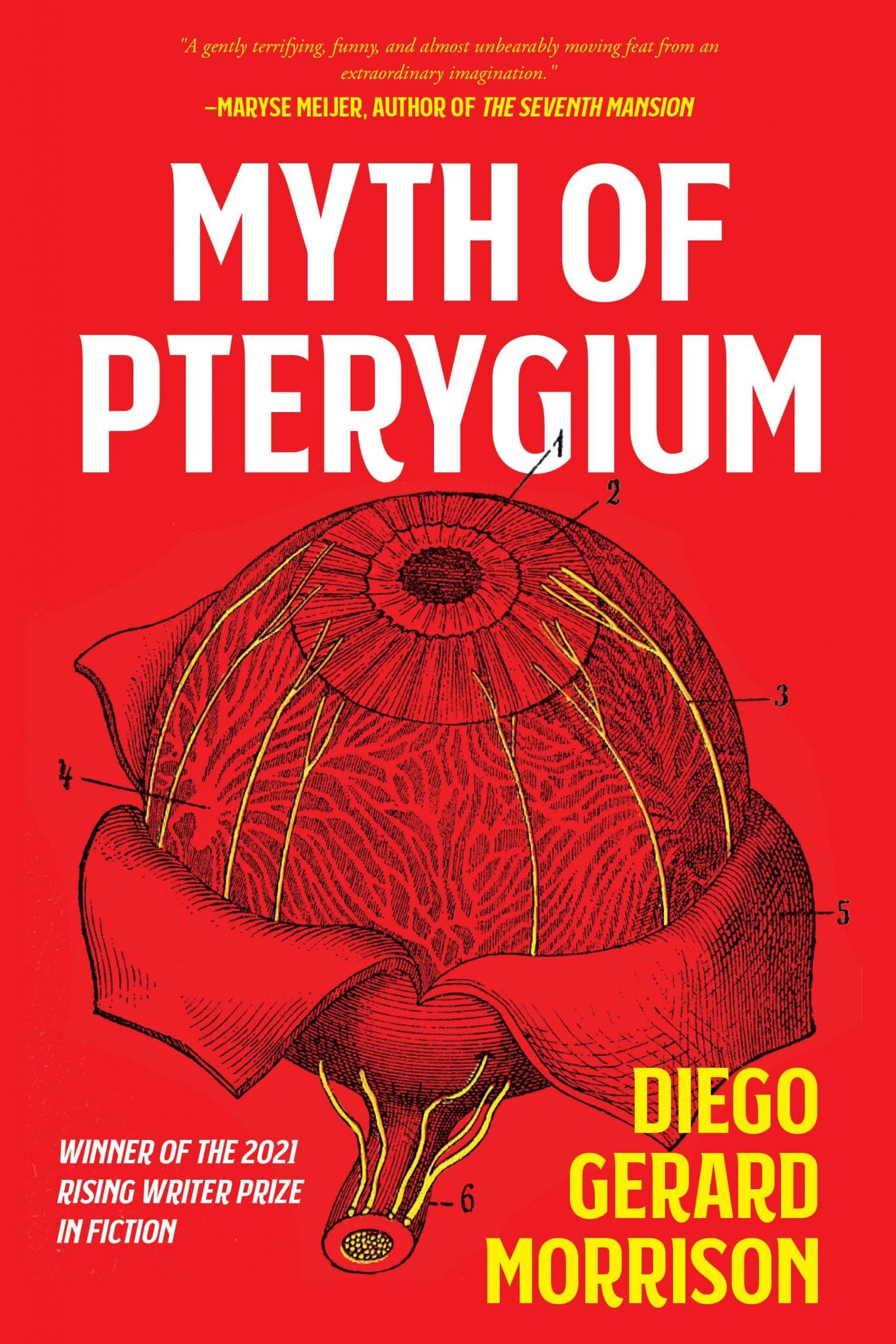
Set in a vaguely dystopian, yet also realistic, Mexico City—endless traffic jams, relentless clouds of pollution, economic hardships, and the ever-present threat of drug cartels, Myth of Pterygium, the debut novella by Diego Gerard Morrison is the story of a struggling poet contending with vision loss, poverty, and what it means to be an arms dealer in Mexico City.
The unnamed narrator of the book, at times referred to as Arthur—in part because of the growing similarity of his life with Arthur Rimbaud’s—struggles with the dissonance of leading an artistic life while providing for his family. A failed, penniless poet with a child on the way, he is forced to take a job in his family’s weapons dealing enterprise, which he soon discovers is connected to the corrupt Mexican armed forces and drug cartels, who are responsible for the increasing death toll in the country. All the while, the narrator struggles with a growing condition in his right eye, a pterygium, that is slowly taking over his vision, blurring the events of his life, including his wife’s complicated pregnancy, extortions by the drug cartels, and his own relationship to his writing.


". . . what makes Morrison’s debut exciting is his ability to tread the line between the mundane and the terrible. The common and the frightening. The writing is razor sharp, able to dance between the narrator’s exasperation in the face of a hack writer and his fear and anxiety as he juggles his family and gun-running cartels." —Masters Review
"The short novel offers succinct chapters—sometimes just a few lines—in which every word is not only meaningful, but also carefully chosen to smartly match its main character’s status as an editor, a lover of language, and a failed poet. And amid all of the devastation, Morrison manages to deftly weave threads of optimism into the bleak claustrophobia of his story. A well-crafted tale of despair and hope." —Kirkus Reviews
"This must-read is a moving story with an intriguing plot, a distinctive setting, and an unforgettable cast of characters." —US Review of Books
"Like all the best myths, Diego Gerard Morrison’s surrealist mirror throws our own world into such sharp focus it practically draws blood. Simultaneously hallucinatory and utterly clear-eyed, Myth of Pterygium whirls the reader through a near-future-on-fire via the inimitable perspective of a broke poet and father-to-be as he tries to build a future for himself and his family in a city falling apart at the seams. . . . A gently terrifying, funny, and almost unbearably moving feat from an extraordinary imagination." —Maryse Meijer, author of The Seventh Mansion
"Written with aberrant rhythm and a vision that is both expansive and at other times remarkably compressed, Diego Gerard Morrison’s debut novel explores what lies in the center of a narrative only to discover events that unexpectedly occur on the margins. Morrison’s prose style seduces the reader with its descriptive originality, while at the core of the protagonist’s cognitive dissonance, the flow of images is both filmic and poetic." —Phong H. Bui, Publisher and Artistic Director, The Brooklyn Rail
"Diego Gerard Morrison’s enigmatic and sweet-humored debut is a thing all of its own. It’s a poignant account of how family, self, and love come together, drift apart, and somehow—gently, miraculously—reform. It’s a satire on the logic of artistic production against a background of elaborate brunches, crime of baroque violence, and no-longer-just-impending ecological collapse. It’s a purgatorial evocation of a city that’s forever pulling itself apart and trying to begin again, all relayed in a form and style whose reckoning with the physical will leave you looking up from the page with the world around you freshened and suddenly, newly relentless. Rich, strange, and brilliant, you won’t read anything else like Myth of Pterygium." —Tim MacGabhann, author of How to Be Nowhere