


Some error occured while loading the Quick View. Please close the Quick View and try reloading the page.
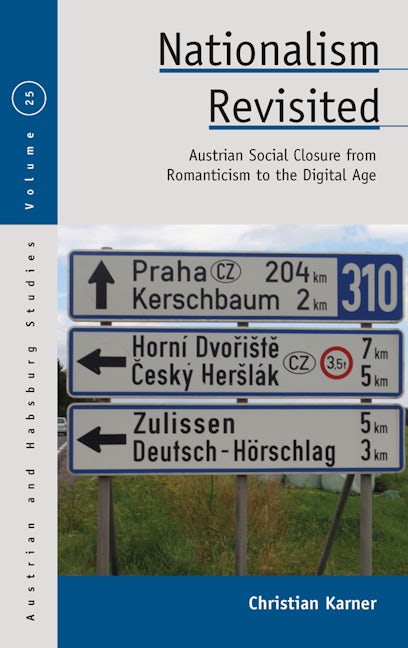
Focused on the German-speaking parts of the former Habsburg Empire, and on present-day Austria in particular, this book offers a series of highly innovative analyses of the interplay of nationalism’s discursive and institutional facets. Here, Christian Karner develops a distinctive perspective on Austrian nationalism over the longue durée, tracing nationalistic ways of thinking and mobilizing from the late eighteenth century to the present. Through close analyses of key texts representing diverse settings and historical episodes, this book traces the connections, continuities and ruptures that have characterized the varieties of Austrian nationalism.


“This important book further sophisticates the debate about Austrian contemporary history… Karner’s study helps to explain how decisively the Austrian identity has changed.” • Austrian History Yearbook
“Building on the constructivist tradition, Christian Karner demonstrates how, when and why the historical mechanisms of social closure take nationalist forms. His analysis is empirically rich and successfully utilizes theoretical insights from multiple disciplines.” • Siniša Malešević, University College Dublin
“This fascinating book takes a refreshingly direct approach to sociological concepts that past studies have too frequently obfuscated. It combines a clear and innovative theorization with persuasive, empirically grounded conclusions.” • Jan Jakub Surman, Poletayev Institute for Theoretical and Historical Studies in the Humanities
Christian Karner is Professor of Sociology at the University of Lincoln (UK). His research and publications focus on memory politics, urban sociology, and on the negotiations of local, ethnic, religious and national identities in the context of contemporary globalization and its dislocations.
Acknowledgments
Chapter 1. The Crystallization of Discursive Structures
Chapter 2. National Closure in the Nineteenth Century and Beyond
Chapter 3. The Darkest Side of Modernity: World Wars and the Holocaust
Chapter 4. From Political and Discursive Reconstruction to Selective Memories and “Banal Nationalism”
Chapter 5. Multiple Crises Turning Banal Nationalism(s) “Hot”
Chapter 6. “Localizing Strategies” Against Global Flows
Chapter 7. Renationalization Gathering Pace
Conclusion
References
Index